
The best carry-on luggage is the bag that your actual flights accept and that you can move comfortably through the rest of your trip. A suitcase marketed as cabin size can still fail a sizer if the wheels protrude, the airline uses stricter limits or the fare includes only a small personal item. Start with the operating carriers and fare conditions, then choose a roller, backpack or duffel based on stairs, walking distance, packing weight and the likelihood of a gate check. This is a bag-selection guide, not a current luggage product ranking.
Verify cabin allowance for the whole itinerary
The FAA’s carry-on guidance tells passengers to check the airline’s limits for bag size and item count, noting that smaller aircraft can have limited overhead space. A flight to a major hub and a subsequent short connection might not offer the same cabin experience. Check all operating airlines, including any partner that actually flies a segment, and the booking class or fare purchased. Also confirm whether a full carry-on is included or must be paid for separately. A personal item placed under the seat is not always interchangeable with an overhead-bin bag.
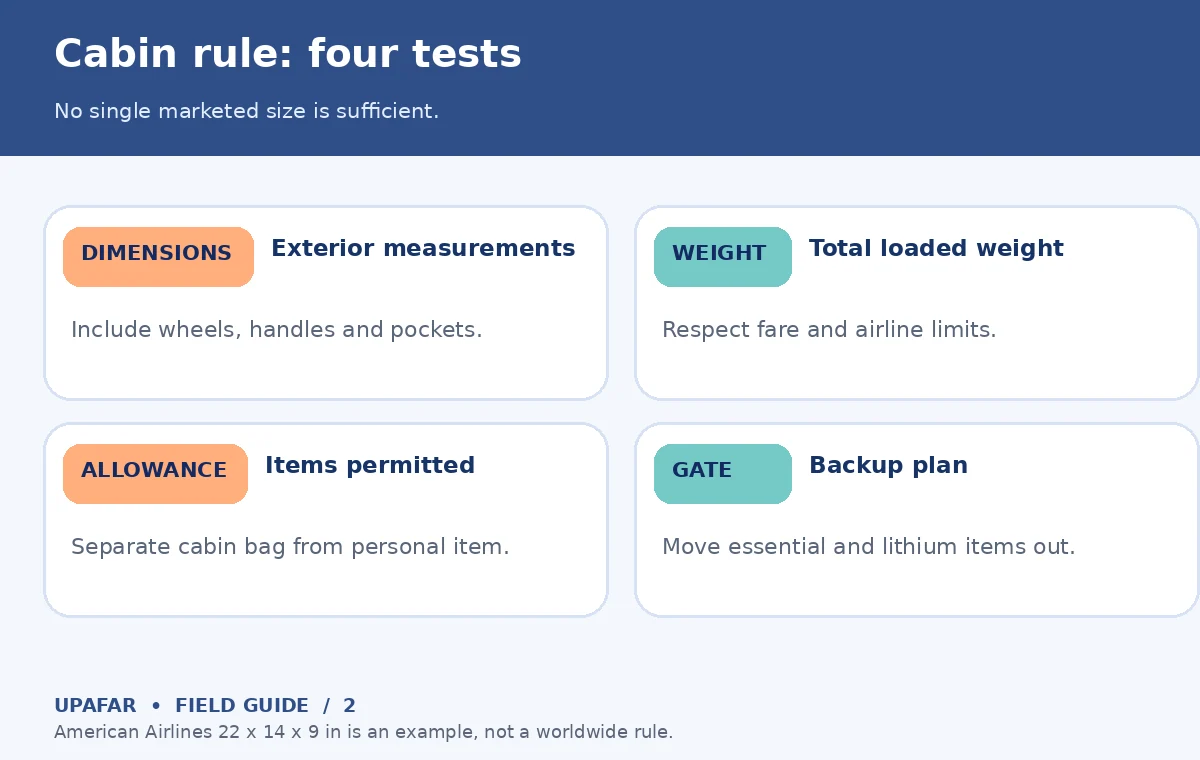
As one concrete carrier example, American Airlines publishes 22 × 14 × 9 inches, including wheels and handles, for its standard carry-on. That does not establish a global limit and does not override different airlines, aircraft restrictions or later policy updates. Never buy a suitcase based only on the word international in its product name. Preserve screenshots or ticket details showing the allowance that applies to your reservation, then measure the bag yourself.
Measure the exterior and test the packed weight
Stand the suitcase upright and measure its maximum external height including wheels and any fixed handles, then measure the widest and deepest points with pockets filled. For a soft bag, measure it when realistically packed rather than flattened on a store shelf. A 20-inch product label may describe only part of a case or use an inconsistent manufacturer convention. Check the airline’s sizer dimensions and compare all three measurements, not just the combined total. Do not assume compressing a full soft bag at the gate will always be acceptable.
Weigh your bag once packed, including toiletry bags, electronic devices and the bag itself. An ultra-light shell is helpful if the airline imposes a low cabin-weight limit, but it may trade away structure or wheel durability. A heavy laptop can shift the calculation considerably; if there is a separate personal-item weight restriction, it may count toward a combined allowance. The point is to test the combination that will actually be lifted into the cabin, not the bag’s empty weight advertised online.
Choose wheels, straps or a soft carry style
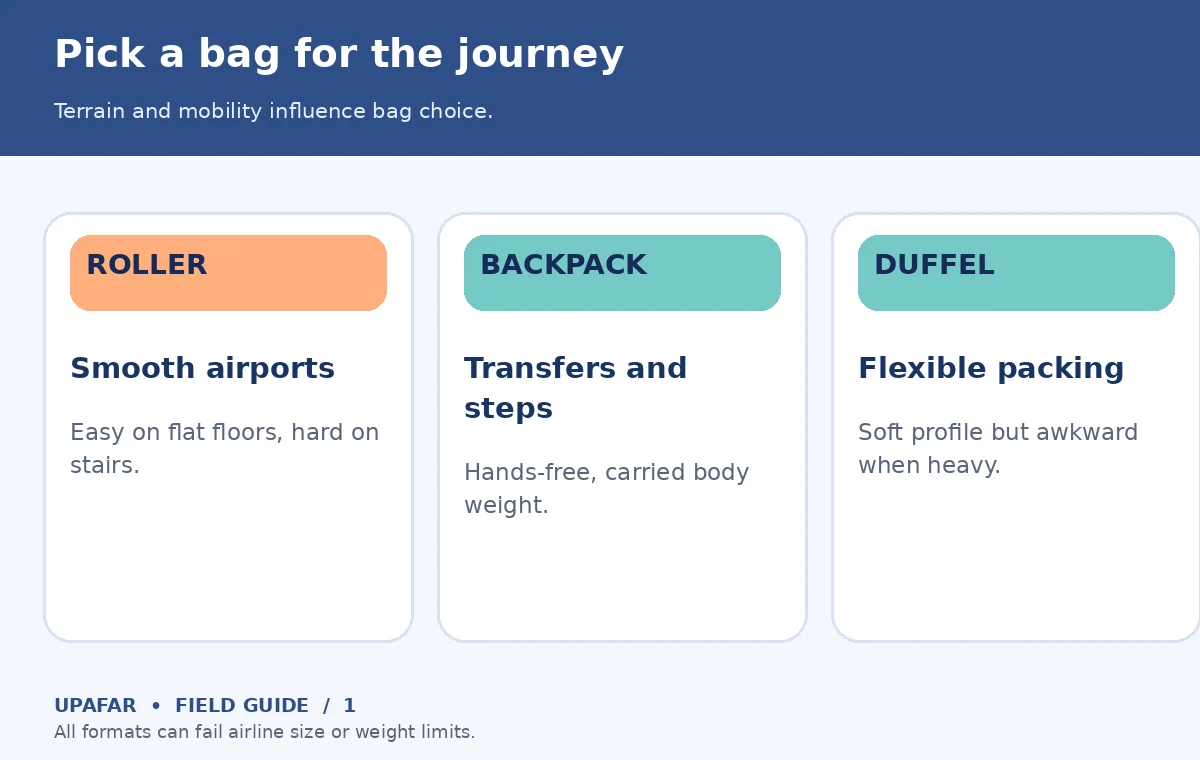
A four-wheel spinner rolls easily through smooth airports and hotel lobbies, but small wheels can snag on cobblestones or uneven sidewalks and the frame occupies space. Two-wheel rollers may handle rougher ground differently, but either style becomes inconvenient on long stairs. A travel backpack can keep your hands free for train platforms, narrow streets and frequent short transfers, provided its straps fit and you can carry the weight safely. A duffel is flexible and can fit irregular spaces but becomes tiring when heavily loaded on one shoulder.
Try a short route that resembles your trip: carry the full bag up a flight of stairs, roll it over an uneven surface and lift it to approximately overhead-bin height without twisting. Consider accessible transport, personal mobility, height and wrist or back comfort. A bag that technically fits the airline but is painful or unsafe for you to maneuver is still a poor choice. For mixed train-air itineraries, the awkward station staircase may be the decisive feature rather than the airport terminal floor.
Understand gate checks and the battery rule
Overhead storage can run out even when a bag meets all published size requirements. The FAA warns that carriers may require bags to be checked at the gate. Plan a detachable essentials pouch for documents, prescription medication, travel valuables, a spare layer and anything you cannot wait to retrieve at baggage claim. Never place your only passport or immediate medical supplies in a bag that might be taken from you at boarding. If an item is fragile, do not assume gate-check handling will resemble cabin storage.
The FAA PackSafe lithium-battery page requires spare lithium batteries and power banks to remain in cabin baggage; remove them if a carry-on is gate-checked and keep terminals protected. Electronic smart luggage deserves another check. The FAA’s guidance on battery-equipped baggage explains why some bags must have batteries removed before checking and why very small tracker batteries are treated differently under specific limits. Verify the precise bag model and airline policies before relying on powered weighing, charging or tracking features.
Compare bag value without treating features as necessities
Avoid ranking bags only by the number of pockets, branded locks or charging ports. Start with the structure that prevents travel friction. Are handles comfortable when fully loaded? Can wheels or straps be serviced? Does a protective laptop compartment steal too much room from clothing? Can the opening be used on a narrow train seat? Is a contrasting lining helpful for finding items in low light? Do zippers and seams look robust? These are practical inspection questions rather than an endorsement of a specific material, maker or suitcase.
Use a decision table mentally: airline compatibility is a pass-or-fail gate; carrying comfort is a personal preference; organization and expansion features are secondary. An expanding suitcase can be useful after a trip, but if the expanded depth exceeds the cabin limit, it stops being a carry-on for that flight. A hard shell provides a structured shape but does not make valuables indestructible. A flexible backpack can fit a sizer only if the real packed dimensions comply. No feature compensates for the wrong allowance.
Perform a five-minute departure inspection
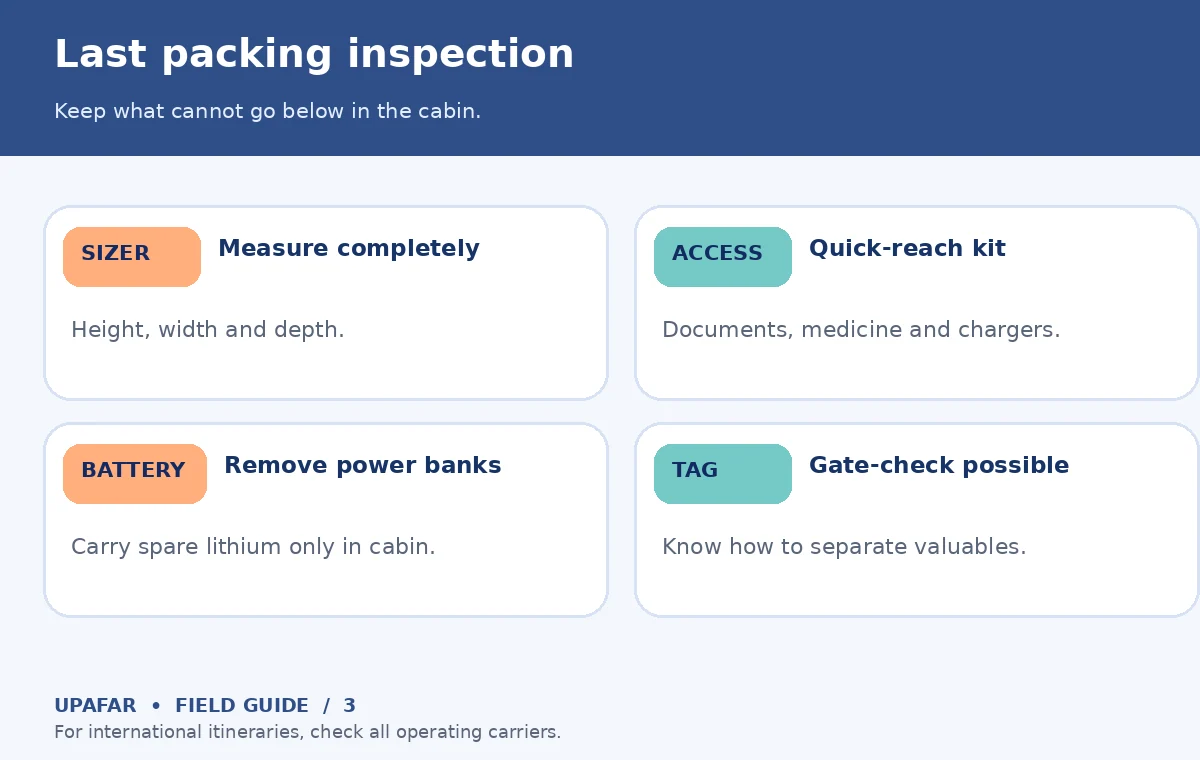
Review the operating carrier’s page one final time, measure the packed bag, verify fare item counts, weigh everything and move cabin-only batteries and essential documents into an easily accessible part of your personal item. Label the luggage and check that handles, wheels, buckles and zippers work. If the aircraft has limited bins or your airline warns about likely gate checking, separate important cabin possessions before boarding. Keep your bag stowed according to crew directions; do not retrieve it during an emergency evacuation. Small preparation protects the journey better than buying a bag labeled universal.
How We Research cabin luggage decisions
The airline-size example was checked against American Airlines’ carry-on page; safety and gate-check guidance comes from the FAA and PackSafe, reviewed October 19, 2026. Our bag-type comparison is editorial guidance, not lab testing of branded suitcases. Airline allowances are changeable and may depend on route, aircraft and fare. We do not claim merchant relationships. See UpAfar’s affiliate disclosure for our general policy.
Frequently Asked Travel Questions
There is no single worldwide limit. American Airlines publishes 22 x 14 x 9 inches including handles and wheels as one example; use your actual airline and fare rules.
No. A 20-inch marketing label may not include protruding wheels or handles and does not address width, depth or weight limits.
A backpack helps on stairs and uneven ground if comfortable to carry; a roller helps on smooth terminals but can be awkward over curbs and cobblestones. Choose for route and load.
Airlines may gate-check bags. Keep travel documents, medication and spare lithium batteries in a separable personal item, and follow crew instructions.
Sometimes only when its battery is removable and handled under airline/FAA rules; certain non-removable configurations face restrictions. Verify the model and carrier terms.