
Carry-on size limits are set by each airline and often by the fare and aircraft, not by a universal ‘international carry-on’ standard. Measure the entire bag, including wheels and handles, then verify both its permitted dimensions and whether your purchased fare allows an overhead-bin bag. A personal item is a separate allowance and may have a smaller limit. Below is a comparison method with official airline examples; a carrier can revise its rules, so the operating airline’s baggage page remains the final authority.
Read the allowance before reading the suitcase label
A luggage product described as ‘cabin size’ or ’20-inch’ is not an airline approval. The quoted dimension might refer to the case body alone while the airline measures the exterior footprint. Before shopping or packing, note every operating airline, fare family, cabin class and whether you will connect onto a regional aircraft. Write the permitted overhead bag size, personal item size, weight rule and number of items in separate columns. A generous dimension means little if your fare excludes that bag.
Some airlines include one cabin bag and one personal item; others give only an underseat item on the cheapest fare and charge for the larger piece. Travel partners, marketing airlines and operating carriers can differ, especially on itineraries involving multiple airlines. Check the allowance shown on the actual booking and the operating carrier’s current policy rather than borrowing a limit from a search snippet or another traveler’s experience.
Compare real airline examples without assuming one rule
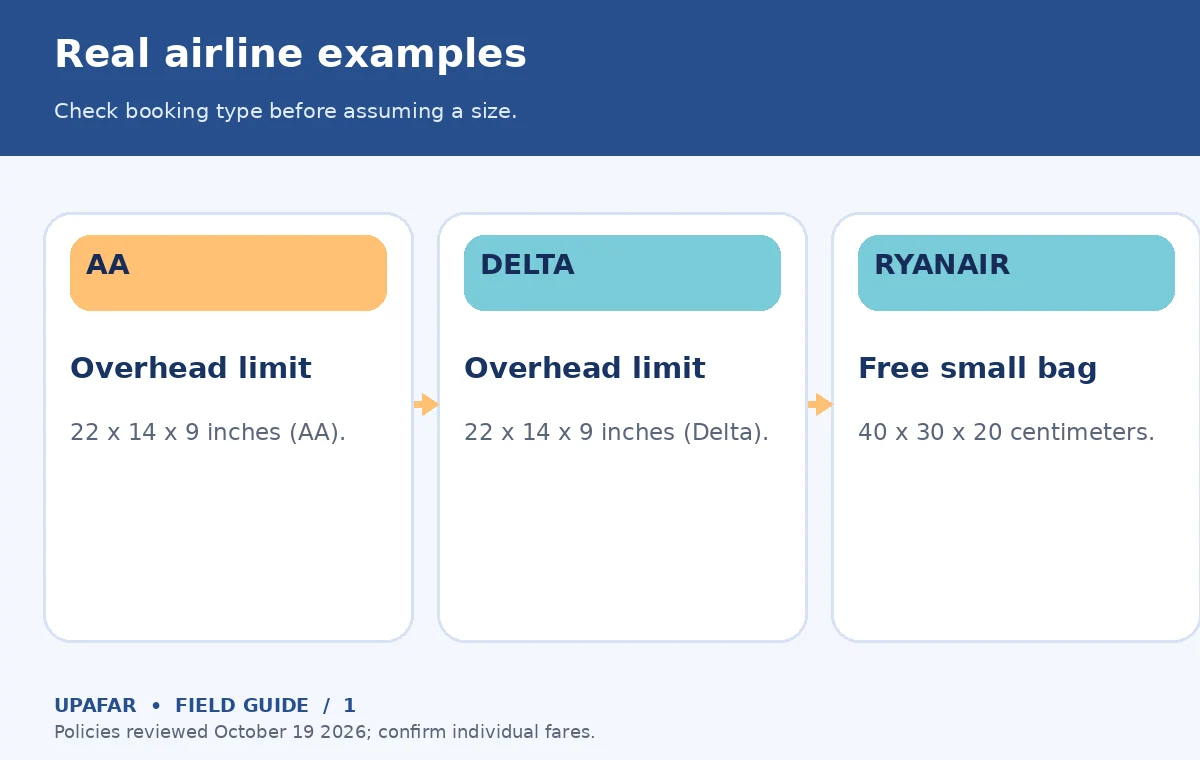
American Airlines’ official carry-on page lists a main carry-on limit of 22 × 14 × 9 inches (56 × 36 × 23 centimeters), including handles and wheels, and a personal item limit of 18 × 14 × 8 inches. Delta’s official baggage guidance specifies 22 × 14 × 9 inches and a 45-linear-inch maximum for the main carry-on. These similarities are useful examples, not evidence of a nationwide or global uniform allowance.
Ryanair’s terms effective June 25, 2026 specify a small personal bag of up to 40 × 30 × 20 centimeters, while an additional 55 × 40 × 20 centimeter bag of up to 10 kilograms applies to eligible Priority & 2 Cabin Bags purchases. This illustrates the distinction between allowed size and included service. Rules, costs and fare labels may change after this review; do not assume a paid allowance applies to a ticket just because your bag fits its dimensions.
Measure height, width, depth and loaded weight
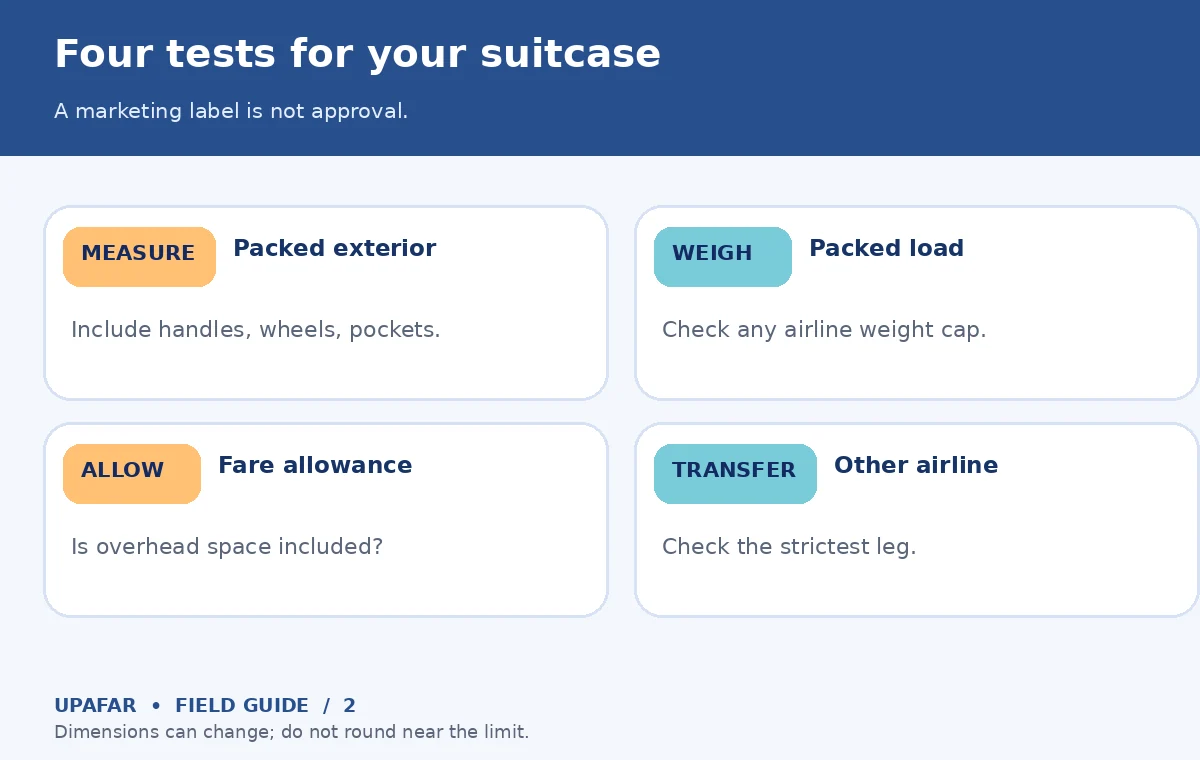
Set the bag on a hard floor, extend or position it as it travels, and measure the tallest point including wheels or fixed handles. Measure the widest point including side pockets and then the greatest depth including protruding front compartments. Compare those exterior measurements with the airline’s stated orientation or sizer information. For a soft backpack, test it packed as you would board: flexible material does not excuse a bulging bag that cannot fit in the sizer.
Now weigh the bag after packing if your airline has a cabin weight restriction. A lightweight empty suitcase may become too heavy with a laptop, camera and shoes. Do not convert centimeters to rough inches and round down near a strict threshold; use the airline’s listed units and verify accurately. Also confirm whether a laptop bag, purse, camera bag or child-care item counts toward the personal-item allowance for your exact carrier.
Separate the overhead bag from your underseat item
An underseat personal item is meant to fit under the seat in front of you and normally holds what you need during a flight. It is not simply a second unmeasured suitcase. Keep passport, medication, glasses, necessary snacks, essentials for children and any required travel documents where they remain accessible. A laptop or chargers may be heavy, so weigh their effect on whichever bag the airline will check.
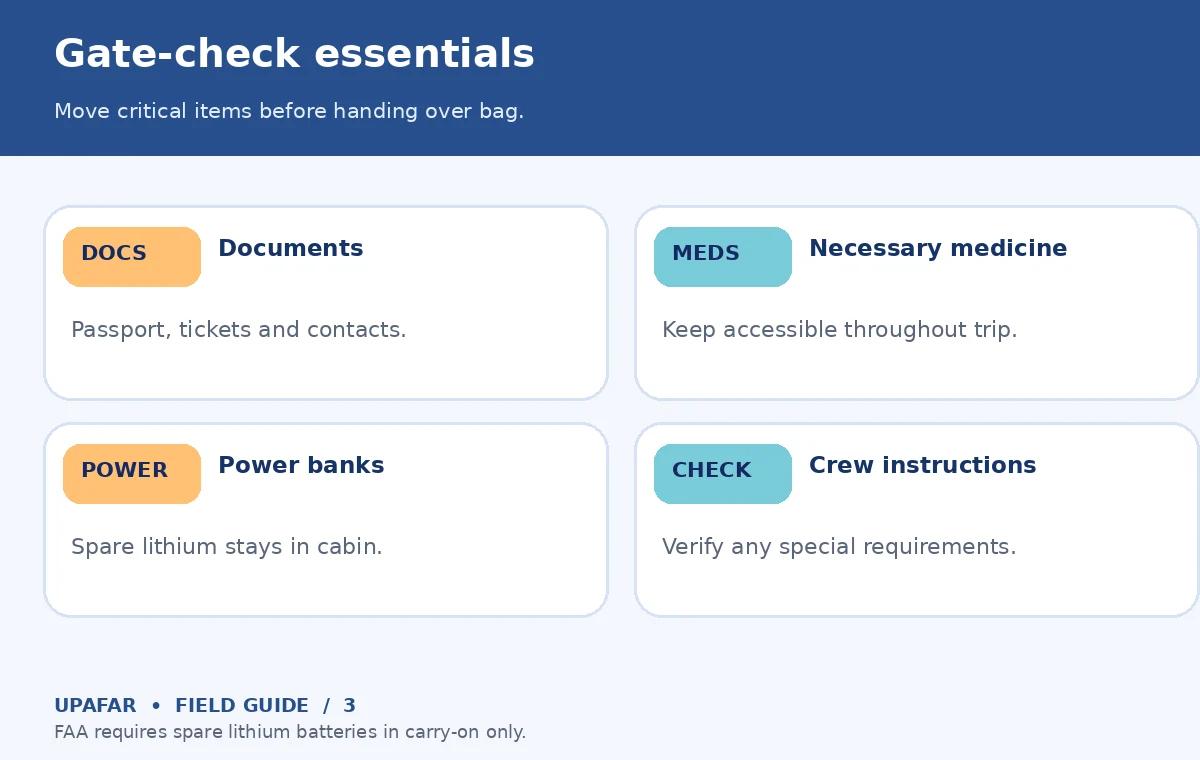
The Delta baggage page warns that smaller Delta Connection aircraft can require larger cabin bags to be tagged for gate or planeside handling even when the bag meets standard dimensions. Aircraft storage and operational limits matter. Prepare for that possibility by making the essential personal-item kit independent of the roller. Treat a gate-check offer as a change to luggage handling, not permission to leave restricted battery items in the hold.
Plan for batteries, liquids and screening rules
Bag size and what can travel inside are different rule systems. Spare lithium batteries and power banks have specific airline and aviation safety restrictions and generally belong in carry-on baggage rather than checked baggage. If the airline gate-checks your case, move spare batteries into the personal item you keep with you and follow crew instructions. Check the FAA PackSafe lithium-battery guidance for current quantity and watt-hour rules instead of relying on luggage-brand instructions.
Liquid screening depends on the country and airport. A US departure may involve TSA’s liquids rules, while other security authorities or terminals may have different screening equipment and procedures. This article does not guarantee an item will be permitted through security. Check the departure and transit airports and the official transport security authority separately from the airline’s cabin-bag allowance. Fragile equipment, mobility aids and medical supplies deserve an airline-specific check rather than a general packing assumption.
Choose the smallest compatible bag for a multi-airline trip
Put the baggage policies for every flight leg into one comparison grid. The limiting policy may be the strictest depth measurement, a weight cap, a separate fee for the overhead bag, or a small plane where the case might not remain with you. Decide whether one compliant bag will work on every leg or whether a checked bag is less stressful. A bag that technically meets one airline’s standard is not automatically best for the full itinerary.
For a short trip with stairs, ferries or frequent hotel changes, a soft backpack that fits within the relevant packed limits may be easier to carry than a large roller. On smooth airport and hotel surfaces, wheels may be more convenient. This is a use-case decision, not a product ranking. Do not spend money on a new bag until the confirmed airline allowance and the realities of your route are both clear.
Use a final five-point gate checklist
Before check-in, confirm: first, the main bag is actually included with your fare; second, the bag’s exterior measurements fit; third, its packed weight meets any airline limit; fourth, your underseat item also complies; and fifth, your gate-check backup separates medications, documents, electronics and any restricted spare batteries. Recheck the relevant airline page shortly before travel because terms are provider-specific and subject to change.
If your bag exceeds a limit, evaluate the airline’s lawful paid-bag options in advance. Do not assume it will go unnoticed or that a gate agent must accept a soft suitcase. Checking your bag can sometimes be the predictable solution, provided you separately verify what may or may not travel in the hold. The useful question is ‘What is allowed on this entire booking?’ rather than ‘What does the luggage tag say?’
How We Research airline size limits
We checked American Airlines, Delta, Ryanair’s June 2026 terms and FAA battery safety guidance as of October 19, 2026. We did not test actual gate sizers, purchase fares or independently certify a suitcase. Examples are illustrative only; confirm the operating carrier’s latest conditions. UpAfar’s affiliate disclosure explains our linking policy; this guide contains no claimed airline or luggage-brand relationship.
Frequently Asked Travel Questions
There is no worldwide standard. American and Delta currently cite 22 x 14 x 9 inches for typical overhead bags, but check the airline and fare you booked.
Yes on the AA and Delta examples reviewed. For any other carrier, follow its stated measurement method and pack your bag as you will board.
No. The underseat personal item is usually smaller and may be the only free item on some fares. Compare allowances rather than assuming two cabin bags.
Not automatically. Current June 2026 terms tie a 55 x 40 x 20-centimeter cabin bag to qualifying Priority & 2 Cabin Bags purchases; check your own fare.
The FAA says spare lithium batteries and power banks must be removed from a gate-checked bag and kept in the aircraft cabin; follow your carrier’s restrictions.