
A checked bag weight limit belongs to a particular airline, ticket and route—not to the airport as a whole. A 50-pound (23-kilogram) economy limit is a familiar example, but it is not a universal worldwide rule, and paying an overweight charge does not always mean the bag will be accepted. Before packing, confirm how many pieces you may check, each piece’s weight limit, full exterior dimensions and any restrictions for specific segments. This article is a verification guide, not a table of guaranteed current fees.
The quick answer starts with your ticket and operating carrier
Open the confirmation for the fare you actually bought. Identify each operating airline, fare family or cabin, flight route and any baggage benefit provided by frequent-flyer status or the ticket itself. Look for included checked pieces and allowance per piece, not just a generic ‘baggage’ line. On some systems, one purchase may cover a number of bags; on others, baggage is handled differently according to the itinerary or weight concept. A marketing airline may sell a flight operated by another carrier, so the rule governing a connection requires separate attention.
Next, open the operating airline’s current baggage policy and read the portions for your exact journey and ticket. Save a screenshot or PDF of the relevant allowance and compare it with the e-ticket. Policies can vary between domestic and international itineraries, flights involving partner airlines, loyalty tiers, cabins, and special sporting equipment. A blog post that says ‘most airlines allow 50 pounds’ is useful background only. It is not evidence of what will happen at your check-in counter.
Understand the 50-pound and 70-pound examples correctly
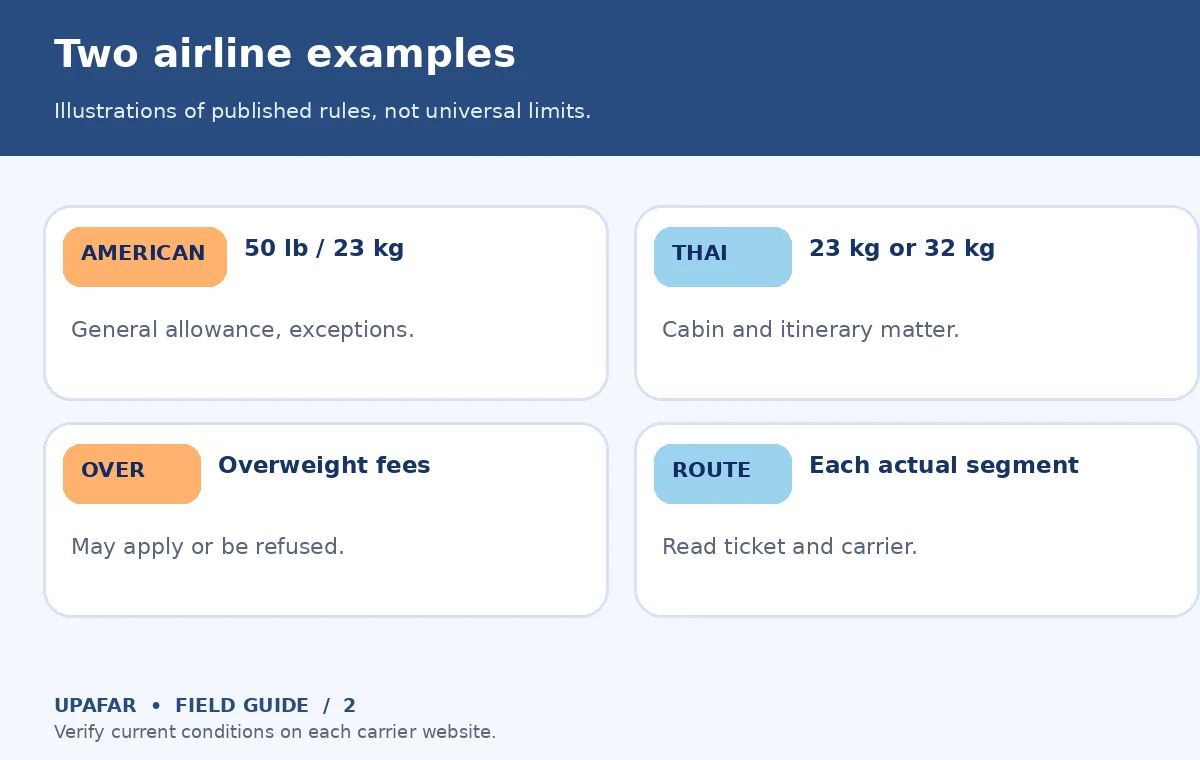
American Airlines’ published checked-baggage policy describes a 50-pound / 23-kilogram allowance for many routes and an allowance up to 70 pounds / 32 kilograms for particular eligible bags in higher cabins or other exceptions. Its own page has different terms for some journeys, including travel involving Australia or New Zealand. That makes American a useful example of why even one airline needs route-aware checking. Do not use those numbers as a promise for another airline or as a blanket right to check a heavier suitcase for an added fee.
Thai Airways’ published baggage guidance likewise distinguishes service classes, routes and piece-based conditions, with 23-kilogram and 32-kilogram examples. Its page notes policy changes applying to particular itineraries and ticket dates, so a traveler should read the effective conditions rather than quoting one heading. Travelers accustomed to a weight-based allowance need to check whether the actual ticket instead describes a number of pieces. On a multi-carrier trip, seek a written clarification for the full ticket when policy application is unclear.
There is also a unit trap: 23 kg is roughly 50.7 lb, not mathematically exactly 50 lb, and 32 kg is roughly 70.5 lb. Airlines often publish familiar rounded pairs of units. Weigh the bag using the unit in the carrier’s applicable rule rather than treating a conversion rounding difference as guaranteed free luggage. Aim comfortably below the maximum to allow for scale variation, last-minute items and luggage shifting.
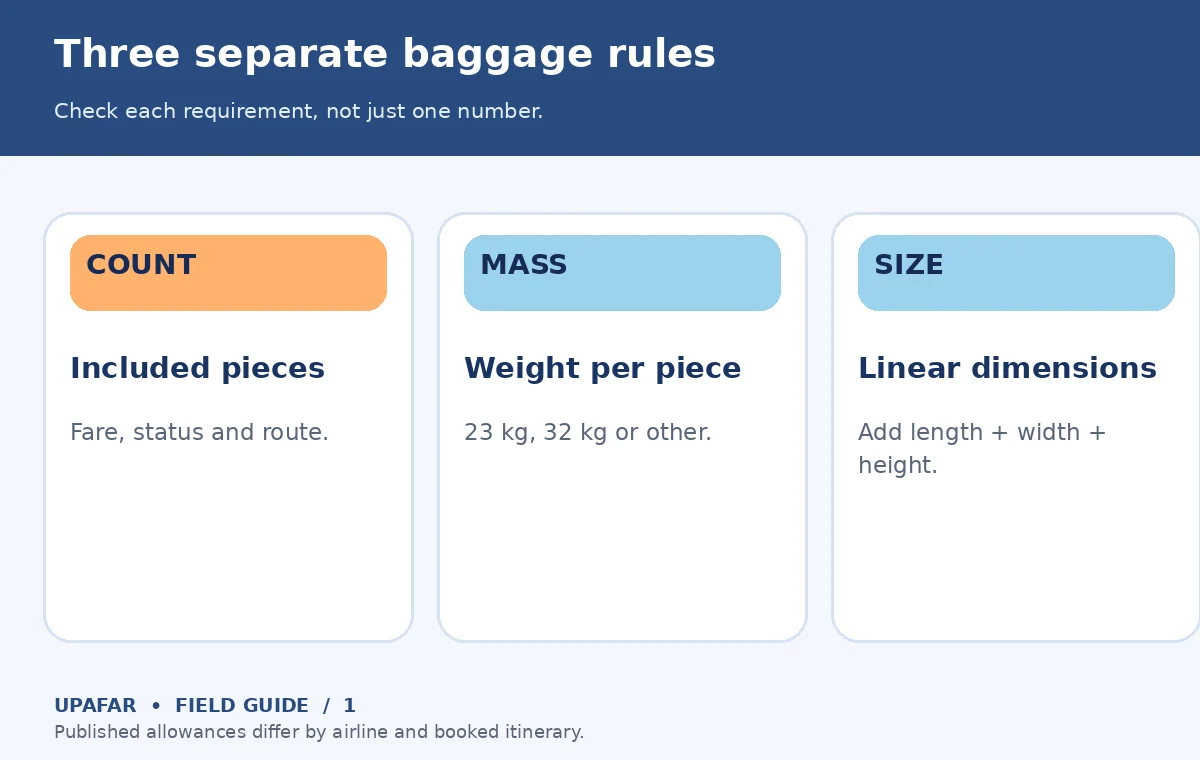
Check pieces, weight and dimensions as separate rules
Weight and size are two independent tests; piece count is a third. A suitcase can weigh less than the permitted maximum yet be too wide or long. Many carriers calculate ‘linear dimensions’ by adding the fully packed bag’s length, width and height, including handles and wheels where the carrier says to count them. Do not measure just the soft fabric shell or rely on an online product listing’s interior dimensions. Use a tape measure on the real packed bag and compare with the specific airline’s published external size criteria.
Check the allowance for the return flight as carefully as the outbound trip. Even with the same airline, a change of fare, destination or route can produce different terms. If your itinerary includes a separate ticket for a regional flight, do not assume the long-haul baggage benefit will transfer. For sports gear, instruments, strollers or accessibility equipment, look up the category-specific policy. Those items may use different handling rules that cannot be reduced to the standard suitcase weight.
Understand overweight payment versus refusal
A surcharge, when offered, may apply to a specific weight band and route. Other combinations are not accepted at all, and maximum handling weights can be different from the allowance included in the fare. Rather than assuming you can pay at check-in, inspect the airline’s current overweight and oversize tables, confirm that your particular bag is eligible, and evaluate whether a second compliant bag would cost less or be easier to handle. Prices are deliberately omitted here because the correct amount depends on your itinerary, payment channel and policy in force.
The U.S. Department of Transportation requires transparency about optional fees, but the regulatory details have changed. In June 2026 DOT issued a rule returning disclosure regulations to the pre-2024 framework after a federal appeals court vacated the 2024 ancillary-fee rule. Do not rely on descriptions of that vacated rule as though they still control. For the actual fare and baggage charge, use the airline’s current official fee page and ticket information; the amount is not dictated by the 50-pound example.
Battery safety is a different baggage limit
Even a bag that meets every size and weight rule can contain items that must be moved or removed. Under FAA PackSafe guidance, spare lithium batteries and power banks must travel in carry-on baggage, not checked baggage. Portable electronic devices containing installed lithium batteries are subject to separate conditions; if placed in checked baggage where allowed, they must be completely powered off and protected from damage and accidental activation. Device, airline and international rules can differ. Always review current safety guidance for your specific battery and destination.
If your carry-on is unexpectedly gate-checked, remove spare lithium batteries and power banks and keep them in the cabin, consistent with FAA rules. Do not leave an unapproved high-capacity battery in a checked bag simply because it fits the dimensions. Smart luggage with built-in power systems may require battery removal or have additional restrictions. Safety and weight are separate checks; passing the airport scale does not override prohibited-items rules.
Pack with a scale and a margin
Weigh your fully packed suitcase on a reliable home or travel scale, ideally checking the reading more than once. Measure all external sides after filling pockets and attaching straps. Keep a modest margin below the applicable airline weight limit rather than packing exactly to the published maximum. If you are carrying a heavy or fragile item, check whether it is better in an appropriate carry-on within the cabin’s own limits. Do not transfer banned checked-bag items into carry-on without separately verifying cabin security rules.
When the bag is too heavy, remove genuinely optional belongings before paying for another bag. Packing cubes may organize the interior, but compression does not reduce the mass of your clothes. Splitting items between two bags might help with per-piece weights, yet it could create a second-piece fee, so calculate the cost for your fare. Ask about oversized or sports equipment separately; do not try to disguise it as a normal suitcase. For a short trip, check whether laundering once could replace carrying many extra outfits.
Resolve conflicting information before airport day
Imagine an itinerary with a long-haul flight and one regional connection. The confirmation lists a checked allowance, but the regional airline’s website displays a smaller standard limit. Rather than choosing whichever number benefits you, ask the ticket issuer and operating airline which allowance applies to the through ticket and whether the baggage is checked through. Keep the replies with your booking. On separate bookings, expect extra collection, recheck and possible fees unless the airlines confirm otherwise.
Do this work before traveling to the airport, when you still have time to repack. At the desk, you may face strict check-in cutoffs, long queues and less room to negotiate. If baggage rules are a major cost in your choice of flight, incorporate the true bag total while comparing fares instead of treating a low headline price as the final cost. The point of a weight limit guide is to prevent a preventable surprise, not to promise that one carrier’s allowance will remain unchanged indefinitely.
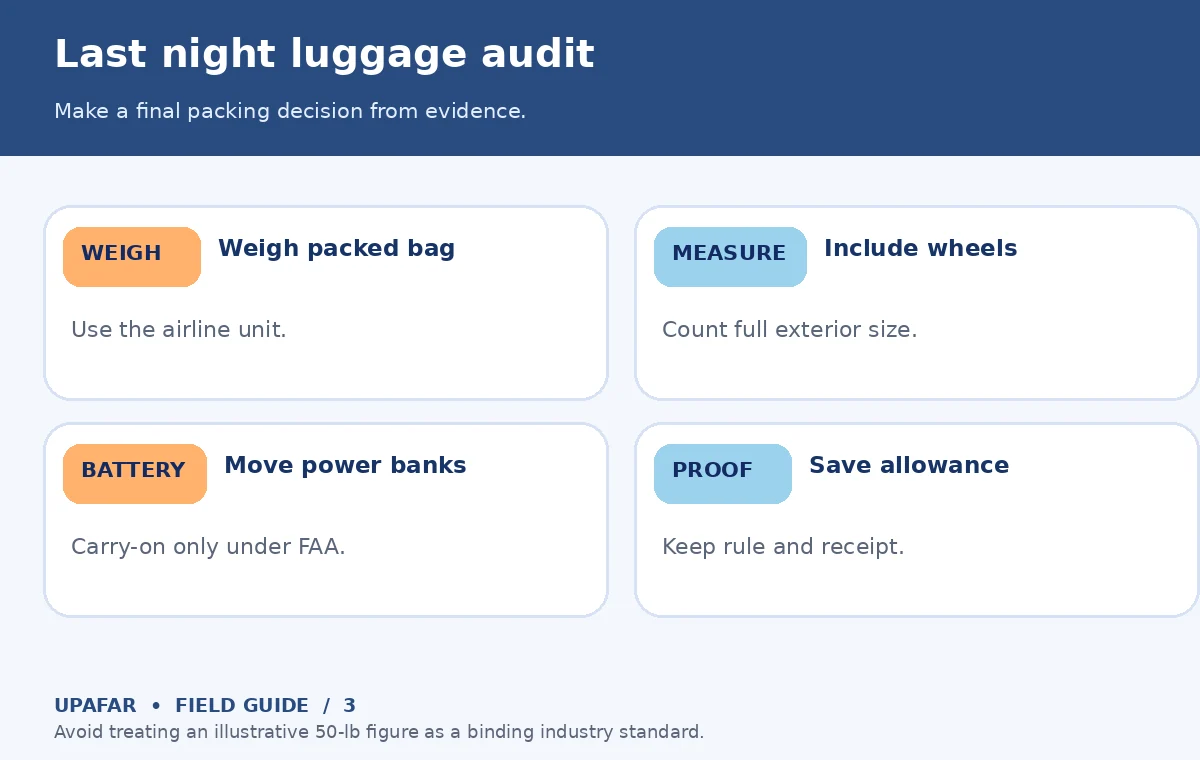
The five-minute pre-departure baggage audit
Match the booking reference to the operating airlines, check included pieces and per-piece mass, measure the loaded suitcase, and remove all carry-on-only spare batteries. Confirm overweight acceptance and fees if needed and save the relevant carrier pages offline. When an airline supplies an allowance in kilograms, record the actual kilogram number. Photograph the bag and store your claim checks after drop-off. If you still cannot reconcile two carriers’ rules, mark the issue unresolved and contact them rather than accepting an uncertain answer from a general comparison chart.
How We Research checked baggage allowances
We reviewed the published American Airlines and Thai Airways baggage-policy pages, the FAA’s current lithium-battery safety guidance and DOT’s June 2026 ancillary-fee rule materials on October 19, 2026. We use examples only to illustrate why fare, route and cabin must be checked separately; no carrier’s fees, available entitlements or policies are guaranteed for your specific booking. This is editorial travel guidance, not a legal interpretation of passenger entitlements. UpAfar asserts no airline partnership; read our affiliate disclosure.
Frequently Asked Travel Questions
No. Fifty pounds (about 23 kg) is common for some standard economy allowances, but actual included weight, excess charges and acceptance limits depend on airline, fare, cabin and itinerary.
No. Twenty-three kilograms is about 50.7 pounds. Check the carrier’s published unit and its rounding practices rather than assuming a scale threshold.
Sometimes, for certain cabins, routes, status benefits or paid overweight options; some carriers or destinations refuse bags above lower limits. Obtain exact airline confirmation.
No. Piece count, maximum weight and linear dimensions are separate conditions. A bag can be within the weight allowance and still be oversized.
No. FAA guidance requires spare lithium batteries and power banks to travel in carry-on baggage, subject to applicable capacity and carrier restrictions.