
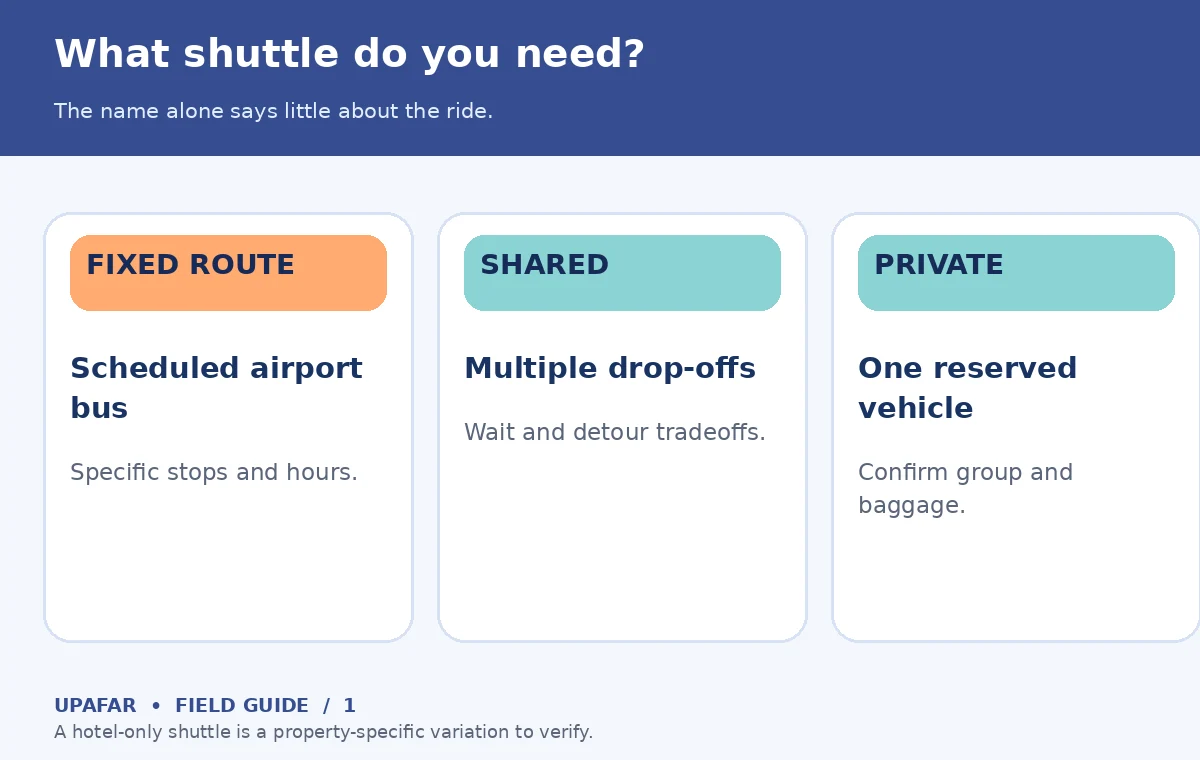
An airport shuttle can be a scheduled airport bus, a shared van with several drop-offs, a hotel vehicle or a private reserved transfer. Those services differ more in waiting time, pickup procedure, baggage space and service hours than the word ‘shuttle’ suggests. Choose by comparing your real route from arrivals to the hotel door, not the advertised ride price alone. The safest method is to confirm which vehicle you booked, where it picks up, what happens after a delay and what the entire traveling party will pay.
First identify what kind of shuttle the listing actually means
A fixed-route airport bus follows scheduled stops and published operating hours. It may be excellent when your hotel is near a stop and you can manage your luggage. A shared shuttle might collect multiple parties, wait until a vehicle fills or take a route that includes several hotel drop-offs. A hotel shuttle may be included with some reservations, offered on a timetable, available only on request or not provided at all. A private transfer normally reserves a vehicle for your group but requires checking the exact service terms. None of these definitions proves that a particular vendor is licensed, available or suitable for your flight.
The practical question is not ‘Which shuttle is best?’ but ‘Which option has the least serious drawback for this journey?’ If you arrive alone in daylight with one small bag, scheduled public transportation may be convenient. If a family arrives late with child seats and several suitcases, vehicle capacity and pickup assurance may outweigh the cheapest headline fare. A hotel transfer could be convenient if it serves the precise terminal at your arrival hour. But an allegedly free shuttle with a last departure before you land is not a usable arrival plan.
Compare door-to-door time rather than vehicle speed
For each option, calculate arrival to hotel door = immigration and baggage time + walking to pickup + likely waiting + ride and stops + final walk. You cannot know the first or third terms exactly, so keep a reasonable range. A shared van advertised as a twenty-minute drive may consume an hour of waiting and intermediate stops, while a scheduled airport bus may be faster if the pickup is simple and the final stop is near your lodging. The reverse can be true if the bus schedule is sparse. Treat published travel times as conditional and check your actual date and arrival period.
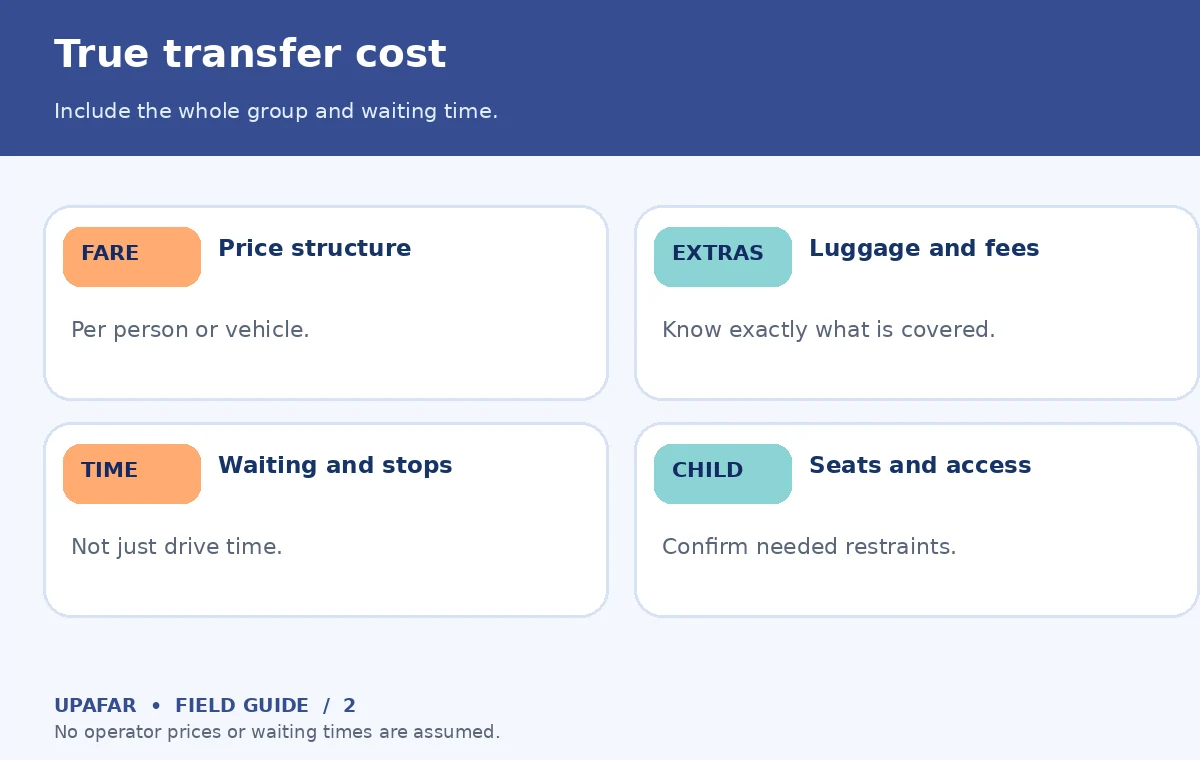
When comparing fares, multiply a per-person shuttle price by the number of travelers. Add any luggage supplements, child seat charges, service or booking fees and the cost of reaching the final hotel. Compare that total with the full private-vehicle quote and with official public transport fares. A private vehicle can be competitive for a large group but expensive for one traveler. An option that reduces transfers and confusion may be worthwhile even if it is not the cheapest, particularly after a long overnight flight.
Find the official terminal pickup location before traveling
Airport transport pickup areas are not always at the curb you first see after customs. The San Francisco International Airport ground transportation guide, for example, separates public transit, airporters, taxis, ride-app pickup zones and hotel shuttles. It advises checking hotel-shuttle availability directly with the hotel. Its pickup guidance also places conditions on where vehicles may stop and wait. These details demonstrate why ‘meet outside the terminal’ is insufficient in many airports; use the relevant airport’s own directions rather than copying SFO’s layout elsewhere.
The official LAX FlyAway page provides a different example: a scheduled airport bus service connecting terminals with specified Los Angeles destinations and a dedicated system for checking stops and schedules. That is not the same as a hotel-to-door van and does not mean every hotel is served. Before buying, locate the actual stop, check the current operator and airport instructions, and determine whether you will need a second ride after leaving the airport bus. Do not invent exact terminals, prices, hours or travel times from the name of a transfer product.
Check the flight-arrival and waiting policies
Read the booked operator’s instructions for flight-number tracking, arrival-time definition, grace periods, late flights, missed connections and cancellation. Does the provider track changes, or must you contact them? Is the promised pickup window measured from scheduled landing, actual landing or the moment you clear baggage claim? Will the vehicle wait if immigration is slow? If you miss a scheduled shuttle, is there another service, a refund, a fee to rebook or no guarantee at all? Ask these questions before a nonrefundable reservation.
For late-night arrivals, verify operating hours against the arrival date and terminal rather than the airport’s general opening hours. A rail or bus link may stop before you clear passport control. If your flight lands near the final departure, build a credible backup such as an officially regulated taxi or another transport mode whose late service you have checked. Save the pickup contact and instructions offline; phone battery, roaming and Wi-Fi problems are not the time to learn that a vendor never specified a meeting point.
Match the vehicle to luggage, children and access needs
Some shuttles limit large cases or sports equipment, and different operators handle folding strollers, wheelchairs or mobility devices in different ways. Confirm the number, dimensions and type of bags permitted, not just the number of seats. If a vehicle is sold per person, ask whether a larger bag takes extra space or carries a separate charge. For groups, price an appropriate vehicle rather than reserving an undersized car and hoping the driver can fit the luggage. Large instruments or specialty equipment need advance confirmation.
Travelers with children should ask about the exact child restraint required by applicable local law and the provider’s policy. Do not presume every shuttle comes with appropriate car seats or that one type of vehicle is exempt from all requirements. For people with mobility needs, verify whether the vehicle and pickup route are actually accessible, how assistance is requested and whether there are steps or long walks at the drop-off. A label such as ‘accessible’ should lead to detailed questions about the particular vehicle and service, not end the conversation.
A simple three-option comparison exercise
Imagine three hypothetical transfers from the same airport. Option A is a scheduled bus to a stop ten minutes on foot from the hotel; option B is a shared shuttle that serves the hotel but may involve other drop-offs; option C is a private vehicle reserved for your family. Do not attach made-up dollar amounts or promise one will always be fastest. Instead, score each on four criteria: final group cost, realistic worst-case waiting, luggage/seat fit, and clarity of pickup instructions. Then identify the criterion you cannot compromise on.
A budget-focused solo traveler may accept a longer walk and published departures. An older traveler who struggles with luggage may need confirmed door-to-door assistance. A party arriving near midnight might reject any transport that cannot verify its last pickup. The best result is sometimes a regular train or official taxi, not a shuttle at all. The comparison is a decision tool: it does not imply field testing or current vendor availability.
Protect yourself from vague transfer listings
Before booking an independent operator, determine who actually runs the vehicle, the precise service name, the number of passengers covered, the full payment amount, and what happens if the provider does not appear. Check whether the service is recognized by the airport or operates from a lawful pickup location. A professional website is not evidence of terminal access. Beware of a generic link that advertises ‘airport transfers’ but does not name the arrival airport, the destination area or the meeting point. Ask for a written booking confirmation with a contact method usable while traveling.
Check refund terms and avoid informal demands for extra payment outside the agreed channel. If a driver claims your luggage requires a new fee, refer to the published booking terms and use official airport assistance when concerned. Do not send passport information or payment details to unknown messaging accounts. Save booking documents somewhere you can access them when your phone has no mobile data. The central goal is to replace uncertainty with a confirmed route and a genuine fallback, not simply to buy the first transfer shown after airfare checkout.
Complete the arrival-day shuttle checklist
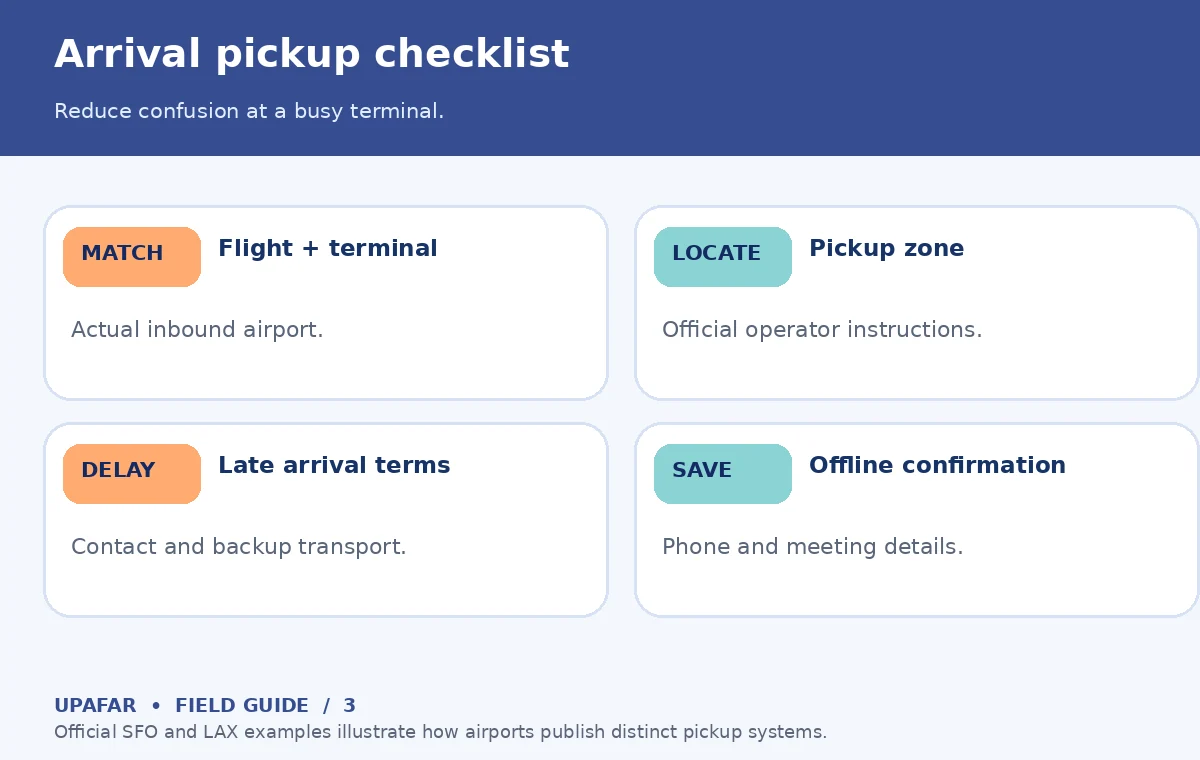
First, confirm the airport and terminal on your actual flight rather than the city name. Second, check whether the shuttle serves your destination directly or stops somewhere requiring onward transport. Third, calculate the group total and check bag, child seat and access requirements. Fourth, save the operator’s current pickup map, late-arrival policy and contact. Fifth, name a backup you can actually use if the flight is delayed or the service cancels. A transfer is booking-ready only when those facts match your itinerary.
If you are traveling through a large airport, check the airport’s current official ground transport page shortly before departure; airport pickup arrangements can change. If you are staying at a hotel, ask the hotel whether it provides the shuttle, whether you must reserve it and which terminal or off-site stop is used. Do not mistake a shuttle from the airport to an off-site parking area for transportation to the hotel. Keep the arrival day light enough that a slightly delayed transfer does not unravel your first paid activity.
How We Research airport shuttle choices
We reviewed official San Francisco International Airport ground transportation and curbside guidance, plus the official LAX FlyAway bus page, on October 19, 2026. These are examples of how airports distinguish services and pickup instructions; they do not establish current conditions at other airports. We did not test providers, verify availability or obtain current prices. The comparison is editorial and hypothetical, and each traveler must verify the service contract for their arrival. No operator partnership is asserted; see our affiliate disclosure.
Frequently Asked Travel Questions
Not necessarily. Shuttle can mean a fixed-route bus, shared-ride vehicle, hotel pickup or a private reserved service. Check the specific service model.
No. Some properties offer complimentary transportation and others charge or offer no service. Also confirm hours, booking rules and which terminal is served.
Not always for a group. Multiply per-person charges, luggage extras and any stop surcharges, then compare with the full private vehicle quote.
Ask the operator what happens after flight delays, missed pickup windows or last service; identify a genuine alternate route before departure.
Use the airport’s current official ground transport instructions and your operator confirmation; pickup zones may be separate from regular terminal curbs.