
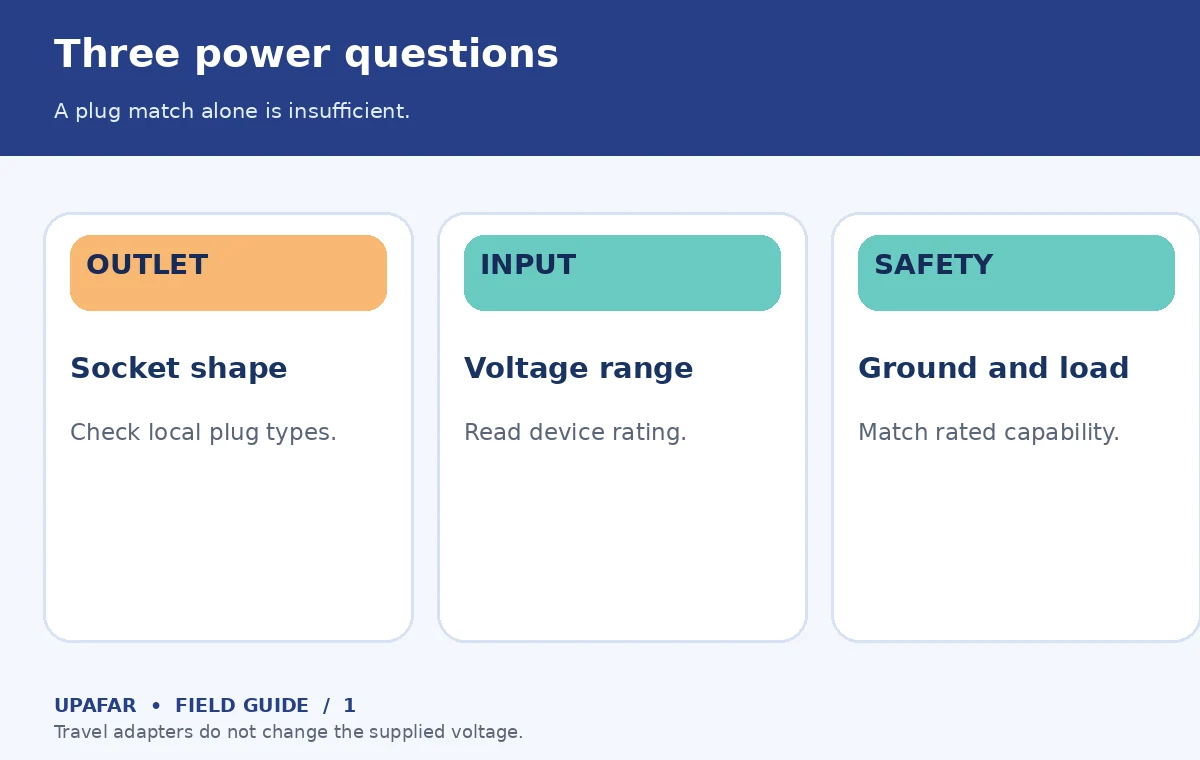
A travel adapter solves the shape of the plug, not the electrical supply behind it. For many phones and laptops, the correct outlet adapter is all you need because their chargers accept a range of input voltages. But an adapter alone can be dangerous for a single-voltage appliance or equipment requiring a grounding connection that the adapter cannot preserve. Start with three checks for **each device**: destination outlet, input voltage and frequency, and wattage or grounding needs. Only then decide whether to pack a simple adapter, a suitable USB charger or another product.
Identify your destination's sockets and power supply
Countries use different plug configurations; some locations use more than one. Look up the electrical socket types, nominal voltage and frequency for every destination—including cruise accommodations and transit lodgings when relevant. Plug shape and voltage are independent questions: two outlets that look different might carry similar voltage, while familiar-looking outlets are not proof of compatible supply. Check the official details supplied by your accommodation if they are available, especially when a property provides built-in international sockets or USB charging. Do not assume the property guarantees every connector type.
Electrical Safety First’s travel electricity guidance advises checking socket style, voltage and frequency before using equipment abroad. Its country information is a reference point, not a substitute for the particular accommodation’s posted electrical ratings. If an outlet is damaged, loose, wet or unexpectedly hot, do not use it. An adapter is not a repair for unsafe wiring.
Read the exact input label on every charger
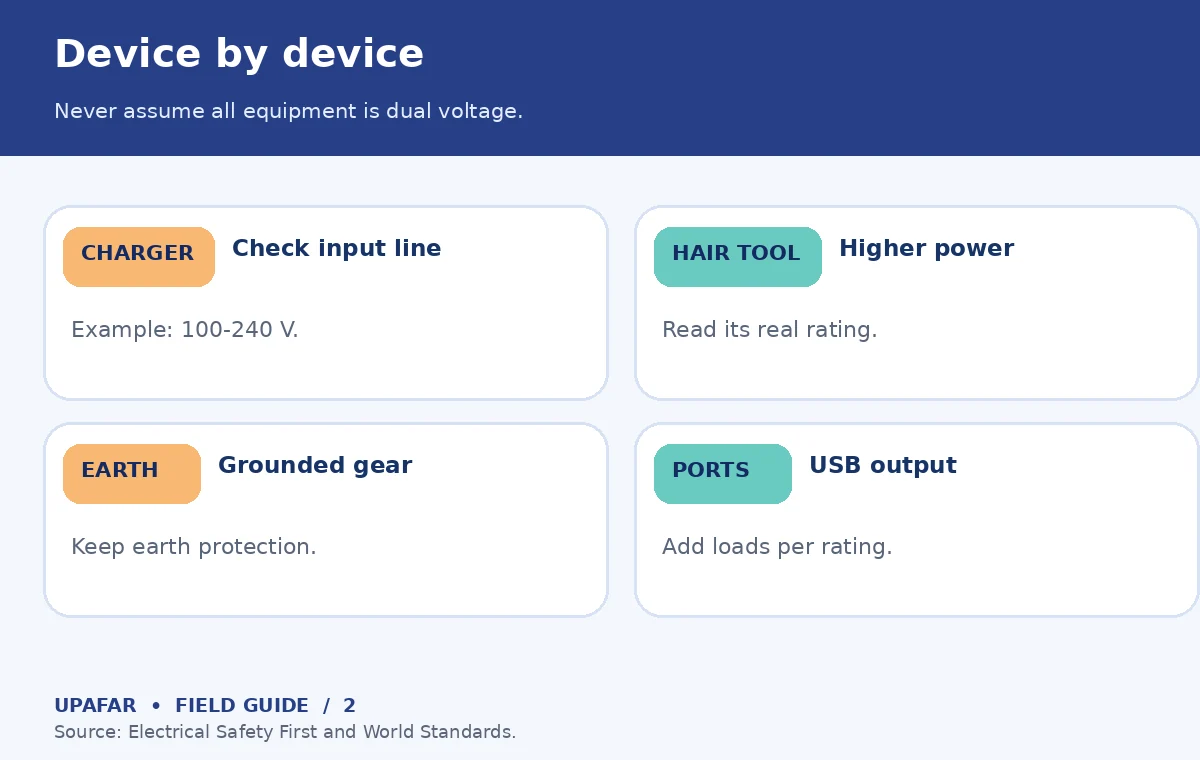
Find the label marked INPUT on the charger or appliance, not only the printed output value. A charger marked, for example, “100–240 V ~ 50/60 Hz” is designed for that input range, so it generally does not need a separate voltage converter when connected to a supply within the stated limits. It still needs a physically compatible plug and suitable adapter rating. A device marked for only “120 V 60 Hz” is different: inserting its plug through a shape adapter into a 230 V wall outlet does not magically change the voltage. The World Standards traveler explanation explicitly distinguishes adapters from converters and recommends checking equipment labels.
If a label is unreadable, missing or ambiguous, do not guess based on the age, price or brand of the device. Find the manufacturer documentation for the exact model. The rating on a power brick belongs to that brick; do not assume every appliance in your bag shares its characteristics. High-wattage hair dryers, straighteners, heating appliances and devices with motors deserve particularly careful assessment of current, power and operating frequency. When in doubt, use destination-compatible equipment instead of improvising electrical conversions.
Check grounding and power limits before buying
Some equipment requires a protective earth connection. A small two-pin adapter may fit a three-prong appliance physically while defeating the grounding protection it was designed to use. Electrical Safety First’s travel adapter safety page cautions that certain adapters are not suitable for devices requiring grounding and tells consumers to check stated maximum current or wattage. A multipurpose socket or USB port also has an output rating: read it rather than adding connected gadgets without checking their combined demand.
Avoid chaining adapters or plugging one into another to reach a distant socket. The IEC standard information for adaptors describes a warning against inserting an adapter into another adapter. Never treat a universal-looking block as a worldwide, unlimited-power solution. Plug fit, safe construction, earthing, load rating and local regulations all matter. A certified product from a reputable seller is preferable to an unbranded unit with inconsistent markings, but product claims should be checked rather than accepted at face value.
Choose among a plug adapter, USB charger and converter
If your travel kit is mostly phones, a tablet and a laptop with clearly marked universal-input power supplies, you may only need compatible plug adapters or a destination-appropriate USB charger. A multiport charger can reduce clutter if its output is adequate for devices used simultaneously, but the charging ports’ output power is not the same as the AC outlet’s input rating. Verify that the charger and detachable mains lead are approved and rated for your use.
If an essential appliance is single-voltage, first consider leaving it at home, using an accommodation-supplied appliance or obtaining a manufacturer-recommended dual-voltage equivalent. Voltage transformers and converters vary in the appliances they support and in continuous versus short-duty operation; the choice requires matching the exact device’s specifications. A plug adapter should never be sold to yourself as a substitute for this check. Frequency-sensitive motors or clocks may operate incorrectly even if nominal voltage is handled.
Use a simple three-row inventory: device, input label and connector needed. For example, a phone charger with a universal-input label may need only plug adaptation. A grounded laptop power supply needs both the correct voltage range and preservation of its intended earthing arrangement. A single-voltage styling device is a hold until its manufacturer confirms a suitable setup. None of these examples asserts which accessory is safe for an unknown product.
Run a predeparture charging rehearsal
Pack the charger, power lead and adapter together and inspect their markings for damage. Confirm that everything fits in your day bag without exposing pins to bending. Make sure the destination socket type you have researched actually matches the adapter’s output plug, and that its supported amperage or wattage suits the connected equipment. If you will visit multiple countries, repeat the checklist for each one instead of assuming “Europe” or “Asia” has one uniform plug system.
The night before departure, store essential travel documents offline and charge your devices using familiar safe outlets. If you rely on electronics for navigation or boarding passes, plan a low-tech backup when feasible. Avoid a risky test of unknown power equipment abroad. Product reviews can help spot broken zippers and poor fit, but they do not replace properly verified electrical specifications or safety approvals.
Use the six-point electrical compatibility gate
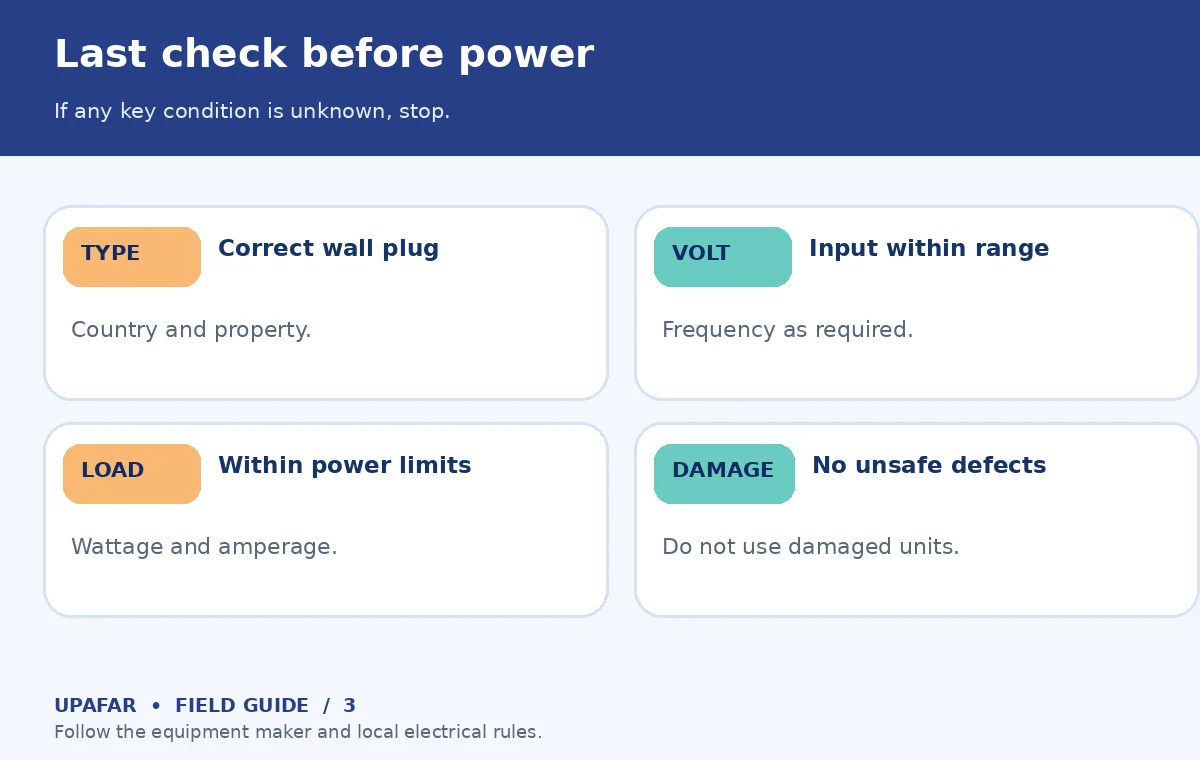
Record the local plug type, local voltage/frequency, each device’s input range, grounding requirements, adapter and charger ratings, and manufacturer warnings. If any safety-critical field remains unknown, do not energize the device. Revisit your list when buying a new appliance or changing the itinerary. This decision approach is more robust than buying the adapter with the most countries printed on its packaging.
This article deliberately contains no rankings, shopping links or promise that a particular universal adapter works everywhere. Standards, market certifications and product specifications require model-by-model verification. The right accessory is the one that meets your confirmed electrical requirements without unsafe compromises.
How We Research travel power compatibility
We checked Electrical Safety First’s travel advice and adapter-specific safety guidance, the international plug-and-voltage explainer at World Standards, and IEC’s published adaptor standard overview on October 19, 2026. The decision checklist interprets those principles; it is not electrical testing or an official product certification. Always follow the equipment manufacturer’s manual and the destination’s electrical rules. No vendor compensation is claimed; see our affiliate disclosure.
Frequently Asked Travel Questions
No. It changes the plug connection shape only. Read the device input label before using an appliance on a foreign supply.
That input rating generally indicates compatibility with supply voltages in that range; plug type, grounding, wattage and manufacturer warnings still matter.
Do not assume so. Outlet types vary, as do adapter pin designs, grounding and power ratings. Check every actual destination.
Only after verifying the appliance input, outlet supply, adapter power rating and manufacturer advice. A simple adapter cannot correct voltage mismatch.
No. Avoid adapter chaining; the IEC adaptor standard overview includes warnings against inserting an adaptor into another adaptor.