
Packing cubes are most useful for keeping categories of clothing easy to find and making a bag faster to unpack. Compression cubes can reduce how much space soft clothing occupies, but they do not make a heavy load lighter or override an airline’s carry-on limits. Rather than choosing a large matched set by default, measure the luggage you actually travel with and assign each cube a job: everyday clothing, underwear, layers or laundry. A **small, repeatable packing system** often beats a crowded suitcase full of compartments you never open.
Decide whether regular or compression cubes fit your trip
Regular packing cubes organize without squeezing clothes much; you can see which category is inside and move it as a unit into a hotel drawer. Compression versions use additional zippers or panels to reduce the volume of compressible fabrics. They can help with light layers and T-shirts but work less well on rigid items such as shoes or thick electronics cases. Unlike true vacuum bags, they typically do not remove all air, and their compressed shape may become dense or awkward inside a small backpack.
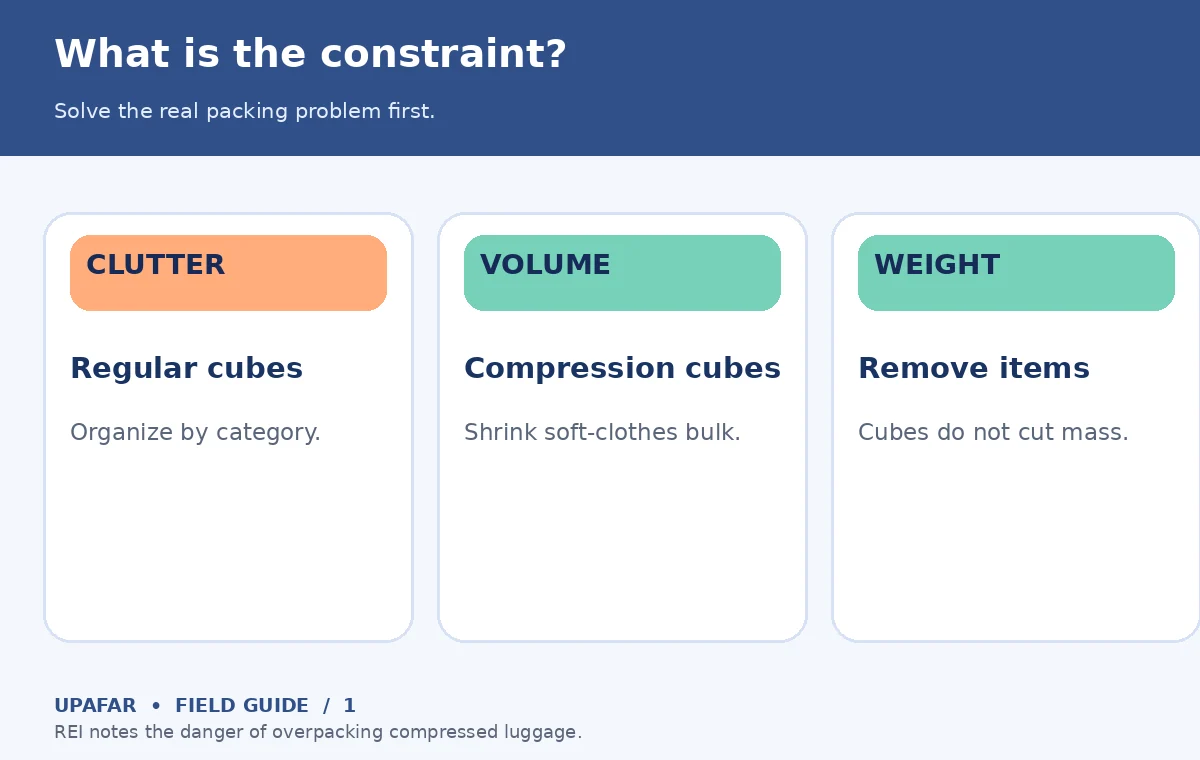
If your bag is already close to its maximum permitted weight, compression can make overpacking easier. REI’s traveling-light guide recommends packing organizers for finding gear quickly, while also warning that compression can encourage travelers to add weight. Start by deciding whether your bottleneck is clutter, volume or total mass. If clutter is the issue, regular cubes solve it without extra mechanics. If soft clothing crowds the zipper but your bag remains light enough, compression may help. If weight is the problem, remove items instead.
Test cube dimensions against real luggage space
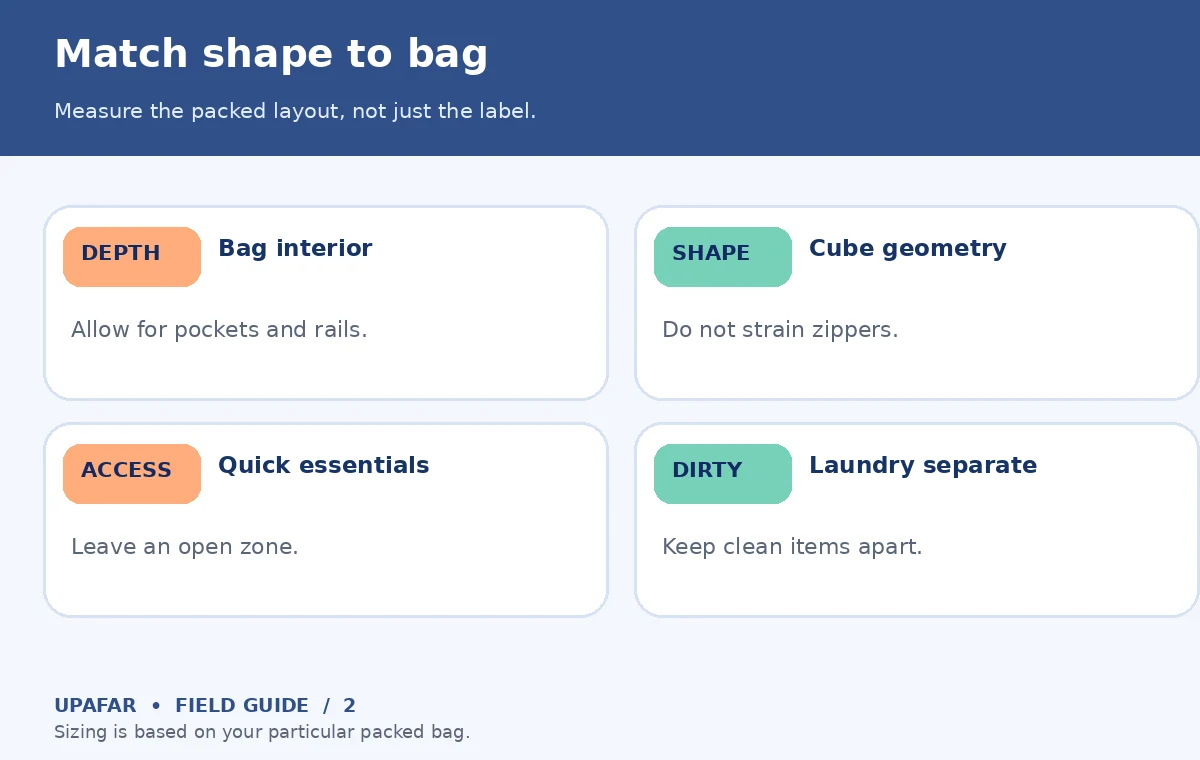
Use the usable interior of your suitcase or pack, accounting for wheel housings, curved corners, frame rails and internal pockets. Product dimensions measured on an empty cube are not always its dimensions when stuffed. Arrange paper rectangles or existing pouches in your bag before buying. For a typical split-opening suitcase, shallow cubes that sit under the closed dividers may be easier to access than tall, rigid ones. A narrow travel backpack can be better served by flexible stuff sacks; rectangular cubes are not automatically the best fit for every pack style.
The REI travel accessories guide describes folders, stuff sacks and toiletry bags as alternative organizing tools. This matters because some travelers need wrinkle control for formalwear, waterproof containment for damp shoes, or quick-access compartments for chargers more than they need another cube. Treat any storage pouch as part of a system, not a standalone guarantee of a neat bag.
Measure the packed arrangement, not just each individual organizer. A cube that holds all your socks but blocks access to a raincoat is poorly placed. Leave a high-access zone for travel documents, medication, a warm layer and items you expect to remove in transit. Do not bury essentials inside tightly compressed cubes just because they technically fit.
Organize by how often you need each item
A practical layout has one cube for everyday tops, one for base layers or underwear, and one for less-frequent items such as sleepwear or a change of climate. Families can give each traveler a color or label, but the system should remain intelligible without proprietary accessories. A two-hotel trip might benefit from packing a cube per destination rather than per garment category if you want to leave one segment unopened. Make sure people know where medicines and child essentials are; some items should stay outside the cube system for quick retrieval.
Choose a small repeatable packing routine: roll or fold clothing into a shape that matches your organizer, close it without excessive force, and place heavier items where the bag is designed to carry them comfortably. Inspect zippers and seams before departure. Mesh panels are convenient for seeing contents, but are not appropriate if you need privacy or moisture protection. Labeling can be more useful than visibility in shared family luggage.
Compare three travel profiles before buying a set
Weekend carry-on: one or two small cubes can keep changes of clothes separate without using too much bag volume. Two-week trip with laundry access: organize a repeatable set of outfits and a dedicated dirty-laundry container, instead of a cube for every day of the itinerary. Frequent hotel changes: prioritize fast retrieval and consistent placement, because repeated unpacking costs more time than folding technique. Backpack travelers who move frequently may prefer softer packing sacks that conform to the bag’s shape.
A useful way to test the value is to time a mock pack and a mock unpack. Can you reach a clean shirt and a toothbrush without opening everything? Can you repack after doing laundry while keeping dirty clothes separate? Can you close the bag without sitting on it? If you can already do these tasks easily, you may not need additional organizers. Buying a complete matching set is not a prerequisite for efficient travel.
Avoid treating influencers’ claimed percentage savings as universal. The effect depends on fabric, fullness, cube construction and luggage geometry. Do not extrapolate from a promotional demonstration using thin T-shirts to a winter wardrobe with heavy boots or a camera kit. REI’s adventure gear checklist notes both the organizational role of cubes and the space-saving intent of compression versions; it does not promise a particular reduction for your bag.
Prevent the three most common packing mistakes
The first mistake is overloading cubes until the closure or stitching strains. Compression fabric and zippers cannot make every garment smaller indefinitely. The second is ignoring the airline’s current weight and dimensions; measure and weigh the packed bag according to your actual carrier, route and fare, rather than assuming a cube-based system guarantees cabin eligibility. The third is grouping everything by item type while forgetting the trip’s sequence: spare clothes needed during a layover should not be buried under items for the last hotel.
Plan laundry before you leave. Separate clean and worn clothing with a washable sack, and keep damp items from contaminating dry garments. For longer journeys, a small buffer of empty space often matters more than filling every compartment to its limit. You want to be able to repack reliably after real travel, when clothes may not fold as perfectly as they did at home.
Run a simple at-home packing experiment
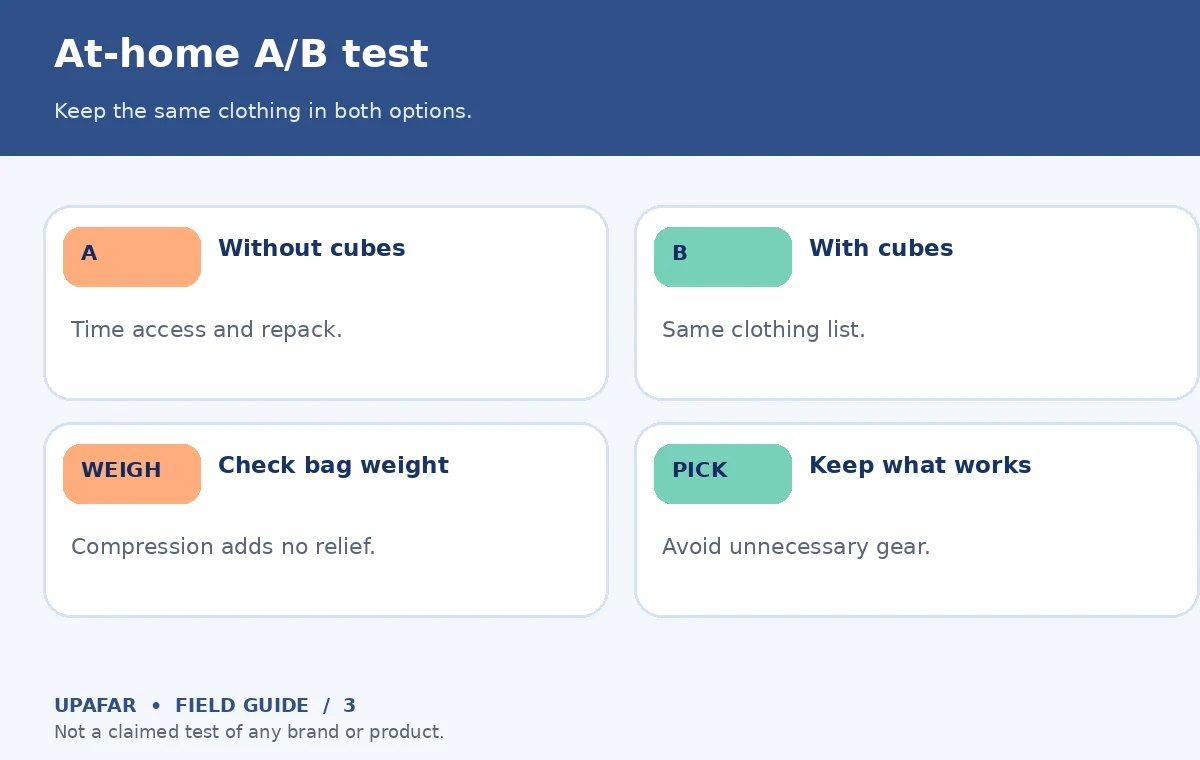
Make two versions of the same bag using the same clothing list. In version A, fold clothes without organizers. In version B, use the cubes you already own or comparable temporary pouches. Compare ease of access, filled luggage dimensions, weight and time to repack. Do not let the cube version silently include additional clothing, or you will have changed the experiment. If the organized setup is clearly easier with no unwanted weight or zipper pressure, you have found a sensible solution.
For purchasing decisions, prioritize accurate dimensions, light empty weight, easy-to-operate zippers and a fabric that suits your use. This is a method for choosing characteristics, not a claimed laboratory test or an endorsement of a particular brand. You can organize a bag successfully with inexpensive pouches, reused sacks or simply thoughtful layering.
How We Research packing organizers
We reviewed REI’s travel packing, travel accessory and adventure gear guidance on October 19, 2026, and compared the distinct claims about organization, shape and compression. We did not conduct hands-on abrasion testing, measure volume reductions across products, or verify retailer inventory or prices. Recommendations are based on realistic packing tradeoffs rather than sponsored rankings. Read our affiliate disclosure.
Frequently Asked Travel Questions
No. The cubes add some weight; compression can shrink the volume of soft items but does not reduce their mass.
Only when compressing soft clothing solves a genuine space problem. Regular cubes may be simpler for organization and access.
No. Carrier size and weight rules still apply. Measure and weigh your fully packed luggage for your actual fare and route.
Use the smallest number that handles your clothing categories and travel pattern. A few small cubes often work better than a complete unused set.
Often, but soft sacks may conform better to a curved or narrow bag. Test the filled organizers against your pack’s usable dimensions.