
A good family hotel is not simply the property with the longest list of kid-friendly amenities. It is the stay where everyone can sleep safely, adults can supervise comfortably, your daily plans remain manageable, and the final price reflects the room your family can actually use. Start with confirmed bedding and occupancy, then test location, food options, child-related extras and cancellation risk. This guide helps compare properties without claiming that any particular hotel is the ‘best’ or that rooms are available.
Decide what everyone needs to sleep before browsing amenities
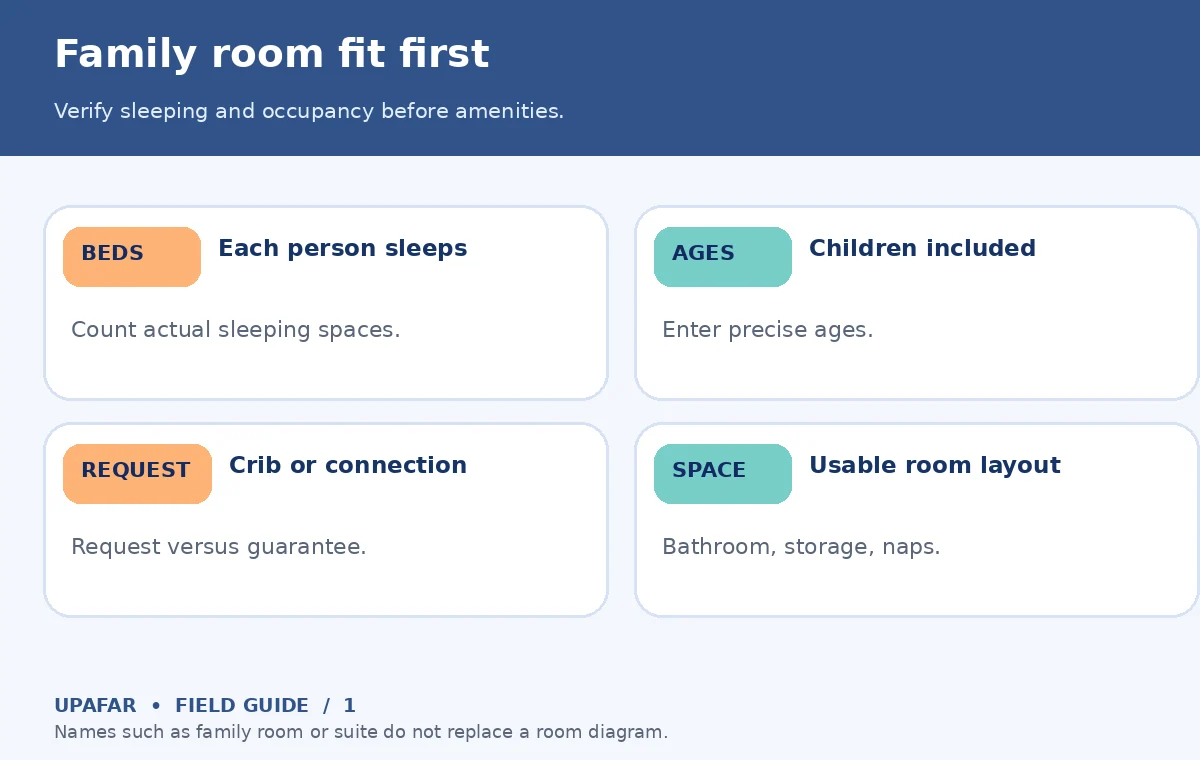
Write down the ages of every child at the dates of travel, who can share a bed, whether anyone needs a crib or travel cot, and whether a separate sleeping area is essential. A listing for four guests may contain two double beds, a sofa bed, bunk beds or one open-plan suite; these arrangements are not interchangeable for a family. A kitchenette may be more useful during a longer stay than a lobby decorated for children, but it does not fix inadequate sleeping space. The most important pre-booking question is: Which exact beds and rooms will be provided for the number and ages of people in this reservation?
Ask whether every child is included in the quoted occupancy, and whether there are charges for additional beds, breakfast, extra guests or a cot. Policies can depend on age, property and room type. Do not enter only the adults in an online search and assume the displayed rate will cover everyone. If a child has a medical, mobility or sensory requirement, verify it directly with the property rather than interpreting a broad amenity icon as a guarantee. An acceptable family room must be usable by the people traveling, not just bookable in a filter.
Understand connecting rooms, suites and child beds
Two rooms labeled ‘adjoining’ may merely be next to one another; ‘connecting’ generally refers to an internal door, but you still need written confirmation for the exact booking. Hotels may treat a request as a preference until room assignment. If an internal door is essential for supervision, ask whether the property can guarantee it and how that guarantee appears on the confirmation. Two independent reservations are not the same as a guaranteed two-room family layout.
A suite with a separate bedroom can create a better bedtime routine than a single large room if children need quiet while adults remain awake. However, some suites have an open arch rather than a full door, or a sofa advertised as sleeping space that is not automatically made up. Ask whether blackout blinds, a mini-fridge, a safe cot location and enough bathroom access are part of the actual unit. If a stroller is used, ask about elevator access and steps between the street and the room. Make no assumptions based on the hotel’s marketing category alone.
Test the location against your typical family day
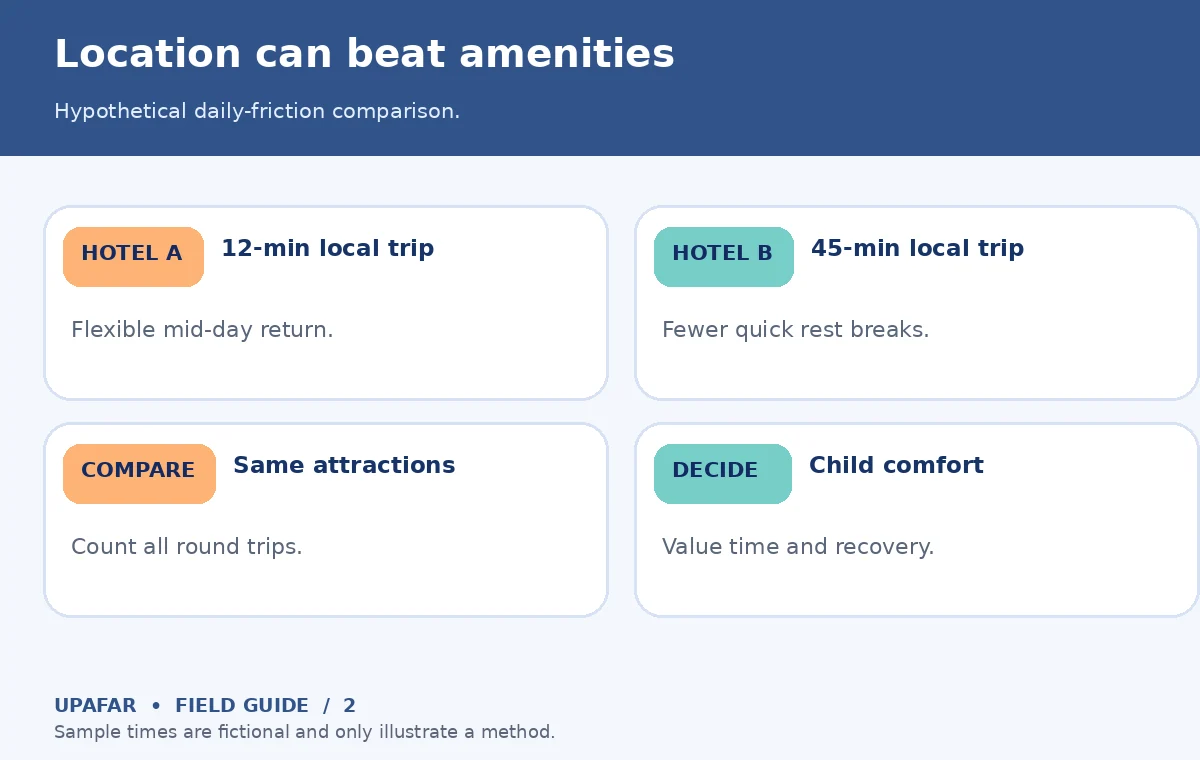
Find your main activity area, closest usable public transport stop and the time needed to reach the hotel from the airport with children and luggage. Then simulate an ordinary day: breakfast, the main outing, a nap or quiet break, a second short outing, and dinner. A less expensive hotel at the edge of town might add two long transfers each day. If those transfers make returning for a nap difficult, the family could spend more on taxis or spend less time doing the activities that justified the trip.
Consider an entirely fictional comparison: Hotel A takes 12 minutes to reach the attractions you plan to visit; Hotel B takes 45 minutes. If your family makes two round trips on a given day, the transportation burden can differ dramatically. These numbers are not quoted journey times for real properties; they demonstrate why you should calculate door-to-door routes with current maps and a plausible walking pace. A hotel beside a station is not necessarily stroller-accessible, and a five-minute map estimate may ignore stairs or platform changes. Check the route at the time you expect to travel.
Distinguish meaningful facilities from attractive labels
A shallow pool, children’s menu or activity room can make a hotel more convenient, but each facility has important conditions. Check pool access rules and any required supervision; ask about a kids club’s age ranges, operating days, extra charges, languages and whether a guardian must stay nearby. ‘Free breakfast’ can refer only to certain guests or room offers. For young children, having reliable water, a refrigerator or a microwave where permitted may solve more daily problems than a large pool you are unlikely to use.
Property-level examples show why the details matter. One Hilton property in Bangkok describes room types with convertible sofa beds, connecting rooms and children’s facilities. That is evidence about one hotel’s promoted offerings, not an industry-wide guarantee and not a recommendation or booking confirmation. Even when a hotel mentions guaranteed connecting rooms in marketing, verify the exact rate, eligibility and reservation before concluding that your rooms will connect.
Compare total prices for the correct party size
Always search with all guests and children’s actual ages. Use the same dates, room standard, breakfast assumption and cancellation flexibility when comparing two properties. Count potential extra bed charges, parking, mandatory destination or resort charges, food costs and expected transfers. A room quoted cheaper per night may be more expensive after these additions. A kitchen facility might offset some meal spending on longer trips, but that is a personal preference and must be balanced against location and time spent preparing food.
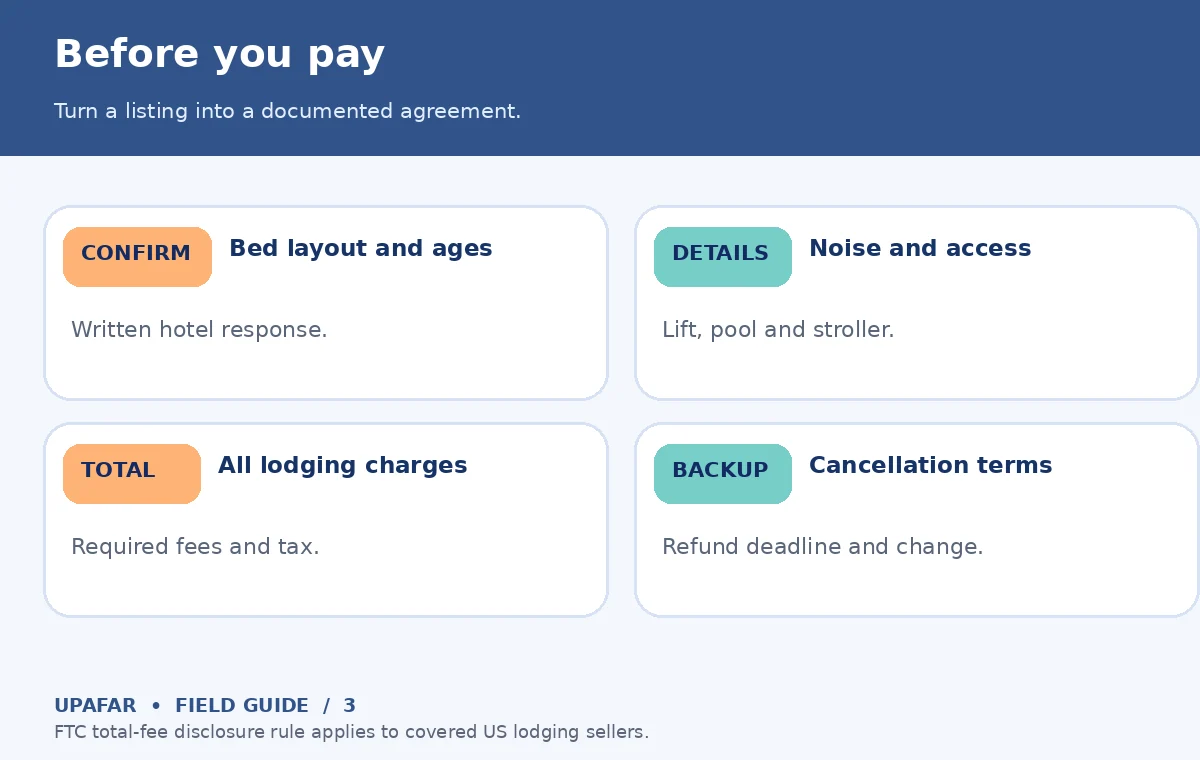
For covered short-term lodging sold in the United States, the FTC rule effective May 12, 2025 requires businesses advertising prices to present known, calculable mandatory fees in the upfront total, with specified exceptions such as government taxes. The rule does not make every service free and does not replace the need to inspect cancellation and refund terms. Elsewhere, regulations differ. In all cases, save a breakdown of the final payment amount and confirm whether a deposit or security hold applies.
Place safety, accessibility and recovery above a star rating
Ask practical questions about the property and room: can a stroller reach the room without stairs, is the lift reliable, are there safe paths to food, can you request a quiet room, are balconies or open windows compatible with your child’s needs, and is the pool area supervised according to the hotel’s current rules? Adults remain responsible for child supervision; amenity descriptions do not imply babysitting or safety certification. Families needing particular accessibility features should get specific details from the hotel and not rely solely on an icon. A location that works during an adult day trip may become difficult with a toddler or someone who tires easily.
Think through arrival and departure. If your international flight lands early, what happens before check-in? Can the family leave luggage securely, and is there a quiet area or nearby place to sit? What does a late checkout actually cost? Will you need child-appropriate transport from the airport? The right room is part of a larger travel day; sometimes one transit-friendly neighborhood with fewer activities is a better choice than a resort requiring long excursions every day.
Evaluate refundability and booking confirmation separately
Check whether the quoted rate permits free cancellation, the local deadline for exercising that option, how much is due in advance, and what happens for an early departure. Consider booking direct with the property if you need specialized bedding confirmation, but do not assume direct booking is always cheaper or more refundable. If using a third-party platform, determine whether the hotel or platform is responsible for changes and verify the hotel has received the exact occupancy request. The FTC’s travel-scam guidance recommends verifying booking details and being alert to demands for unusual payment methods.
Store written confirmation of any nonnegotiable room layout. A chat saying ‘we will try’ does not establish the same assurance as a reservation with guaranteed connecting rooms. When the needed arrangement cannot be confirmed, compare another hotel or split-room configuration rather than hoping check-in staff can fix the problem during a busy evening. A little pre-booking friction is cheaper than losing sleep or discovering that the reserved room legally cannot accommodate the full party.
Run a four-gate family hotel shortlist
First, verify actual bed count, occupancy, child ages and required equipment. Second, estimate the realistic trip back and forth to your priority activities, including an optional midday return. Third, price the whole reservation, including required charges and family extras. Fourth, check accessibility, safe usage needs and cancellation terms. Only after those conditions pass should you compare swimming pools, restaurants and kids clubs. The attractive extra should break the tie, not obscure a room that does not work.
If you cannot settle a key uncertainty before payment, classify the hotel as on hold. If a required feature is unavailable, reject the property for this trip without implying it is a bad hotel for other travelers. This systematic approach also avoids duplicating broader family-vacation planning: choosing a destination and overall budget is a separate decision from confirming one property will be a workable home base.
How We Research family hotel decisions
We reviewed the FTC’s official short-term lodging fee guidance and travel-scam warnings alongside a current Hilton property page as an example of property-specific family amenities, checked October 19, 2026. We did not inspect hotel rooms, test children’s programs, verify prices or rank properties; the time comparison is fictional and labeled as such. Before booking, confirm the exact room and family policies with the property. UpAfar claims no lodging partnership in this article; see our affiliate disclosure.
Frequently Asked Travel Questions
No. The label does not establish bedding or occupancy. Obtain written confirmation of bed types, cot/crib availability, child ages and any surcharges.
Not necessarily. A request is different from a confirmed connection, and guarantees are hotel- and booking-specific. Verify before paying if it is essential.
No. Club ages, supervision, opening times and charges can vary. Safe sleeping arrangements and manageable location may matter more.
Use the same guest ages, room setup and dates; compare final lodging costs plus expected transfers, meals, access needs and cancellation risks.
Do not assume it. Confirm eligibility, availability, whether the room fits it safely, any fees, and the property’s exact policy.