
The easiest way to enjoy two weeks in Southeast Asia is to choose a manageable geographic cluster and stop counting countries. The region spans mainland cities, islands, highlands, coastal weather systems and multiple national entry regimes. A good first route allows time to settle in, explore neighborhoods and recover between transfers. Here we use Singapore and peninsular Malaysia to illustrate a 14-night planning allocation; it is not a verified transport schedule, an immigration guarantee or a claim that this region is best for every traveler.
Choose a trip style before choosing a country count
Ask what the trip should feel like. If museums, neighborhoods and street food are the priority, compact urban bases are attractive. If hiking, national parks or mountain areas matter most, put travel and weather days into the plan. If beach time is the goal, confirm which coast or island is appropriate for your travel dates and allow for sea conditions. A combination of one city and one nearby slower base often provides more balance than visiting four capital cities because they appear on a must-see list.
Southeast Asia is not one uniform destination. The travel time between islands can exceed the time spent on the map, and international flights consume hours beyond the airborne segment. List the international airports you can sensibly reach, your allowed trip length, budget and what kind of accommodation you prefer. Then choose a small number of bases. Resist deciding on an overnight stay solely because it is popular in online itineraries. A city may justify additional nights if it offers several neighborhoods, museums and day-trip options that align with your interests.
Compare mainland routes with maritime itineraries
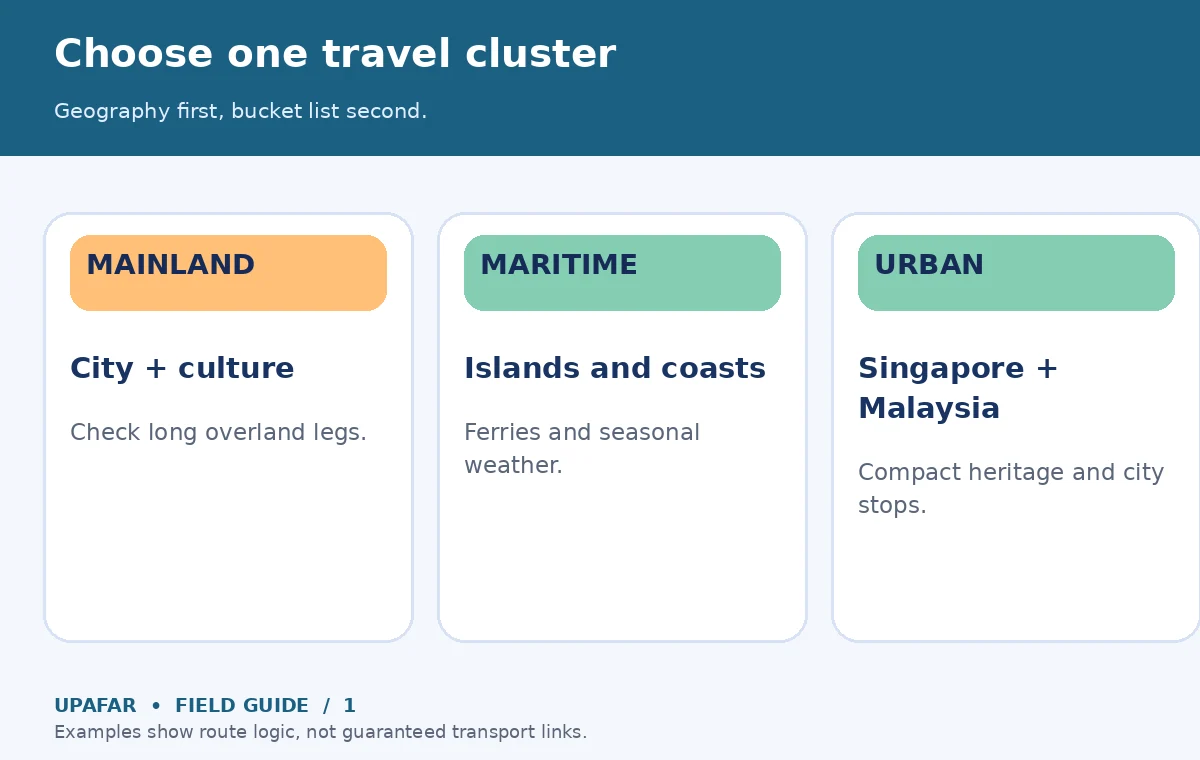
For a first draft, sort alternatives into three broad planning clusters. A mainland-oriented route can connect urban and cultural destinations but requires careful verification of cross-border and domestic transport. An island-focused plan may revolve around one coastline and carefully chosen ferries; it becomes fragile if every second night depends on a boat. A compact city-and-heritage route linking Singapore and Malaysia keeps the trip centered on one neighboring pair of countries while offering different neighborhoods and cultural settings.
Do not treat these clusters as rigid geographic borders. Thailand, Malaysia, Vietnam, Indonesia and other regional destinations each contain multiple possible trips on their own. A route suitable in one month or for one passport holder may be poor for another. If your preferred activity is a particular temple or diving area, build around it rather than copying our illustration. For a two-week vacation, fewer hotel changes usually preserve more time for the purpose of the trip.
Example: 14 nights across Singapore and Malaysia
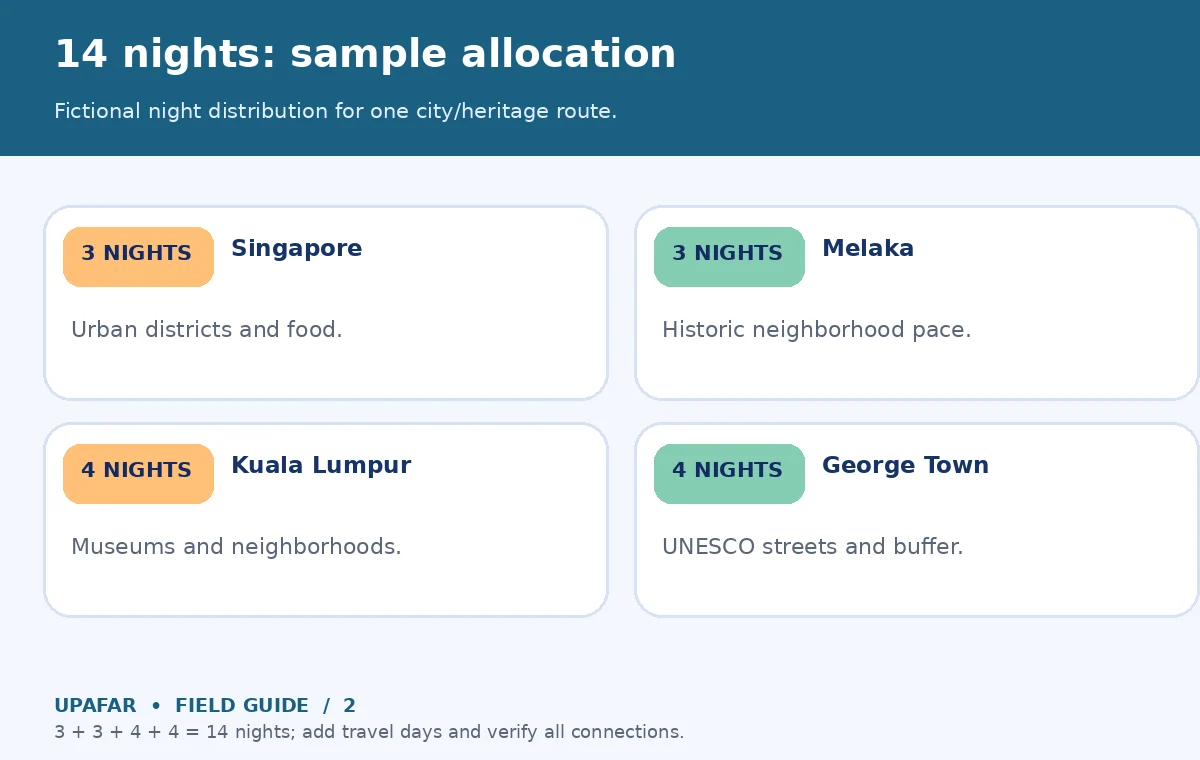
A hypothetical route could allocate three nights in Singapore, three in Melaka, four in Kuala Lumpur and four in George Town. That adds up to 14 nights. It is an editorial example, not a claim that there is a direct train from one stop to the next, a recommendation for every party size, or an availability check. You still need to budget transfer days, book arrival and departure airport connections, and verify the most sensible order for your actual flights. Starting and ending in different airports may avoid retracing your steps if open-jaw airfare and airline rules are suitable.
In Singapore, consider grouping attractions by neighborhoods rather than commuting across the island repeatedly. The Singapore Tourism Board’s four-day itinerary highlights areas such as Kampong Gelam and Katong-Joo Chiat. Use that as place-specific background, not as a promise that every attraction will be open or a prescribed order. Melaka offers a smaller heritage-city pace; Kuala Lumpur offers a larger urban base with varied neighborhoods; George Town supports heritage walks and an opportunity to remain in one location for several nights.
UNESCO recognizes Melaka and George Town together as historic trading cities of the Straits of Malacca, explaining their layered Malay, Chinese, Indian and European cultural heritage. That gives the itinerary a meaningful story beyond ticking off cities. It does not establish how long you will need for museums, current admission hours, bus departures or accessibility. Research individual sites and allow slower days instead of assuming every listed stop is an attraction to complete in a fixed time.
Count transfer days, not just nights between hotels
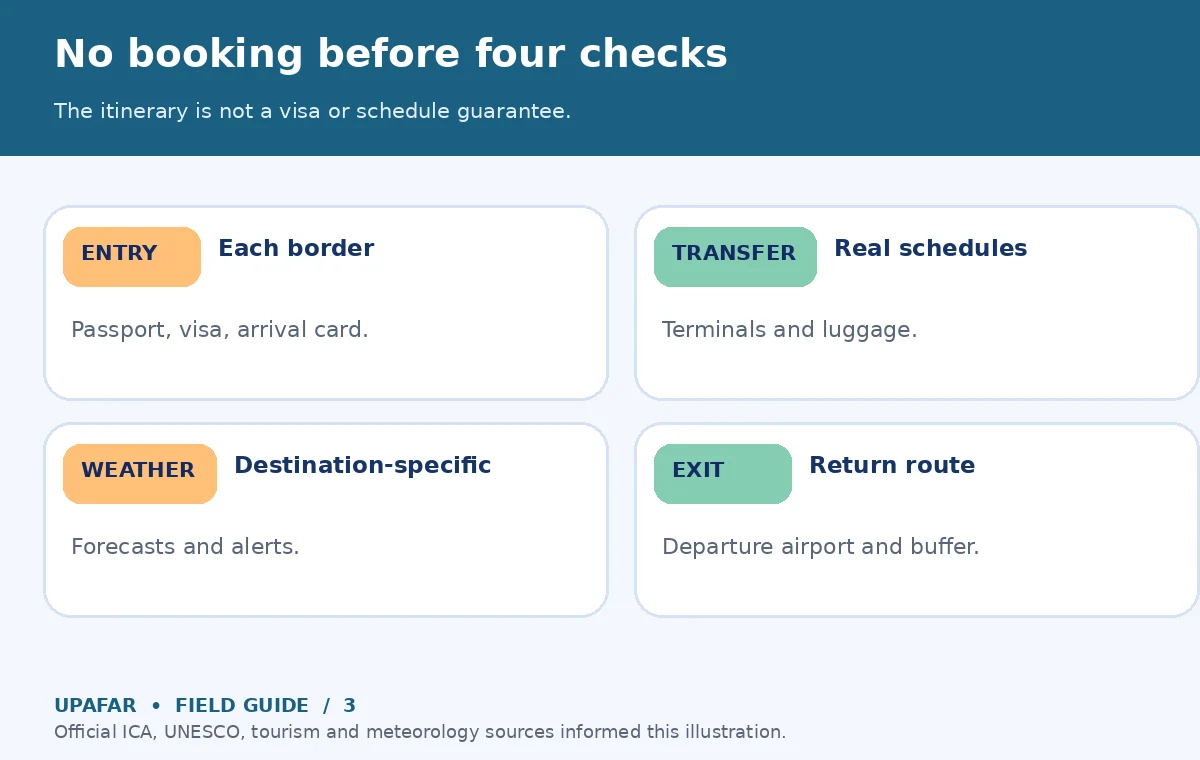
For every proposed move, write down origin hotel to departure terminal, recommended arrival/check-in buffer, actual journey, arrival terminal to next hotel, and the time lost to unpacking and meals. A route that looks like a single straight line on a map may still have inconvenient services, separate stations or border control. Check whether direct options exist for your dates before committing to nonrefundable hotels. The word ‘nearby’ tells you little about a journey that requires a long bus ride or a connection at an inconvenient hour.
Use a transfer day as an intentional lower-activity day. On arrival, plan perhaps a neighborhood meal or gentle walk instead of a paid ticket with a strict start time. If schedules are sparse or road delays possible, include buffer time rather than compressing the route further. A city may be worth four nights even if you have only two major sightseeing days: a full day lost to a transfer, recovery or unpredictable weather need not make the time ‘wasted.’ It may keep the overall vacation pleasant.
Verify the national entry rules separately
No regional visa checklist works for every passport. Check the official immigration authority for each country you will enter, your passport nationality, visa status, entry and exit dates, onward travel and any required arrival form. In particular, Singapore’s Immigration & Checkpoints Authority explains general entry requirements, including passport validity, nationality-dependent visa rules and an SG Arrival Card requirement with exceptions. Rules differ for transit and entry. Read the conditions that apply to your circumstances; an online itinerary cannot grant permission to enter a country.
If the route includes Malaysia or another country, consult that government’s current immigration source too, especially if your documents or previous travel history raise an issue. Before paying for a flight across a border, verify you are permitted to make the journey and that the travel document has the required validity. Local travel advisories, transport safety information and destination-specific health guidance should be checked near departure. Avoid copying a universal ‘visa-free’ statement from a recent social video, as the answer can change with nationality and length of stay.
Research weather at each actual stop
It is misleading to describe all of Southeast Asia as having one dry season. Weather patterns vary by coast, location and month. An itinerary involving a mountain town, a west-coast city and an offshore island can face different conditions even within the same country. Check long-term climate normals during initial planning, then obtain an actual forecast and alerts shortly before activities and transfers. The Malaysian Meteorological Department’s official forecast portal is one place to check current Malaysia-specific conditions; it is not a substitute for other countries’ weather agencies.
Weather is more than comfort. Heavy rain may slow driving, reduce visibility or disrupt an outdoor activity. Rather than choosing travel solely by a broad ‘best time’ internet chart, plan flexible indoor alternatives for heritage walks and identify which parts of the itinerary are safety-critical. If the main goal is beaches and boat trips, research local marine and operator guidance well before paying. Do not demand that a carrier or operator sail or drive when warnings make it unsafe.
Estimate a route-based budget without inventing regional prices
Price the trip in layers: international flight, transport between bases, accommodations at the intended standard, meals, admissions, local transit and travel insurance or other preparations as appropriate. Currency and booking conditions differ, so use real dates and current quotes. Keep a contingency for a disruption, and compare the cost of two bases against four; more hotel moves can create more fees and transport spending even when rooms are individually cheaper.
A two-country itinerary also introduces border-related logistical time. Treat it as part of the budget. For a traveler who wants more nature and fewer city days, a one-country route with two bases may be a more enjoyable alternative. For someone with only eight days, consider focusing on Singapore plus one nearby stop—or one country entirely—rather than squeezing a 14-night example into a short break. With three weeks, an extra base becomes more reasonable, provided the internal transfers and visa arrangements check out.
Finish with a booking-ready itinerary sheet
Put every night in a row of a calendar, attach the probable departure and arrival mode to each move, and mark whether it is confirmed or only a concept. Record the exact entry source checked and any outstanding question, plus a realistic backup if transport fails. Group urban sightseeing into neighborhoods and leave the first evening light after long travel. Confirm hotel check-in, luggage storage and weather-sensitive activity conditions for each base before paying for timed tickets.
What changes this guide from a destination wishlist into a usable route is evidence: an actual ticket offer, a government entry requirement, a clear location for each hotel and enough uncommitted time to manage travel. If the entry rules cannot be resolved, the main connection is unavailable or the weather pattern conflicts with your priority activity, revise the route rather than adding another city to disguise the uncertainty.
How We Research Southeast Asia routes
We checked official Singapore Tourism Board neighborhood guidance, Singapore ICA entry information, UNESCO heritage descriptions of Melaka and George Town, and Malaysia’s meteorological forecast portal on October 19, 2026. The 14-night allocation is our original illustrative planning exercise; we have not confirmed airline, train or bus inventories, quoted fares or immigration eligibility for a particular passport. Readers must verify each leg and national requirement themselves. There is no claimed tour or hotel partnership; see our affiliate disclosure.
Frequently Asked Travel Questions
One country or two nearby countries usually provides more usable time than collecting border crossings. Choose based on travel days, interests and actual transport.
No. Weather and monsoon patterns differ between countries, coasts and seasons. Check the official forecast and local climate for each stop.
No such guarantee is made. Check available bus, rail or flight options and border conditions for your dates; the route is a geographic planning concept.
It depends on your nationality, documents, intended activities and length of stay. Check each government’s official requirements; Singapore also has an arrival-card system with exemptions.
Start with the activities, season and arrival flights you prefer. Singapore–Malaysia is one illustrative compact cluster; it is not a universal first-time best itinerary.