
For a first Thailand trip, avoid treating the country as one compact beach destination. Bangkok, the northern region around Chiang Mai, and the southern coasts offer very different experiences, and every flight, rail leg or boat transfer uses part of your holiday. A useful first route often combines two regions; a third makes more sense when you have extra nights. This guide uses an illustrative 14-night route, highlights official entry checks and separates season-sensitive choices from promises about any particular week of weather.
Pick the regions before choosing daily activities
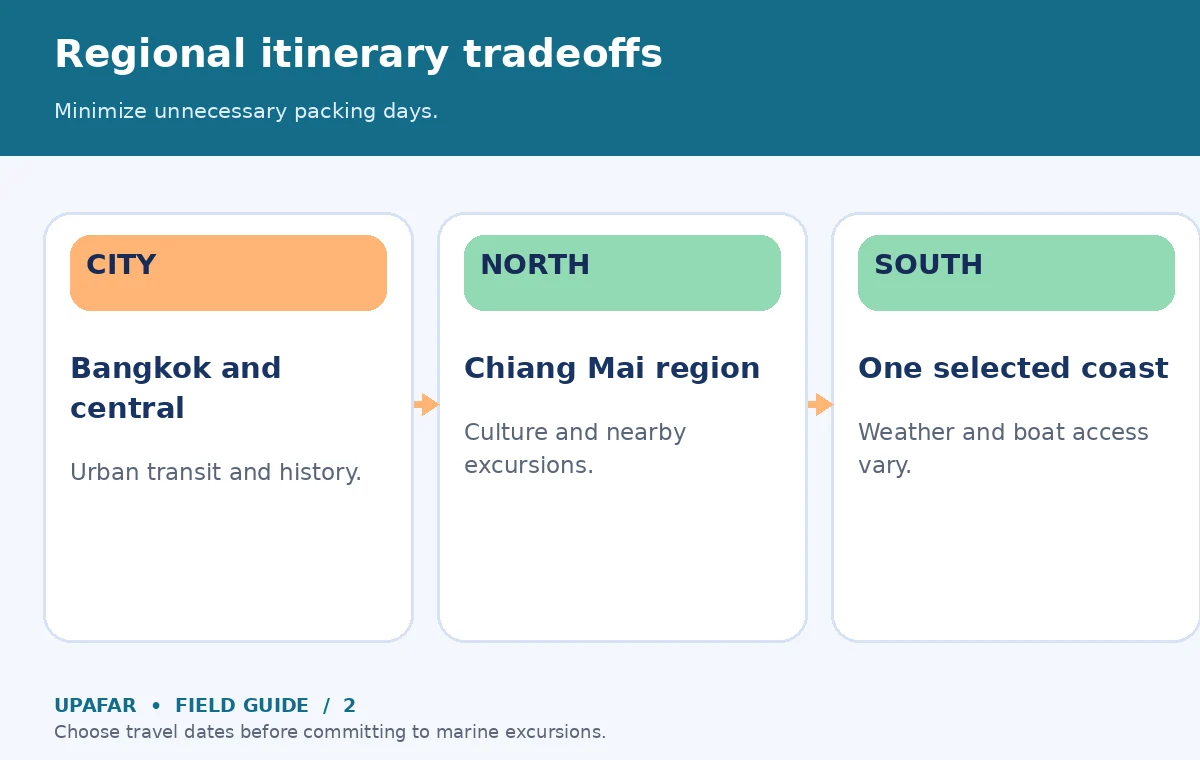
Bangkok works as a gateway for urban neighborhoods, markets, major temples and the Chao Phraya river corridor. Chiang Mai and the north suit travelers interested in historic districts, local food and nearby cultural or landscape excursions. Southern stays may focus on the Andaman side near Krabi or Phuket, or Gulf-side islands, depending on the trip’s season and desired access. The Tourism Authority of Thailand organizes destination guidance by region; use those official pages to narrow your choices before drawing route lines.
Do not start by saving every widely shared Thai island and temple to a single itinerary. First decide whether the trip is mainly city and culture, north and outdoors, or beach-focused. Then choose the number of overnight bases you can comfortably support. If a holiday lasts only seven nights, a Bangkok-plus-one-region plan often protects more usable time than trying to fit three far-apart regions into one week. Distances and the exact transport available on your travel dates must be checked individually.
Build a fourteen-night sample without invented transfer times
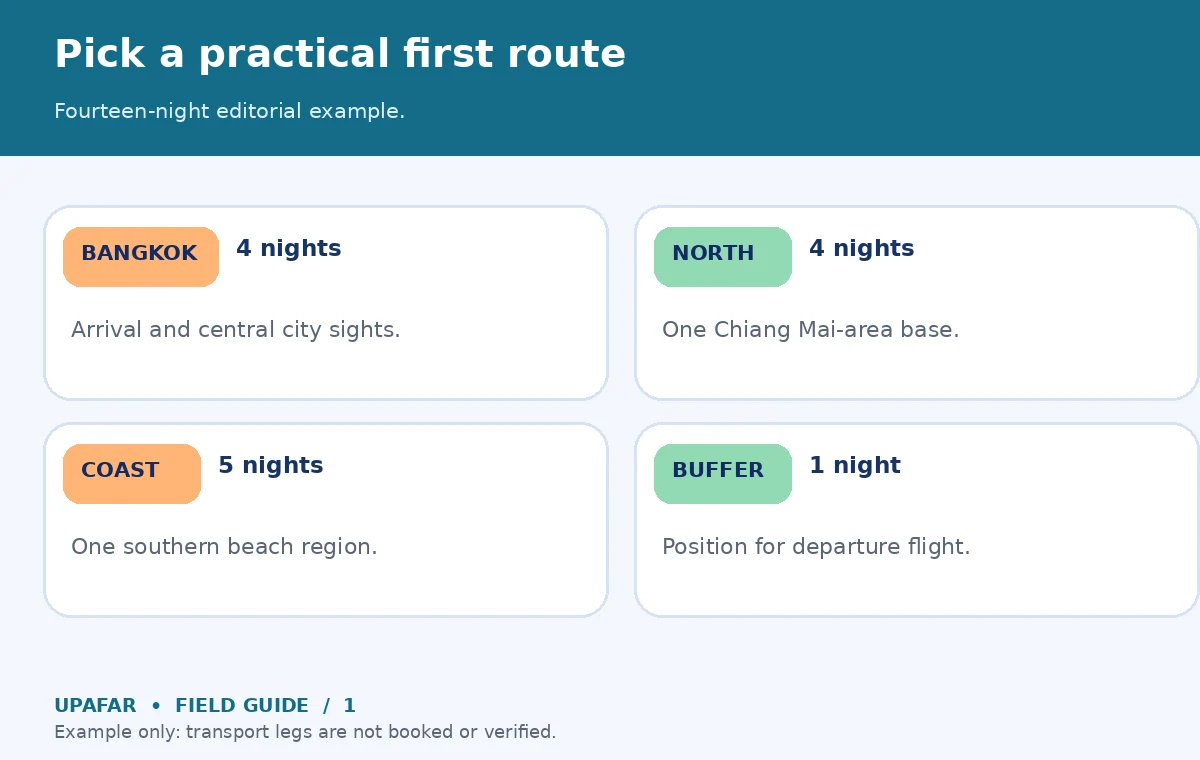
An illustrative route is four nights in Bangkok, four nights based in Chiang Mai, five nights in a selected southern base and one final night positioned for departure. This adds to fourteen nights but does not represent a confirmed air or rail itinerary. If your international flight leaves from a southern airport, the return-to-Bangkok night may be unnecessary; if it leaves Bangkok, a final buffer there could reduce the consequence of a delayed domestic connection. Choose the real transport services before fixing the nights.
A slower alternative for the same period is five nights Bangkok and the nearby central region, then nine nights in one coast or northern base, with local day trips. Neither plan wins by default. The first offers contrasting regions but adds intercity travel; the second offers fewer packing and hotel-change days. For each proposed transfer, record start point, end point, full door-to-door burden and fallback. Flights, trains, ferries and road services require operator-specific checks; no routing pattern here guarantees a connection.
Match seasons to the specific region and activity
Thailand’s weather is not a single nationwide calendar. Heavy-rain risk, marine conditions and local closures can differ between the Andaman coast, Gulf islands, north and central plains. Rather than assert that a month is universally dry or ideal, check regional climate descriptions, near-date forecasts, marine warnings and the operating status of the exact beach, boat or park you intend to visit. This matters especially when a few narrow ferry windows determine the whole trip.
For Bangkok city days, rain and heat can change the order of a long outdoor walking route. Plan temples and open-air markets with shade, rest breaks and indoor alternatives. In the north, seasonal air-quality issues can be important depending on dates and conditions; consult current official air-quality and health information, not a generic annual statement. For southern boat trips, sea state and operator judgment matter more than an app’s sunshine icon. Build flexibility rather than advertising a guaranteed ‘best beach month.’
Confirm entry rules from the correct authority
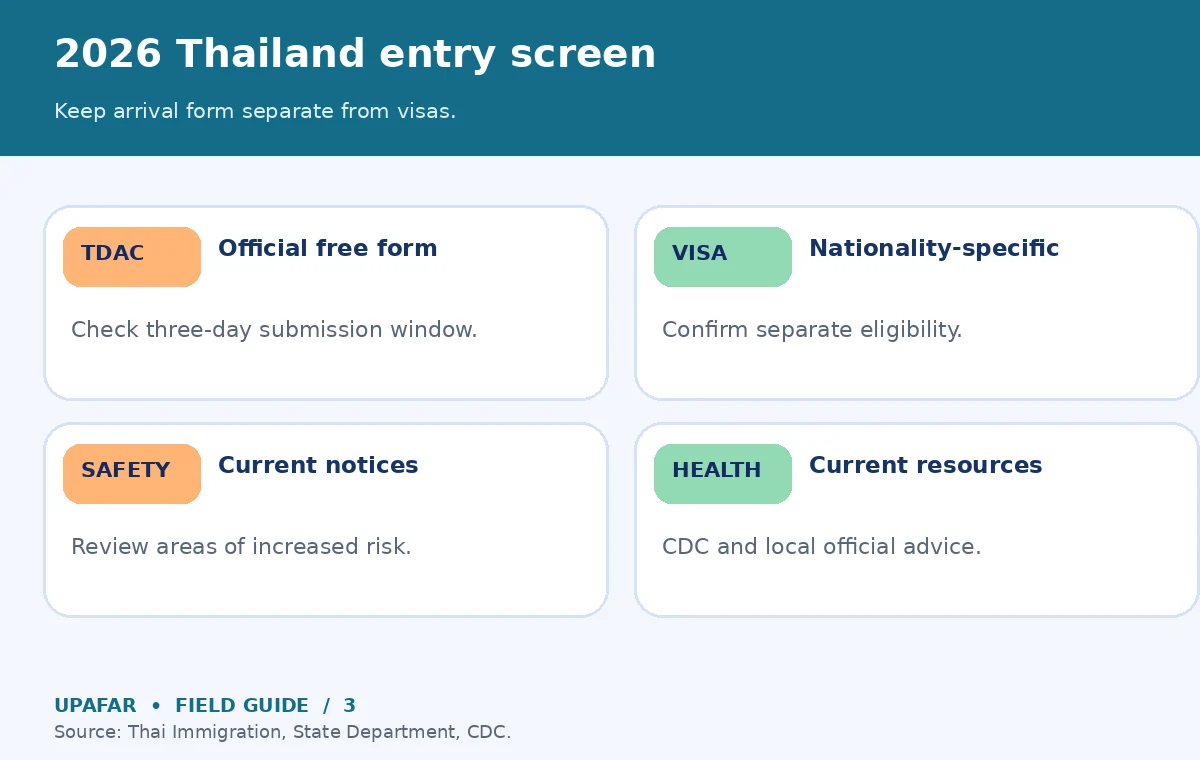
The Thailand Immigration Bureau’s TDAC FAQ states that non-Thai nationals entering Thailand generally must submit the Thailand Digital Arrival Card within the three days before arrival, including the arrival date. It applies to entry by air, land or sea, including children; travelers merely transiting without passing immigration do not need it. Submission through the official TDAC portal is free. The arrival card is not a visa, so do not mistake it for authorization to enter.
Visa and passport eligibility depend on nationality, purpose, travel history and applicable rules. Check with Thailand’s official immigration service or the Thai embassy or consulate responsible for your citizenship before purchasing a nonrefundable trip. For US travelers, the US State Department’s Thailand guidance includes current travel advisory and safety information. At the October 19, 2026 review, its July 7, 2026 advisory listed Level 1 overall with additional cautions in particular areas, including near the Thai-Cambodian border and some southern provinces; conditions may change, so check the latest notice yourself.
Organize Bangkok and northern days by geography
On a Bangkok day, cluster one primary temple or museum with nearby river or historic-district stops rather than repeatedly crossing the city. Allow for dress rules at religious sites, walking in heat and changing entry practices. Use public transport where practical but verify the station, pier and final walking route. Do not assume a boat labeled ‘express’ lands at your desired attraction or that a museum is open on your chosen weekday.
For a Chiang Mai stay, plan the old-city core separately from any more distant mountain or nature excursion. Day-trip operators may bundle widely spaced stops, but the distance between them still affects actual time in each place. When choosing animal-related experiences, independently assess animal welfare and avoid activities that rely on coercive encounters. If you plan hiking or national-park visits, read the attraction’s official access rules and current alerts; a place being shown in a travel video is not proof it is open year-round.
Approach beach transfers and bookings conservatively
A coastal stay requires a specific base decision: mainland lodging near day tours, or an island requiring boat access. A mainland base may preserve transport options; an island can reduce repeated boat excursions but makes luggage, weather changes and the departure ferry more significant. Count check-in, port transfers and safety considerations, not only the advertised crossing time. Avoid scheduling a boat as the only connection to an international flight on the same day when a missed sailing would be costly.
Book accommodation based on confirmed room type, accessibility, child arrangements and cancellation terms. For water activities, verify licensed operators where applicable, life jacket availability, current marine conditions and the policy for weather cancellation. Thailand is a diverse destination; a generic ‘Thailand weather’ chart and a single island price average are both weak planning tools. Travelers should compare the precise region and travel dates rather than expect a uniform cost or forecast.
Prepare for health, transport and practical daily needs
Check the CDC Travelers’ Health destination resources for vaccination and other travel-health considerations appropriate to your itinerary, with clinical advice where necessary. Carry heat and rain protection, drinking water and any personal medications in accordance with entry rules. Keep a secure offline copy of your lodging address, key reservations and emergency contacts. Using a transport provider with clear pickup instructions is more helpful than relying on an improvised late-night plan.
Leave one or two flexible sessions for bad weather, fatigue or a slower-than-expected transfer. Ask whether your chosen accommodation and activities are actually suited to your mobility needs and travel companions. Your first morning should require less coordination than your fifth; your last day should protect the departure flight above another attraction. Verify opening hours, government advisories and transit operators again shortly before travel.
How We Research Thailand trip planning
We reviewed the Tourism Authority of Thailand’s regional destination materials, Thailand Immigration Bureau’s TDAC FAQ and the US State Department Thailand advisory on October 19, 2026, plus CDC health resources. The fourteen-night sample is an editorial route pattern, not verified flight inventory, border clearance, weather forecast or personal travel experience. See our affiliate disclosure. No commercial transport or hotel relationship is asserted.
Frequently Asked Travel Questions
No. Thailand Immigration states that TDAC is an arrival information form, not a visa. Visa requirements are separate and depend on the traveler.
The official FAQ says within three days before arrival, including the arrival day, for non-Thai entrants generally; use the official free website.
Often two distant regions create rushed transfers in seven nights. A Bangkok-plus-one-region stay may preserve more useful time.
Compare the weather and marine conditions for the exact month and destination; Andaman and Gulf conditions can differ, so no single coast is always best.
No. The July 2026 advisory was Level 1 overall with additional cautions for certain areas, including near the Cambodia border and parts of the far south; check updates.