
A useful travel itinerary is not a list of everything a destination offers. It is a sequence of days that a real traveler can complete, with enough time for transport, meals, opening-hour constraints and the surprises that never appear on a must-see list. The easiest method is to design the trip around overnight bases and two or three priorities per day, then test every move that connects them. This guide builds the itinerary itself; the separate travel-planning checklist covers the broader predeparture tasks, documents and purchases.
Start with nights, arrival conditions and departure time
Write your arrival city, arrival time, first night’s sleeping location and final departure point on one line. Count nights before labeling days: a trip advertised as six days may offer only four full sightseeing days once an evening arrival and early flight are taken into account. Record whether the first and last day can support sightseeing at all. Do not promise yourself an all-day excursion on a day consumed by immigration, baggage collection, airport transfer or uncertain check-in timing.
Treat your first night as an operational decision, not an attraction choice. Landing late may make an airport-linked or conveniently reached district more useful than a hotel near an attraction across town. The last night needs the same scrutiny if your flight is early or a boat or mountain road could disrupt the return. This framing prevents a common itinerary mistake: using all the nights for exciting stops but leaving no reliable way to get home.
Group the day geographically before choosing attractions
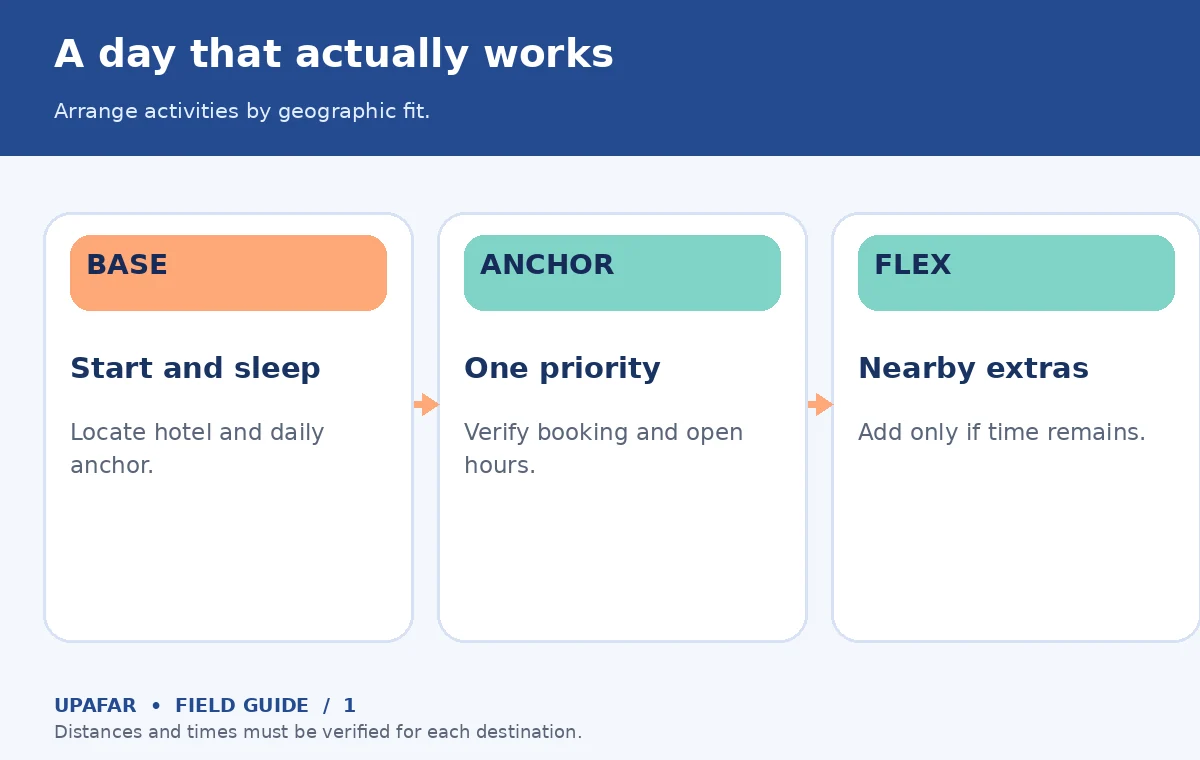
Place your desired stops on a map and sort them into small geographic clusters. Choose one anchor experience that truly matters in each cluster, then add one nearby secondary activity and one optional stop. A downtown museum, a neighborhood walk and dinner within the same district can make a coherent day; combining three distant neighborhoods simply because each ranks highly online often makes the transit the dominant activity.
A good itinerary describes movements as well as sights. Write where the day starts, the likely mode between stops, and where it ends. If a stop requires a timed reservation or is closed on your dates, position it first and let nearby flexible stops follow. Official attraction pages—not an AI itinerary, old blog post or saved social-media video—must determine actual operating days and entry procedures. The National Park Service’s plan-your-visit guidance similarly recommends checking the specific site for hours, reservations, alerts and safety details.
Give transit its full door-to-door cost
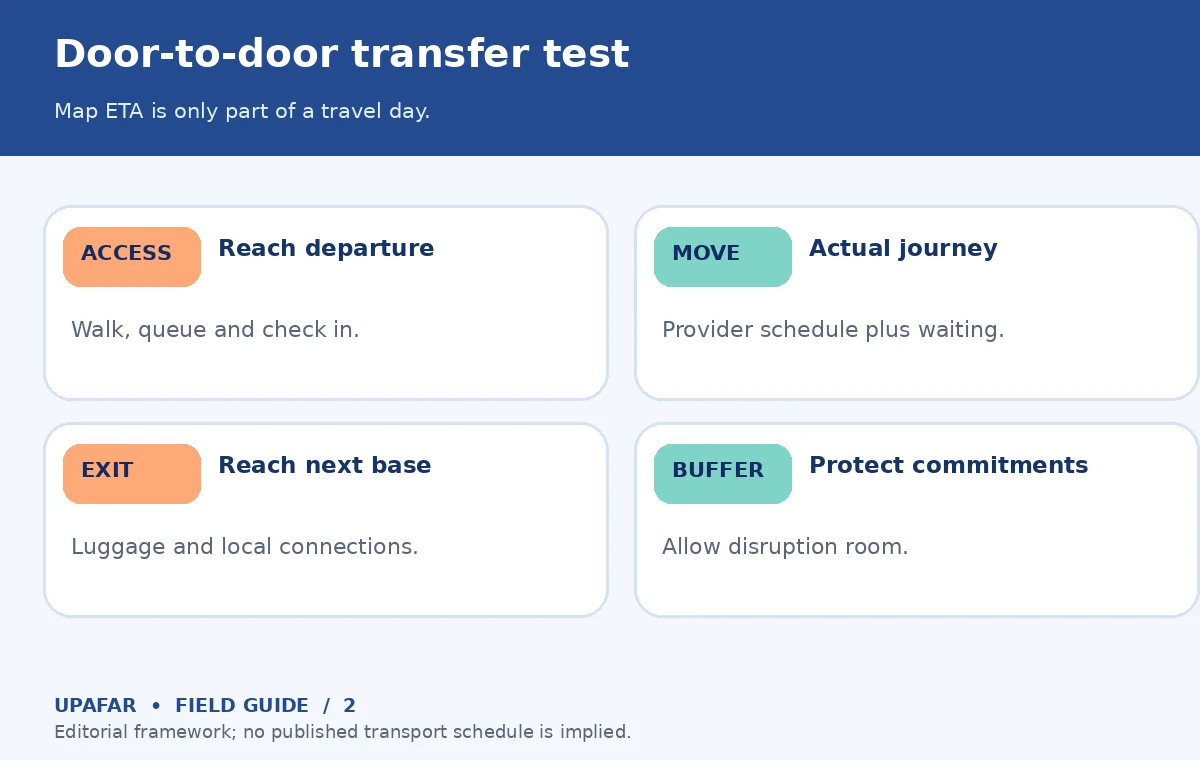
Map applications often show only vehicle travel time. Add the walk to a station, ticket purchase or check-in, any security requirement, waiting, luggage handling and the final transfer to your next accommodation or attraction. A train advertised as ninety minutes between cities might consume much of a morning after getting to the station, storing bags and reaching the next hotel. Treat this as a planning example, not a schedule for a specific route.
Create a transfer-day line with four fields: scheduled travel, access and exit time, buffer for disruptions, and usable time left. If you cannot explain the buffer you need, do not place a nonrefundable event right after the journey. For a family, a traveler with mobility needs, or a group with different walking speeds, plan using the slowest comfortable pace rather than the fastest navigator’s estimate.
Design three levels of itinerary density
A relaxed day has one principal outing plus unscheduled time. A balanced day has an anchor, one related activity and flexibility to linger. A packed day is appropriate only when locations are close, opening hours are verified and everyone wants the same pace. Instead of assigning imaginary universal time limits, build a rough schedule around the actual venue’s published visiting guidance and the group’s needs.
For example, an illustrative city day could be: breakfast near the hotel, one booked museum, lunch in the same district, a short local walk, and dinner within an easy ride. If the museum takes longer, the walk can disappear without breaking the day. Compare that with a day containing three prepaid attractions separated by long cross-town rides: one delay threatens everything downstream. The difference is itinerary resilience, not the number of pins you saved.
Keep a booking register separate from the day plan
Use a small table or notes file with the provider, confirmation number, correct local date, time zone, entry window, cancellation deadline and where the ticket is stored. Then reference it in the day-by-day itinerary with short labels such as ‘Museum—timed entry confirmed.’ An itinerary page should remain readable at a glance; a booking register holds the contractual detail. For each required reservation, verify the official provider’s current instructions before paying.
Put a clear marker next to nonrefundable commitments. For flexible activities, save two alternatives rather than purchasing everything in advance. Include accessibility details and walking distance when these determine whether an experience works. Keep essential phone numbers and offline copies of directions available if mobile coverage fails. The US State Department’s international travel checklist recommends organizing document copies and destination-specific requirements; these complement the itinerary but should not be buried in a sightseeing timeline.
Build recovery space into the itinerary
Do not call a day free if it contains a cross-country transfer, hotel change and an evening reservation. Label those obligations explicitly. Reserve weather-dependent experiences for a point in the trip where an alternative day is feasible. For boat excursions, scenic hikes or outdoor tours, save a nearby indoor or low-risk option. A backup should be genuinely available to your group, not simply another place found online.
Give travel companions a shared version that contains the day’s meeting place and hard commitments, not every tentative idea. Plan how to respond if one person is tired, a venue closes or transport is cancelled: what must be saved, what can move, and what can be dropped? That decision is much easier when the plan distinguishes ‘essential’, ‘nice to have’ and ‘optional.’ For outdoor trips, the NPS trip-planning guide also emphasizes planning for unexpected changes and emergencies.
Use a six-column daily template you can copy
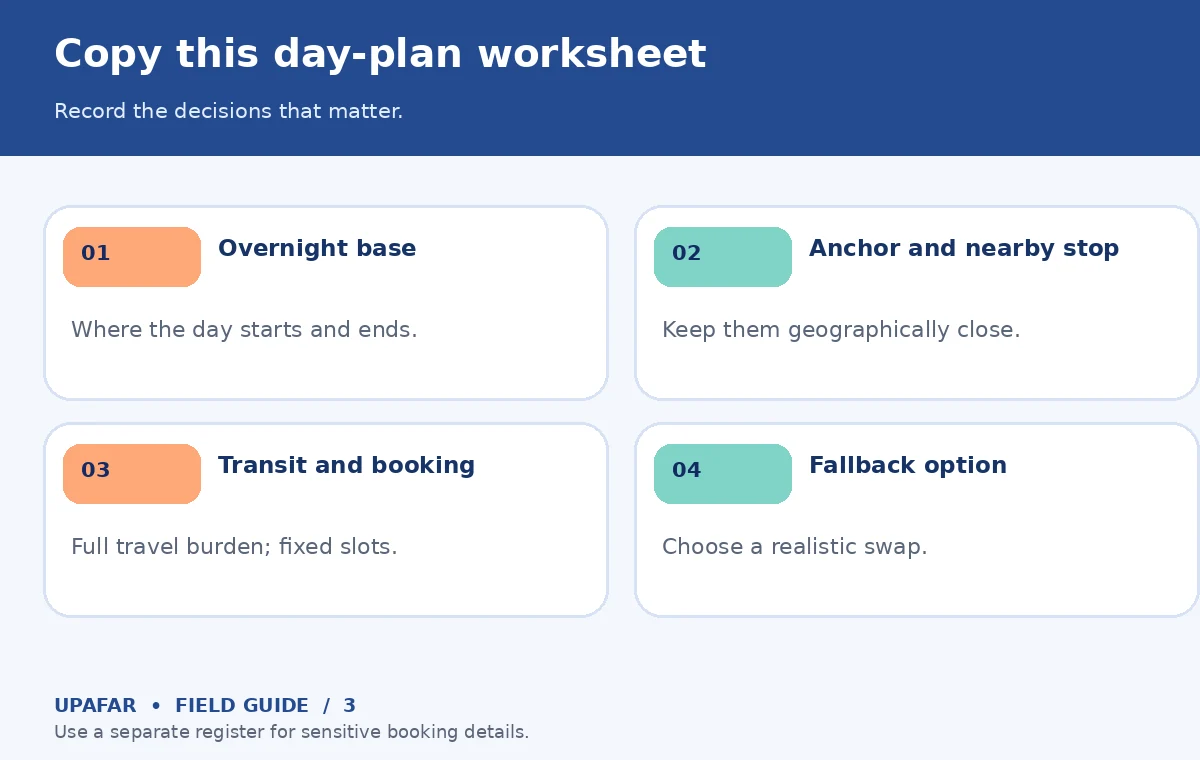
Give each day six headings: Overnight base; anchor activity; nearby optional stop; transfer and travel time; fixed booking or closure; and fallback. For an illustrative three-night city trip, day one may be arrival and local orientation, day two the main district with a prebooked sight, day three a second nearby cluster or optional day trip, and day four departure. This is a shape to adapt, not a recommendation for a particular city or a claim about live availability.
Before finalizing, read the itinerary as a skeptical traveler: Which day depends on perfect transit? Which reservation may be closed on that weekday? Is the arrival-day plan actually feasible? Where is the nearest meal or rest break? Is there a true buffer before the departure flight? After those checks, share a simplified offline itinerary and make a separate document for documents, payments and health preparations.
How We Research workable travel itineraries
Our itinerary method draws on the NPS guidance for verifying location-specific hours, alerts and reservations, its planning and safety framework, and the State Department’s travel preparation checklist, reviewed October 19, 2026. Examples and diagrams here are editorial planning models, not schedules, booking results, real journey times or an assessment of individual attractions. Recheck every operating hour and transport service against its original provider. See UpAfar’s affiliate disclosure; no partnership or personal site visit is claimed.
Frequently Asked Travel Questions
Specify overnight locations, essential booked activities and travel between them; keep the rest optional. A minute-by-minute plan tends to fail when queues or weather change.
Prefer one anchor and one or two geographically nearby options. The workable count depends on real opening hours, group pace and door-to-door transfers.
Book events that truly require timed access, but keep flexible activities uncommitted until local conditions are clearer. Save confirmations separately.
Treat airport processing and transfers as real activities; avoid a nonrefundable attraction immediately after arrival or a fragile connection before departure.
Overnight address, fixed bookings, meeting points, key transfers, contact details and simple backup choices. Keep sensitive personal document copies securely.