
An island-hopping trip succeeds when the islands form a feasible transport chain, not simply when they look beautiful together on a map. Choose one island group, identify every actual boat connection, and reserve enough time for a canceled sailing without risking an important flight. Three nights on one island can be more rewarding than three islands in three nights. Use this planning framework to decide how many stops your trip can support and where to place a weather buffer.
The first practical question is whether you are planning a series of overnight stays or taking day trips from one base. An overnight route gives you evening and early-morning time on each island but creates luggage, check-in, and transfer work. Day trips leave luggage at one hotel and simplify logistics; they may limit time at distant places or rely on a particular sea condition. Neither format is inherently better. Match it to how many full, non-travel days you want on the beach, on a trail, or exploring settlements.
Choose one connected island group first
Many archipelagos look compact on a regional map but are served by separate ports, seasonal routes, or connections that run only on certain days. Draw a route using actual departure and arrival ports, not arrows between island names. A departure from the northern harbor may not help if your lodging is on the southern side and public transport is limited. Likewise, a connection advertised as “direct” needs an operator, sailing date, and booking conditions before it belongs in a finished itinerary.
Official examples demonstrate why route-by-route checking matters. Transport Malta described a new Sliema–Buġibba–Gozo service beginning in May 2026; that doesn’t mean every other island or port has the same links. Greece’s official tourism portal describes different combinations of flights and ferries for islands such as Elafonisos. These examples show how transport access differs; they are not a timetable or recommendation to combine Malta and Greece on one trip.
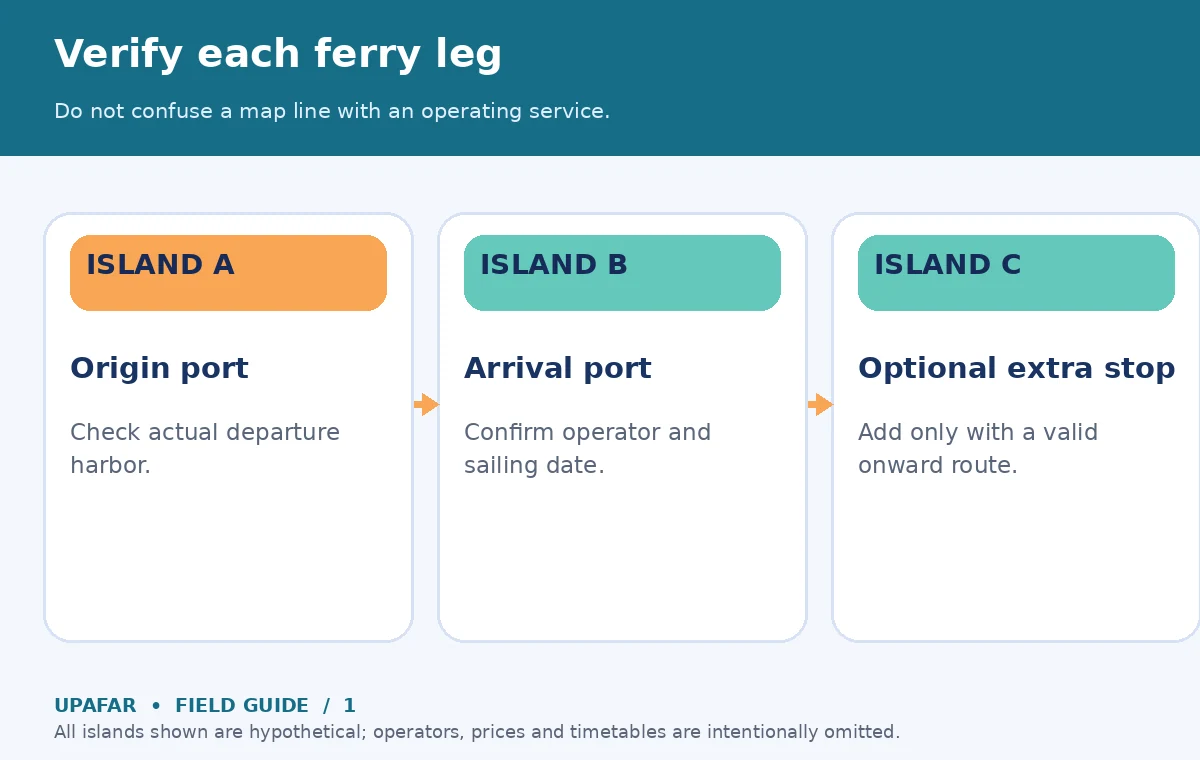
Make a four-column connection sheet: origin port, destination port, verified operator/date, and last practical alternative. Include travel between your accommodation and the port. You can leave the operator column blank until you check it, but do not invent a daily departure. If the only confirmed route runs every few days, it must dictate the order of your stays. Plan in the direction of reliable connectivity rather than insisting on a particular photo stop.
Count usable days rather than nights alone
A four-night trip usually offers less than four full sightseeing days once you allow for arrivals and departures. Each island change can consume a meaningful part of a day: pack, check out, reach the harbor, board, sail, collect luggage, and reach the next room. A boat ride of under an hour can still absorb a half day in practice. Treat this as an itinerary-planning principle, not a universal transfer time. Check each leg against the lodging check-in arrangements.
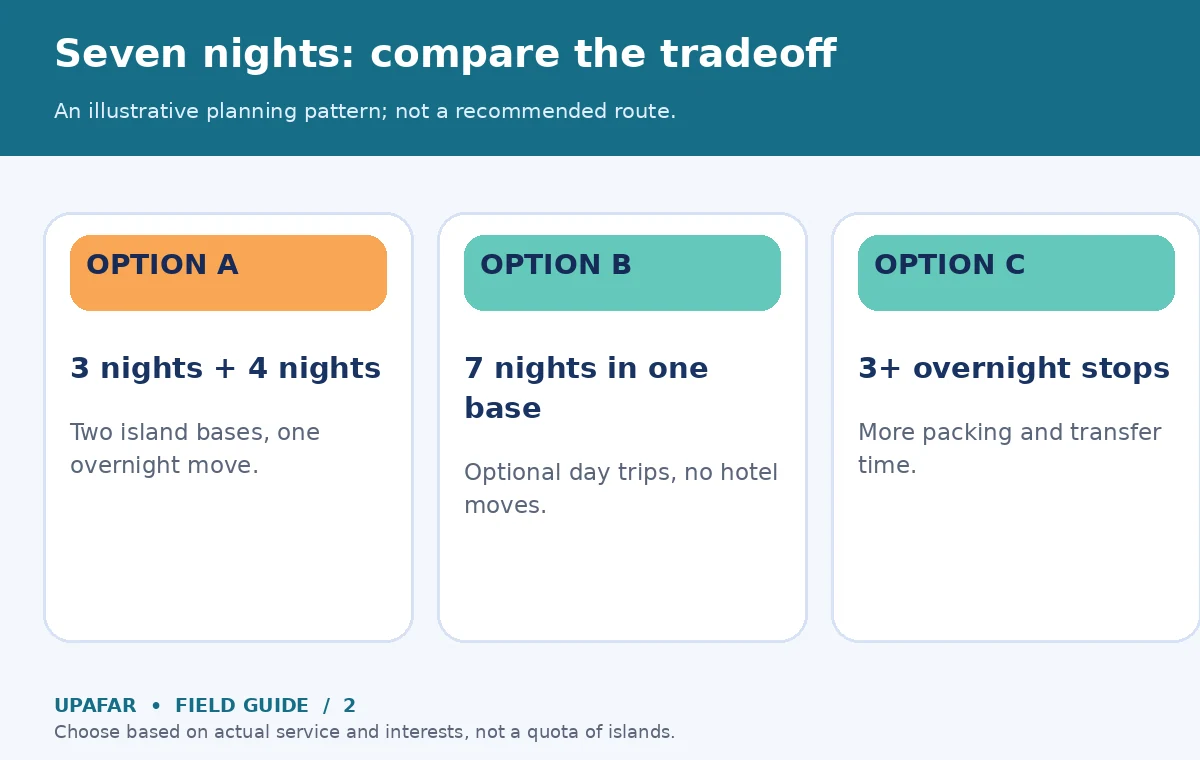
For a seven-night vacation, compare two reasonable structures: two islands with a base of three to four nights each, or one island plus day excursions. Three overnight islands can work when transport is frequent and the traveler actively enjoys moving, but it leaves less recovery time. If you have just three or four nights, a single base may reduce the chance that transfers overwhelm the trip. The right number is determined by connections and interests, not a compulsory island-per-day formula.
Weather and sea conditions change the reliability of small-boat travel. The UK government’s Thailand travel guidance identifies overloading, poor maintenance, and rough seas as hazards for passenger boats; it also notes that monsoon patterns differ across parts of the country. Never generalize one region’s dry season to every island group. Use the local meteorological service, port authority, and current operator notice to decide whether a specific sailing is sensible.
Protect your final connection with a buffer
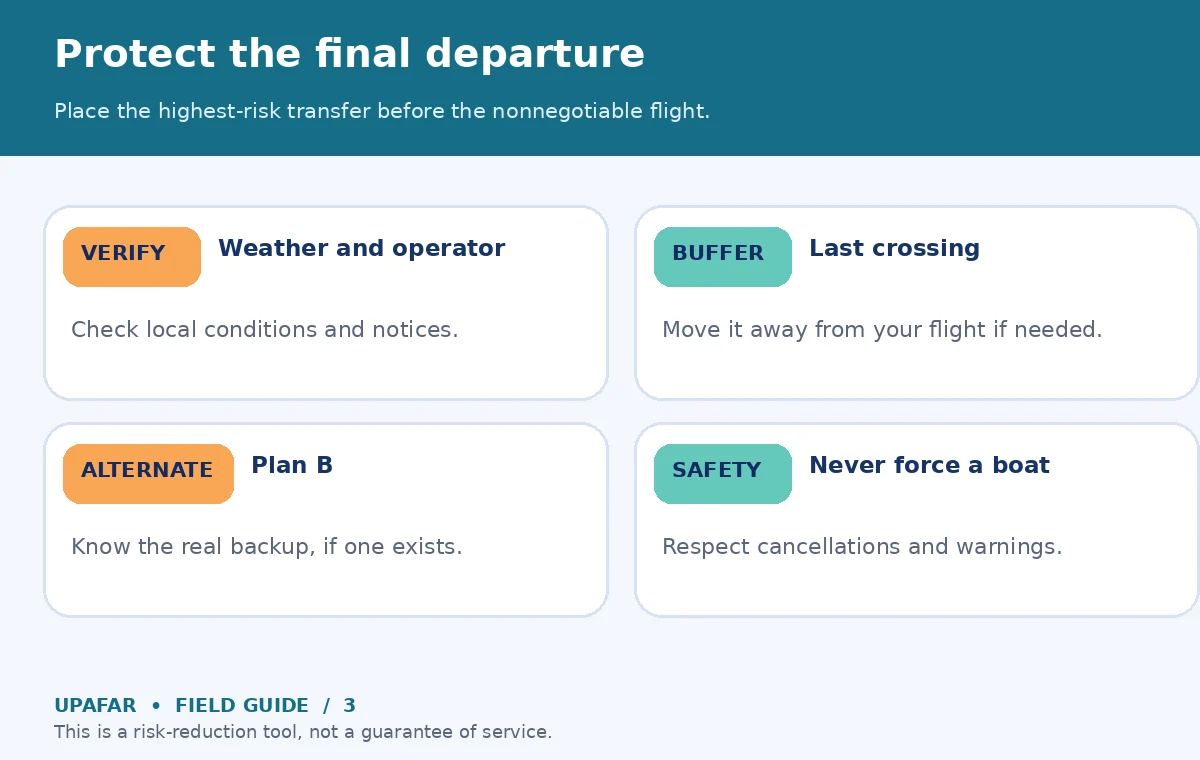
The highest-stakes transfer is usually the last one, when an unreliable boat is followed by a nonrefundable or long-haul flight. Avoid relying on a single final-day sea crossing if missing it would derail the trip. For routes with meaningful disruption risk, consider reaching the mainland or flight-departure island the previous day and keeping flexible accommodation. The size of the buffer depends on operator frequency, seasonal weather, alternate routes, and the consequences of delay; a fixed guarantee would be misleading.
Read the cancellation and refund terms separately for boats, hotels, and onward transportation. A boat operator canceling for weather does not automatically make an unrelated hotel or airline booking refundable. Keep the operator’s contact channel and the location of a suitable alternative port, if one genuinely exists. If conditions are unsafe, follow official warnings and operator decisions rather than seeking an unlicensed substitute vessel. Safety and legal requirements vary by country and vessel.
Pack for boats, not only for beaches
Keep essential medication, identification, water protection for documents and electronics, and a light change of clothing accessible. A soft bag may be easier to move between piers and guesthouses than a rigid case, but bag restrictions can vary by vessel. Confirm luggage limits with the operator, especially on smaller services. A dry bag protects contents from splashes but should not be treated as a guarantee that valuables can be submerged. Pack footwear you can use safely on wet or uneven landings.
Ask the lodging how you will reach it from the arrival port and whether a late check-in is possible. If carrying mobility equipment, a stroller, or heavy baggage, verify the pier layout and assistance rather than assuming an accessible boarding ramp. For a family with young children or travelers sensitive to motion, a larger, more stable vessel and fewer transfers may matter more than minimizing scheduled travel time. Always confirm that the boat has appropriate safety provisions and does not appear overloaded.
Put the booking sequence in the right order
First check climate and the most important connection; then select a small cluster with feasible sailing dates. Reserve the hardest-to-replace segment before choosing every hotel, taking cancellation policies into account. Next, book accommodation near sensible transport and activity locations. Only after those are aligned should you add optional snorkeling, diving, or day excursions. A scenic beach photo does not prove that its nearby harbor is the right route for your onward stop.
For a sample decision: if Island A has direct access from the airport and Island B has limited sailings, base your route around Island B’s confirmed departure day. If Island C adds two transfers without a unique priority activity, leave it for another journey. These labels are deliberately hypothetical; use actual port notices and tickets for the real route. This method produces an itinerary that survives small changes better than one optimized solely for the number of pins on a map.
How We Research Island Connections
We checked government transport information and official destination-access pages, alongside recent government advice on maritime and weather risk, on October 19, 2026. Our original tool is a connection-first worksheet that makes uncertain legs explicit and protects the final flight. This article does not claim any specific current ferry inventory, price, or frequency. Verify the live sailing date and official safety notices for your exact ports before purchasing. We do not represent ferry lines, hotels, or destinations as paying partners. Read the affiliate disclosure for our policy.
Frequently Asked Travel Questions
Two bases or one base with day trips often leave more usable time than moving every day. Confirm frequency and transfer effort before deciding; there is no universal ideal count.
Sometimes, but availability and sailings depend on route, season and operator. Check current official or operator conditions before assuming walk-up seats will exist.
No. Port transfers, check-in, luggage handling and reaching accommodation can take much longer than the scheduled voyage.
It depends on weather, sailing frequency, alternative routes and the consequences of delay. Consider returning to your departure island or mainland at least the previous day on riskier routes.
Only when the extra road, boat or flight transfers are worthwhile and verifiable. A direct-looking map line is not evidence of an actual service.