
Good family travel planning starts with the least flexible part of the day: a child’s sleep, safe transport, feeding or meal needs, and the time it takes everyone to transition between places. Choose lodging and movement first, then add attractions that fit the resulting schedule. A memorable family trip does not require visiting every landmark. The most useful plan is one that still works after a long flight, an unexpected bathroom stop, or an afternoon when nobody wants another museum.
Families differ dramatically: a baby who naps in a stroller, a toddler who needs a reliable quiet window, a school-age child who enjoys hands-on activities, and a teenager who wants independence cannot share one universal itinerary. Use the age bands here as planning prompts, not medical or developmental rules. Check your own child’s needs and any clinician’s guidance, especially for international travel or ongoing health conditions. The objective is to reduce avoidable friction and keep essential safety details from falling through the cracks.
Pick one daily anchor and protect recovery time
An anchor activity is the one thing your family most wants to do that day, such as a zoo visit, a beach morning, a short city walk, or a museum program. Place it when the children are generally most alert and consider the travel required on either side. Everything else is optional. When two anchors are far apart, the schedule often becomes a series of transport transitions with little time at either place. Leaving space for playgrounds, snacks, or a return to the room is useful planning, not evidence of a wasted day.
For infants, identify safe sleep arrangements and feeding supplies before buying attractions; ask the accommodation about crib availability and condition rather than assuming photographs reflect the exact room. For toddlers, prioritize opportunities to move and shorter transitions. School-age children may like choosing between two age-appropriate activities, while teens can help set priorities and understand tradeoffs. None of these are strict age prescriptions; energy and interests matter more than the birthday on a passport.
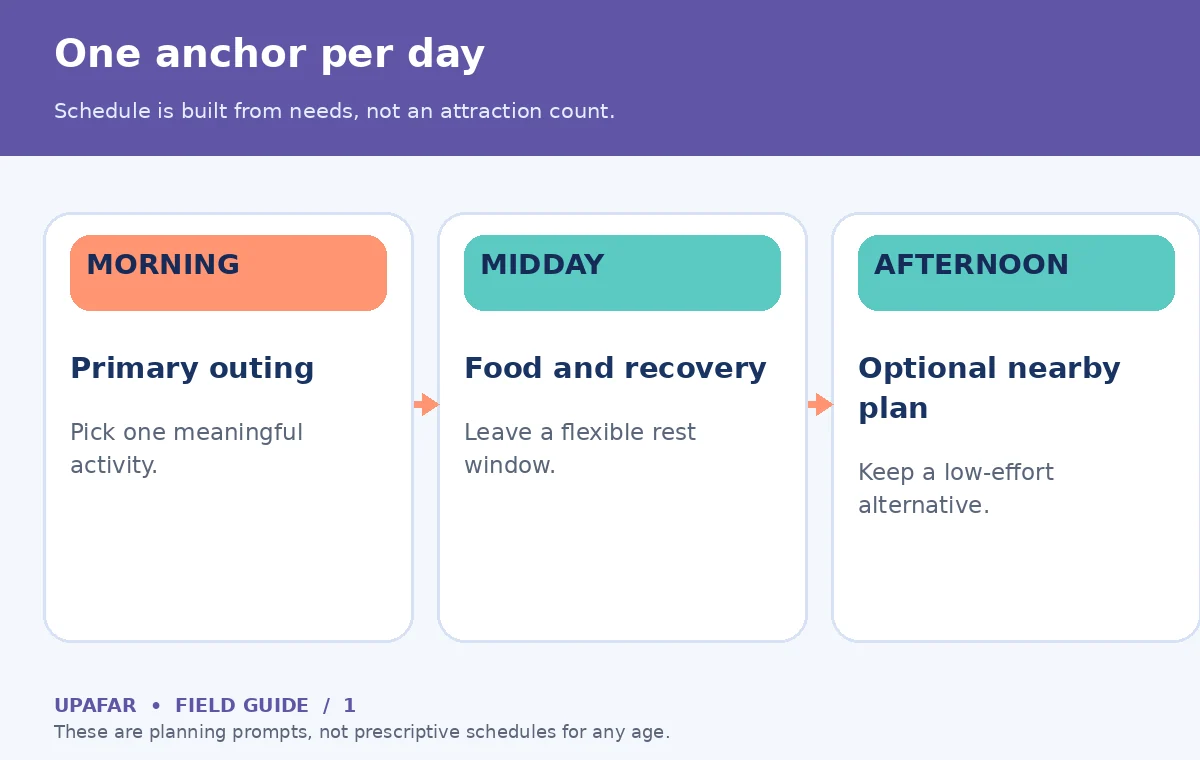
Build each day using a flexible order: morning anchor, food and rest, optional afternoon activity, familiar evening routine. If you are crossing time zones, expect some disruption rather than demanding an instant adjustment. The CDC’s Yellow Book guidance on children traveling notes that time-zone changes and schedule disruption can affect young travelers’ sleep. Plan less on the first day after a long journey and carry comfort items that help children settle in an unfamiliar place.
Work backward from safe transport
Arrange how the family will get from the arrival airport or station to lodging before you land. Verify whether every child can use an appropriate restraint in the vehicle you intend to book; taxis and rideshares cannot be assumed to supply a suitable seat. Check local laws and vehicle compatibility, and avoid scheduling a late arrival followed by a complicated transfer if your family has other options. A short journey with repeated transfers can be harder than a longer direct one when you are managing bags, tired children, and mobility equipment.
The Federal Aviation Administration’s flying-with-children guidance strongly urges approved child restraints for air travel and explains that buying a seat is the way to guarantee an approved restraint can be used for a child under two. The airline must still confirm the device’s labeling, compatibility, and seating restrictions for your particular flight. A lap-infant allowance is not equivalent to the safest restraint recommendation. For road transfers, check an appropriate car seat or booster based on your child’s current measurements and applicable rules.
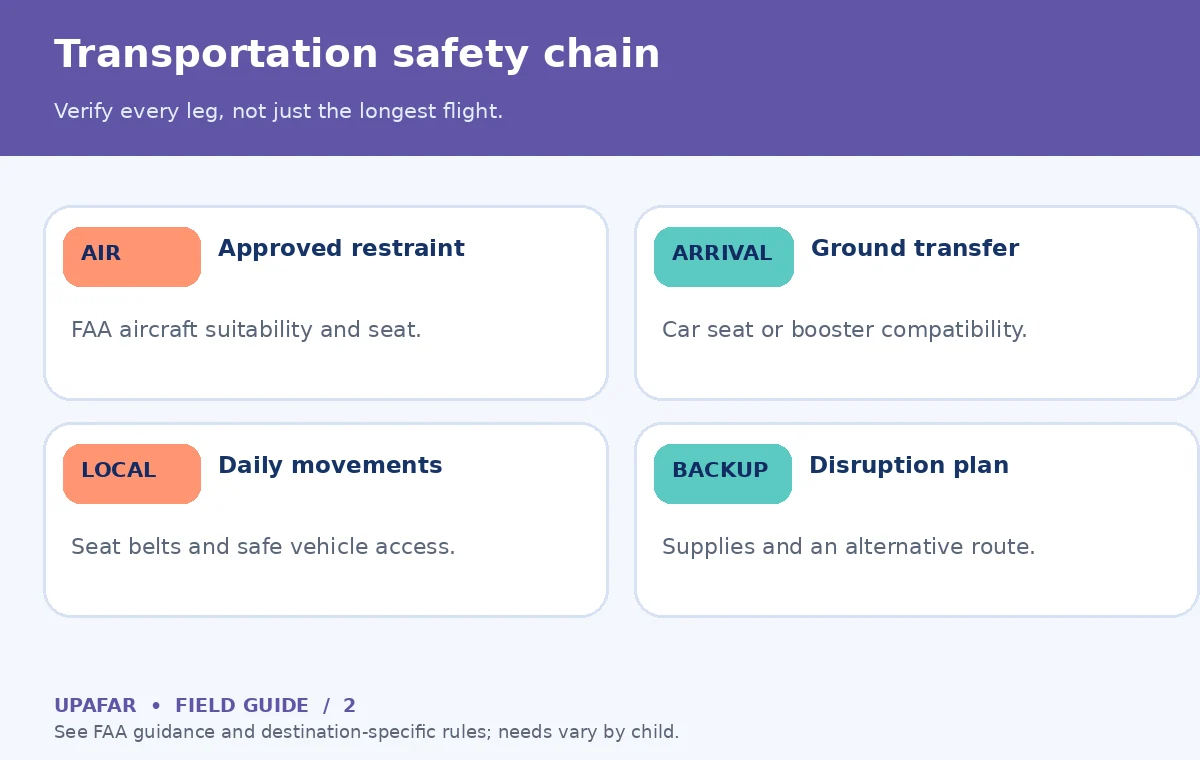
Do not assume a stroller, car seat, bassinet, or accessibility aid is accepted in exactly the same way by every airline. Contact the carrier about baggage treatment, boarding and check-in procedures, and the dimensions of any equipment you plan to bring. Decide what happens if a stroller is checked at the gate and not returned until baggage claim. Keep a carrying option, necessary supplies, and a manageable hand-baggage plan for that possibility. Airport facilities and infant amenities also vary by terminal.
Select lodging by the hours you spend there
Hotel search filters such as “family-friendly” can hide the details that shape a stay. Review sleeping layout, bed and crib arrangements, window or balcony hazards, elevator access, noise, food storage requirements, laundry, and travel time to your daily anchor. A small apartment near a park may beat a larger room requiring long journeys every day. Conversely, a hotel with reliable meals and an on-site pool may reduce the number of logistical decisions when you have younger children.
Consider how parents will spend the hour after children are asleep. If the only room light disturbs bedtime, the layout matters. If meals require a lengthy trip, look for nearby grocery options or suitable on-site food. Families bringing medications that need controlled storage should verify facilities with the accommodation and a clinician or pharmacist rather than assuming a minibar provides dependable medical refrigeration. Always confirm the actual room configuration before paying, because photographs may show a different unit.
Pack in layers for delays and ordinary days
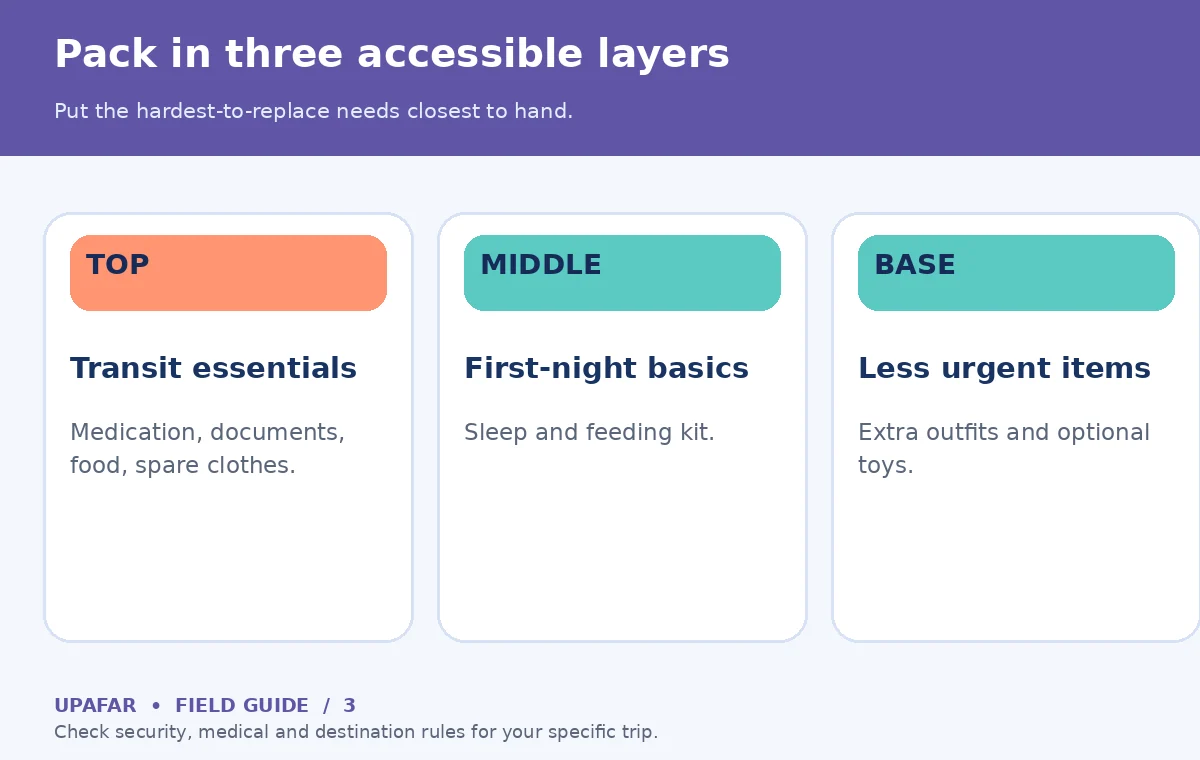
A useful packing method divides belongings into immediately accessible transit essentials, the first-night kit, and everything else. The transit layer holds necessary medications, identification, a change of clothes, wipes or age-appropriate hygiene supplies, snacks where permitted, and entertainment that does not depend on a connection. The first-night layer holds sleep and feeding equipment you will need before unpacking. Place less urgent clothing and spare toys deeper in checked luggage or the main bag.
Check destination-specific health needs well ahead of international travel. CDC’s Family Travel section contains professional guidance and links on traveling with children, while a qualified healthcare professional can advise on immunizations, medication, and individual risks. This planning article does not prescribe medicines or travel vaccinations. Keep prescriptions in original labeled containers when appropriate and verify carrier and country rules. For food or water concerns, use official destination-specific health guidance rather than generic assurances that a place is safe for all children.
Choose plans that can survive a changed day
Before booking activities, mark three levels: must-do, nice-to-do, and replaceable. The must-do item gets a sensible time slot; nice-to-do items fit around it; replaceable ideas are nearby parks, covered spaces, or a relaxed meal. Make the replacement easy by saving locations and transit details offline. A strict sequence of prepaid activities may look efficient on a spreadsheet but leaves little resilience when a child feels unwell or weather makes outdoor plans uncomfortable.
For mixed-age siblings, identify one appealing component for each child without trying to entertain everyone every minute. Divide an outing into a shared first stop and optional short branches only when adult supervision remains adequate. Older children can take part in planning, but safety decisions stay with responsible adults. Give everyone a simple meeting plan if separated and keep emergency contacts available without relying solely on cellular data. The specific safety steps depend on the destination and ages involved.
How We Research Family Travel Logistics
We reviewed CDC Yellow Book guidance for infant and child travel and the FAA’s child-restraint recommendations on October 19, 2026, and compared current family-itinerary search results. Our original planning tool is a dependency-first daily schedule: sleep and transport first, then an anchor activity, then optional extras. This is educational logistics guidance, not individualized pediatric advice. Recheck airlines, child restraint rules, health guidance, and accommodation details for your dates. No lodging or family-travel partner relationship is asserted; read our affiliate disclosure.
Frequently Asked Travel Questions
Start with one must-do anchor and optional nearby extras. Adjust to ages, interests, travel distances, rest needs and the energy of your group.
The FAA strongly recommends an approved child restraint and notes that an airline seat is needed to guarantee a child under two can use one. Verify the device with the airline.
Check the transport available at your destination, local requirements, your child’s fit and the seat’s vehicle compatibility. Do not assume taxis provide an appropriate restraint.
Confirm sleeping layout, actual crib availability, noise, elevator access, safety hazards, meals and the travel time to your main daily activity.
Save a nearby indoor alternative, avoid stacking prepaid activities, keep transit essentials accessible, and protect time for meals and recovery.