
The most dependable way to look for cheap flights is to compare the trip you will actually take, not just the lowest airfare shown first. Search a sensible range of travel dates and airports, look at one-stop and nonstop options, and calculate the full cost after bags, seats, ground transportation, and time. Set a price alert if you are not ready to book, but never treat an alert as proof a fare will fall further. A ticket is good value only when its terms, arrival time, and connections still work for your trip.
Search by Real Flexibility First
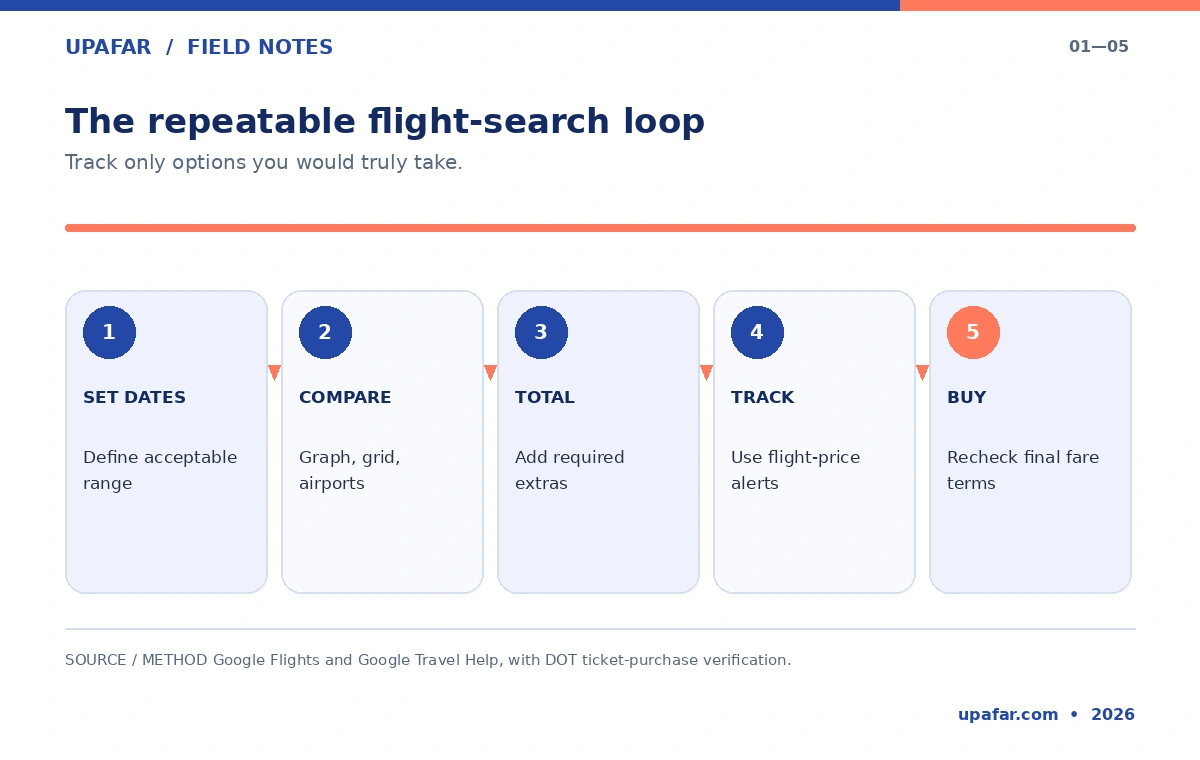
Start with a destination and a range of dates you can genuinely use. Moving departure by a day can be helpful only if the extra hotel night, missed work, or transport change does not erase the saving. Google Flights offers a date grid and price graph for exploring other departure and return combinations. Use those tools as a comparison aid, then check what is included and whether the results match your passengers, cabin, and baggage needs. Nearby airports deserve the same skepticism: the cheaper airport may be farther from the place you intend to stay.
Give the search a fixed shape before opening dozens of options. For example, compare the same party size, a similar departure window, and the same bag requirements across three acceptable date pairs. Record the lowest realistic nonstop and one-stop option for each pair. This removes the misleading effect of a fare that looks cheaper only because it is missing the checked bag you need or lands the next calendar day. If you are planning around a fixed event, prioritize arriving with a sensible buffer instead of stretching flexibility beyond what the trip permits.
Calculate the Complete Door-to-Door Cost
The U.S. Department of Transportation explains that airfare displays include mandatory ticket charges, but optional products such as baggage and seats can vary by ticket type. Therefore compare the actual fare bundle, not the marketing label. For each option, add any needed checked or cabin baggage charges, seat choices your group requires, transport to and from the airports, and an extra hotel night if the itinerary creates one. Include costs that apply only to a specific option, rather than inflating every fare with the same hypothetical fees.
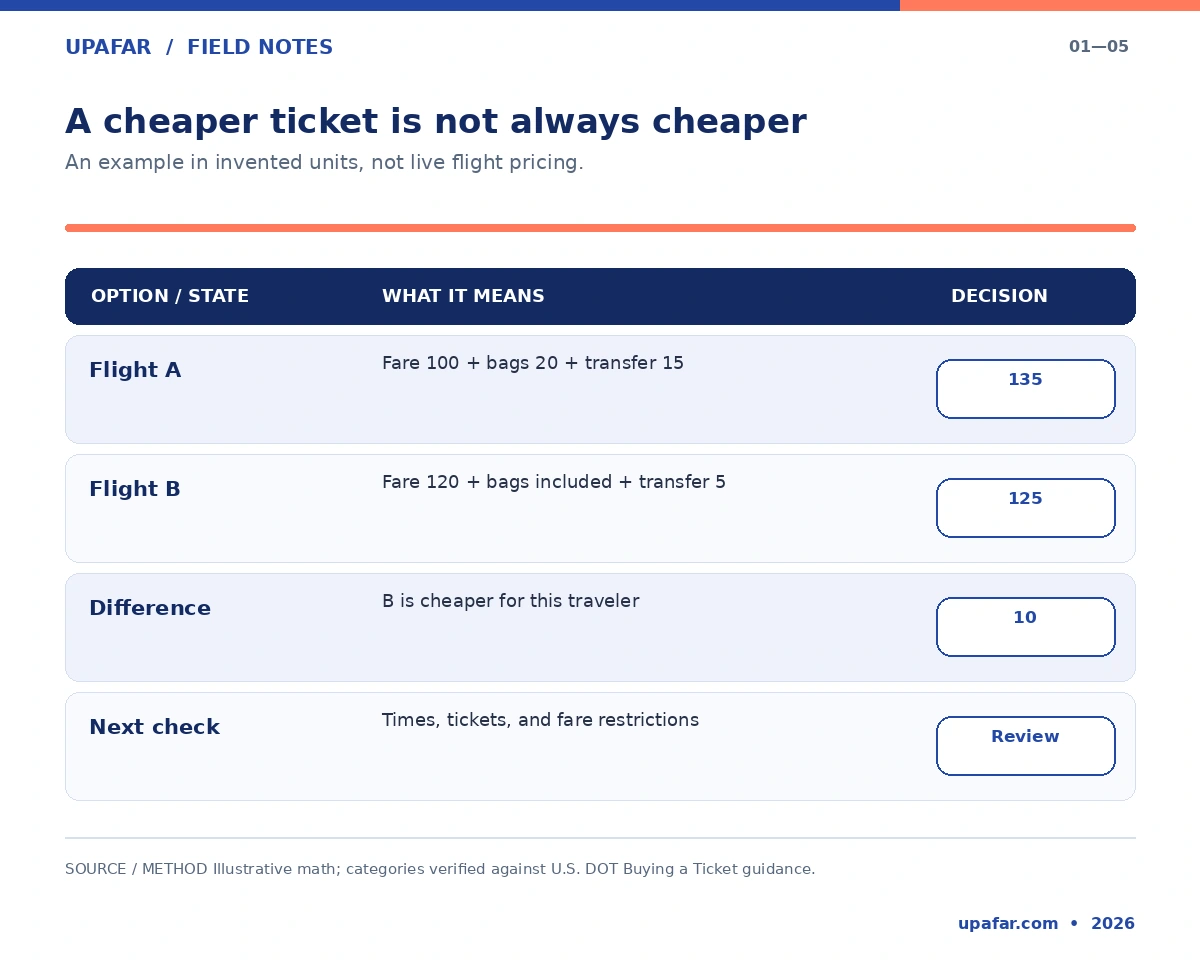
A sample illustrates the logic without pretending to quote live fares. Flight A is 100 illustrative cost units, plus 20 for required baggage and 15 for getting from a remote airport: total 135. Flight B is 120 units, includes that baggage, and uses a nearer airport requiring 5 units of ground travel: total 125. B looks dearer in the search list but is 10 units better for that traveler. Replace the numbers with your live quotes; the example is about arithmetic, not typical baggage pricing or any airline policy.
| Comparison item | Option A | Option B |
|---|---|---|
| Displayed airfare | 100 sample units | 120 sample units |
| Needed bag | 20 sample units | Included in sample |
| Ground travel | 15 sample units | 5 sample units |
| Comparable total | 135 sample units | 125 sample units |
Price the Connection and Arrival Risk
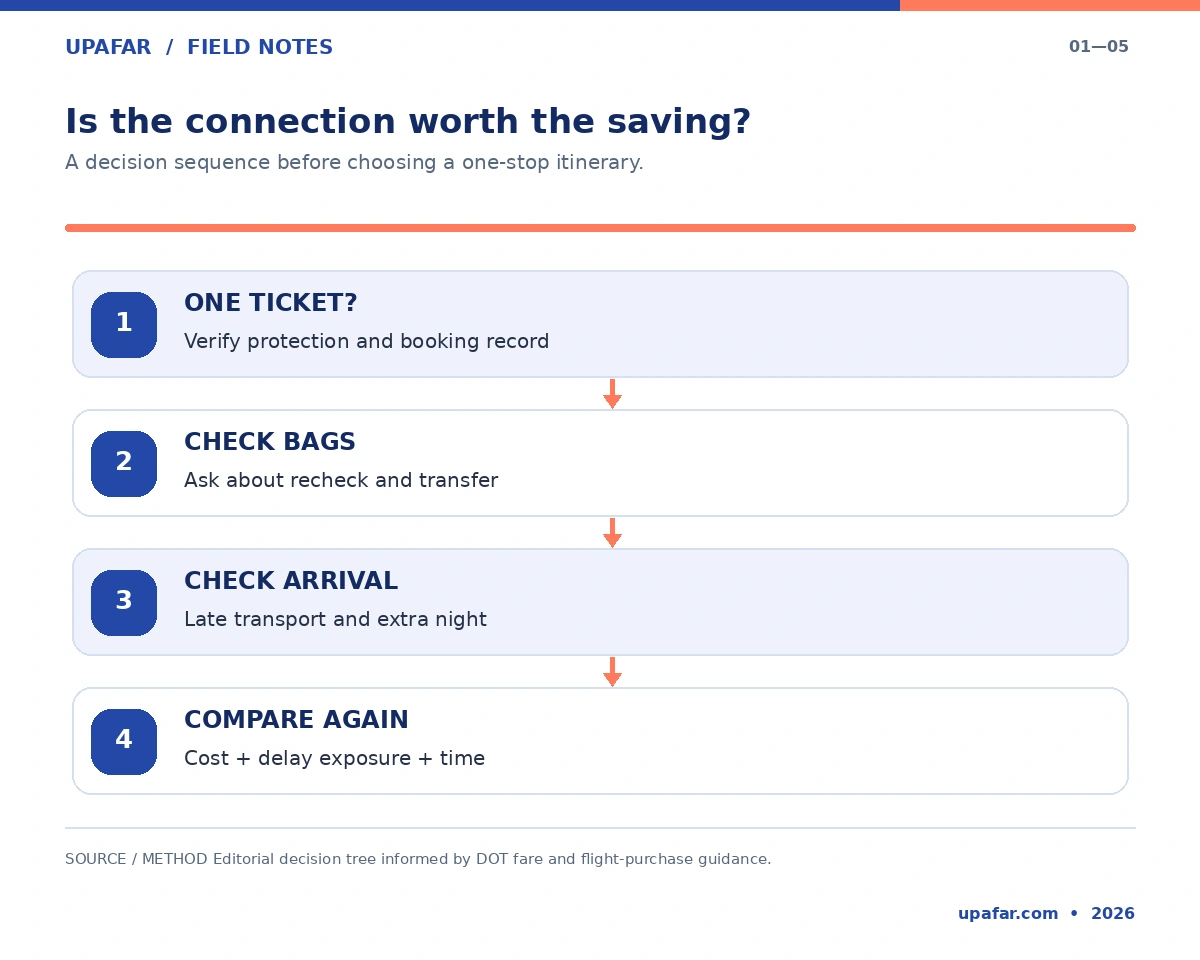
A connection can lower the fare while increasing journey length and disruption exposure. Ask whether the connection is on one ticket, whether you need to retrieve and recheck baggage, and whether a change of airport is involved. A separate-ticket self-transfer can require a very different risk assessment from a protected connection; that specialized topic has its own planned guide. For this initial comparison, avoid choosing a flight simply because a booking engine lists it as possible. Check the actual itinerary, operating airline, connection location, and arrival terminal directly.
Evaluate an arrival as a complete evening or morning, not merely a timestamp. A late flight might save money but leave you with limited public transportation, a longer taxi ride, or little benefit from the first hotel night. A very early departure may require pre-dawn travel or accommodation near the airport. These costs and inconveniences differ by traveler. A business traveler with a fixed meeting may value reliability more highly than a flexible vacationer who can accept another stop.
Use Alerts Without Believing Price Myths
When the route is attractive but the current fare does not fit your budget, turn on price tracking for that route or a specific flight. Google’s support documentation explains alerts for chosen travel dates and an any-dates mode when available. Save the price you observed and the essential itinerary details so later alerts are meaningful. Monitor only routes you would actually book. A notification is a signal to re-evaluate a real itinerary, not an instruction to buy instantly without reading fare rules.
There is no guaranteed magic hour, weekday, or browser mode that will consistently produce the lowest airfare. Prices vary with inventory and demand; broad “best day to book” claims can conceal the far more important question of whether your dates and fare class are workable. The separate Best Time to Book a Flight topic in UpAfar’s queue will address timing-specific evidence. This article instead gives you a repeatable search and comparison process for any departure month. When a price fits the budget and travel constraints, booking can be more rational than chasing an unproven perfect minimum.
Read Restrictions Before Paying
Open the exact ticket terms: changes, cancellations, refundability, baggage, seat selection, airport changes, and the name of the operating carrier. The DOT specifically warns that discounted fare types can have tight restrictions. If buying through an intermediary, know whom you must contact for service issues. If the itinerary includes more than one carrier, verify which carrier operates each segment and how baggage works across the booking. Do not assume the cheapest fare includes flexibility merely because a platform displays a general “free cancellation” banner elsewhere.
Check the airline website against the search result for the exact flight and passenger details. Save the final payment summary and restrictions, especially if the ticket is not refundable. When traveling as a group, confirm that the result really offers the fare for every passenger: a limited number of discounted seats can make a single-traveler search unrepresentative. An accessible fare with predictable arrival, manageable bags, and workable connections may deliver the best total value even when it is not the lowest number on the results page.
Choose the Best Fare for Your Scenario
For the light-packing traveler, a restrictive basic fare may be acceptable after confirming cabin-bag rules. For a family with checked luggage, the bundled fare can win on total cost and convenience. For an event or time-sensitive appointment, nonstop service or longer connection margins may be worth paying for. For an open-ended vacation, changing dates may produce the largest difference without compromising the trip. Make your final decision against the journey requirements you wrote down first, and remember that advertised prices, available seats, and carrier policies change.
How We Research and Keep This Guide Current
This guide separates lasting decision methods from rules and prices that can change. We checked the following primary sources on October 19, 2026: Google Flights fare-comparison tools (date grid, price graph, nearby date exploration and tracking); Google Travel price-tracking Help (setting route or flight price alerts for specified dates or flexible dates); U.S. DOT Buying a Ticket (fare restrictions, baggage fees, optional services and ticket-purchase comparison). Examples and visual decision tools are editorial frameworks, not live quotes or guaranteed offers. Recheck operators, carriers, airports, and government requirements for your exact trip. UpAfar may earn a commission on qualifying links if relationships are activated; our affiliate disclosure explains how referrals are handled. No booking prices or availability are asserted here.
Frequently Asked Questions for This Topic
Sometimes, but add transfer expense, travel time, and the availability of ground transport before deciding.
No. Alerts report price movement; inventory and prices can rise as well as fall.
Choose based on all-in cost, arrival practicality, baggage needs, fare terms, and schedule reliability.
Not necessarily. Allowances and optional charges vary with the airline, itinerary, and fare class; check the applicable carrier rules.
No single booking day guarantees the best price across routes. Compare workable travel dates and fares rather than depending on a universal calendar trick.