
There is no calendar day that guarantees the cheapest airfare. The useful answer to “When is the best time to book a flight?” is to combine route-specific price history with your departure date, flexibility and the cost of waiting. Google’s October 5, 2026 U.S.-origin flight analysis reported historical average lows around 39 days before domestic trips and 89 days before international trips—but averages are not a ticket-price forecast for your specific flight. This article explains when to buy, when to monitor and how to avoid false certainty.
Read the 2026 timing data with its limits
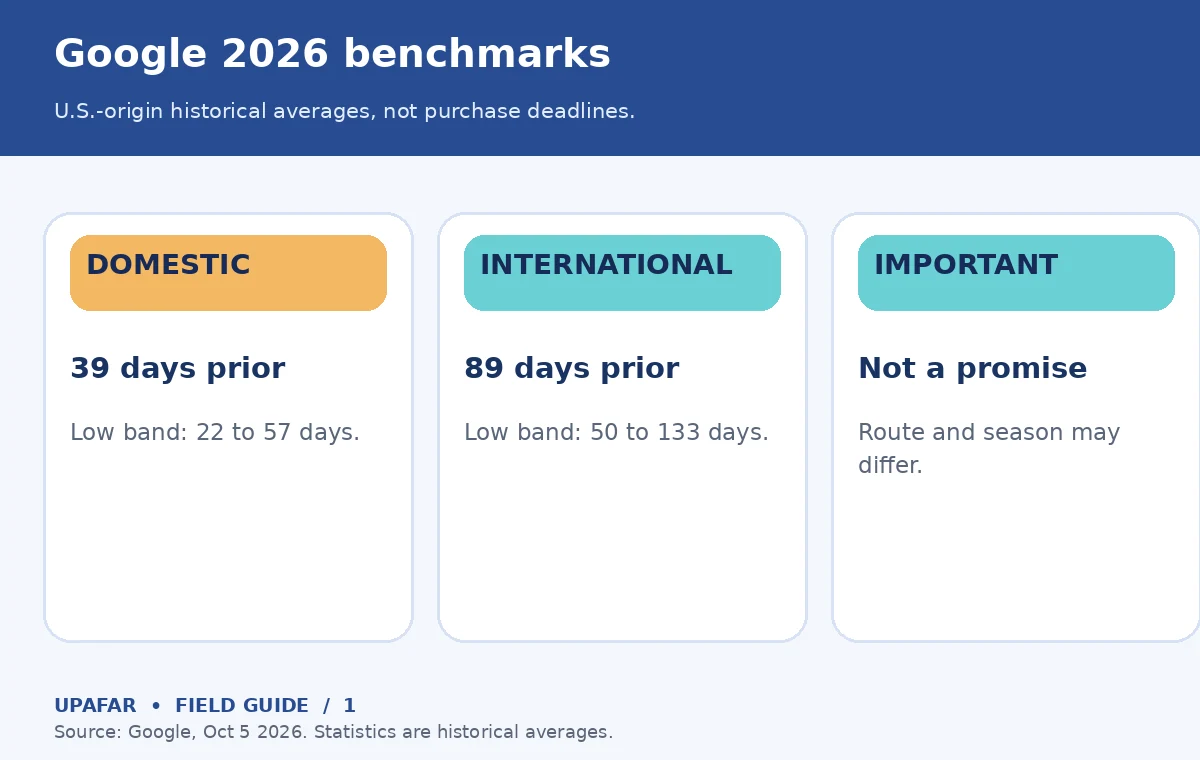
For domestic U.S. travel, Google reported a low-price range of 22–57 days before departure, averaging 39 days. For international trips from the U.S., the average low was 89 days, within a wider 50–133-day range that showed relatively little average price difference. Google recommended booking international trips relatively early, rather than holding out for a single theoretical lowest day. These figures describe patterns across searches and bookings in Google’s data, not a promise of any available fare, and they can differ by origin, holiday, season and destination.
The same analysis gave different averages for major seasonal periods: Thanksgiving around 34 days, Christmas around 56 days, March–April spring breaks around 50 days and July–August summer trips around 21 days before travel. These are descriptive averages for the report’s U.S.-origin scope, not a recommendation to wait until three weeks out for every summer route. The practical lesson is that the shape of demand changes between ordinary weekdays and peak school or holiday departures. A tight event schedule may justify booking earlier even when a broad data set suggests waiting.
Decide whether flexibility or certainty matters more
Start with three questions: Can you change your departure date by a few days? Can you use alternative airports without making the ground trip miserable? Would losing the desired flight force you to miss an event or pay for extra lodging? If you can be flexible on two of these, monitoring prices may be sensible. If none can change, treat an acceptable full-cost fare as the trigger to buy instead of gambling for a perfect statistical minimum.
For a wedding or cruise embarkation, arriving late can be more expensive than a modest airfare difference. A nonstop itinerary may be worth paying more for than a tight connection; the value depends on your circumstances, not a universal hourly price. With leisure dates and multiple viable departures, take advantage of price tracking and compare a range of days. Do not define your budget solely by the cheapest displayed base fare if the cheapest ticket excludes a bag or desirable departure time.
Build a five-minute booking decision grid
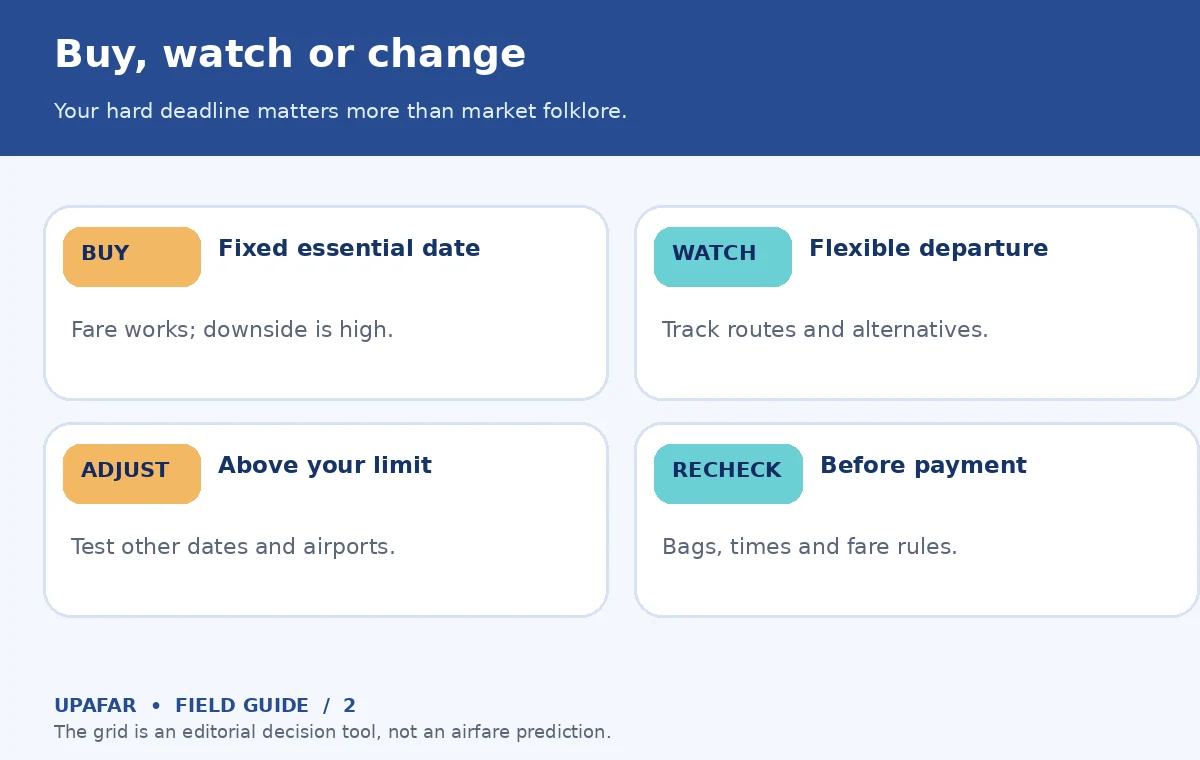
Write the current total price, maximum comfortable price, days until travel, refund or change conditions and your flexibility. Then choose one of three actions. Buy when the fare fits the budget and the timing is essential. Monitor if dates and routing are flexible and you are not nearing a hard event deadline. Adjust the search when the available fare is too high: look at adjacent dates, alternate viable airports or a different itinerary length. You do not need to know the future price to make a disciplined decision.
One example: a traveler going to a fixed Saturday ceremony has few acceptable arrival flights and a high downside to missing the date. That traveler may book well before the historical domestic low window. A second traveler planning a flexible week of sightseeing might track several departure days, compare nonstop and one-stop options, and act when the full ticket price is acceptable. These examples show decision logic, not predictions about specific airline inventory.
Use price history and alerts, not booking-day myths
Google Flights describes route-specific historical price information when its data is sufficient and offers price tracking so you can follow changes instead of checking constantly. In its earlier product explanation, Google notes that the interface can characterize current prices as low, typical or high compared with past averages on similar routes. If historical data is missing, do not treat an unexplained third-party price “score” as a proven signal. Set alerts for one or two valid routes and confirm all assumptions when an alert arrives.
The claim that buying on a particular weekday always lowers the fare confuses the day of purchase with the day flown. Airline revenue management, competition, booking class availability and schedule changes can outweigh weekday folklore. It is reasonable to compare Tuesday or Wednesday departures if your travel dates permit; it is not evidence-based to assume you must click Purchase on Tuesday. Likewise, repeatedly clearing cookies does not replace comparing actual fares with taxes, baggage and acceptable travel time included.
Check the entire ticket before using a low price
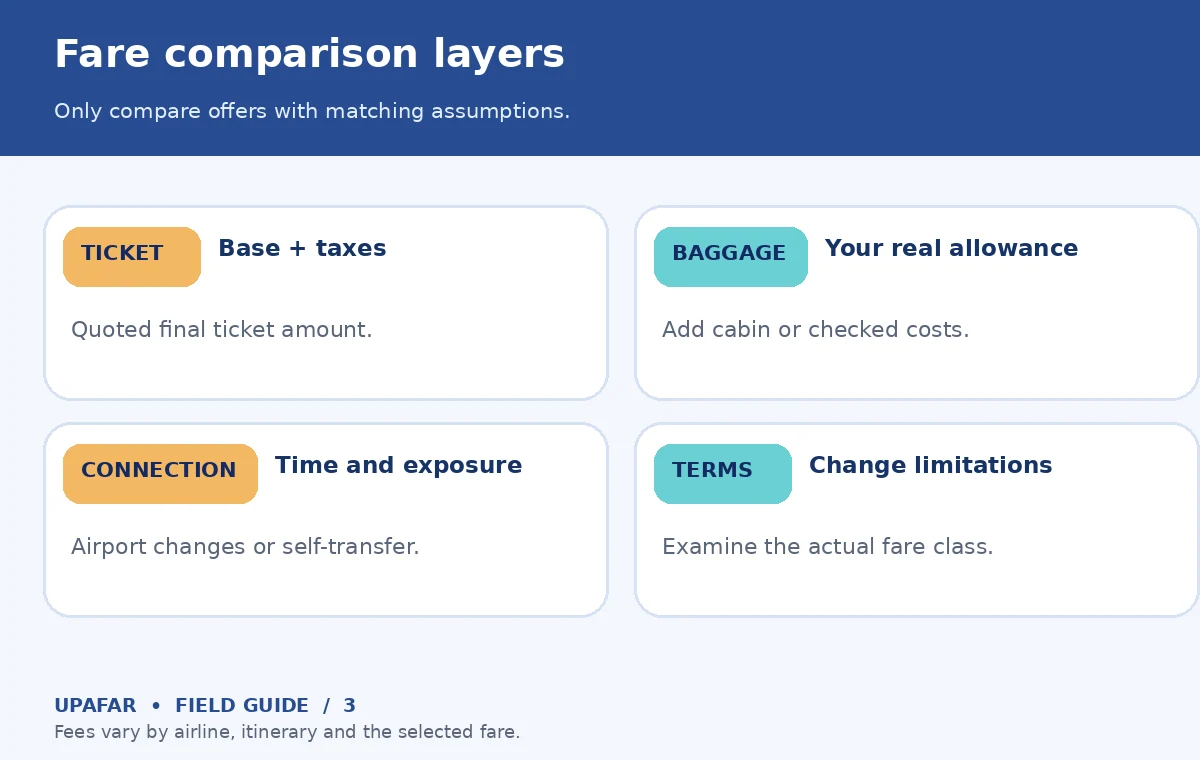
Two itineraries with the same base price can produce very different trips. Compare baggage entitlement for each segment, airport changes, connection risks, seat selections, schedule, refund conditions, separate-ticket exposure and the ground cost at both ends. On a separate-ticket connection, a delayed first flight may not give you the same protection as connecting legs sold under one booking; confirm the terms with the operating carriers. Treat the last flight of the day as a separate risk when an onward train or event depends on timely arrival.
If a flight is displayed through a reseller, read who issues the ticket and who handles changes. For international trips, inspect whether a routing requires different entry or transit permissions. A lower fare that introduces an overnight airport change may be the more expensive choice after food, transport, lodging and time are accounted for. Build an all-in comparison using the exact same assumptions across contenders. Do not present an airfare saving as verified until you have an actual comparable quote.
Know when you should stop waiting
Create a deadline that reflects your trip, not an online countdown. A useful stopping rule is: purchase when a suitable itinerary is below your pre-set maximum and the downside of losing the departure outweighs the possible discount. If the trip becomes impossible without a specific flight, switch from monitoring to securing a viable itinerary. This avoids watching prices indefinitely while capacity declines, and it reduces impulse booking on the strength of a flashing percentage-off badge.
After purchase, save the complete fare conditions, passenger names, ticket numbers and baggage rules. Recheck schedule changes through the airline’s official channels. If your fare permits cancellations or credits, understand their limits before changing plans; consumer protections and airline policies differ by jurisdiction and itinerary. A good booking decision is not necessarily the absolute cheapest flight someone else later sees—it is a defensible choice given your constraints and the information available at purchase time.
How We Research the booking-window numbers
We reviewed Google’s October 5, 2026 2026 analysis alongside Google’s product explanation of route-specific booking insights and price alerts on October 19, 2026. We distinguish descriptive historical averages from traveler-specific guarantees and make no claim to have checked live fares for a route. Our decision grid is UpAfar’s planning method, not a prediction algorithm. Supplier policies and live prices require separate verification. We do not claim an airline partnership; see our affiliate disclosure.
Frequently Asked Travel Questions
No fixed purchase weekday guarantees the cheapest ticket; monitor fares for the actual route and compare feasible departure dates.
Its October 2026 historical analysis reported an average low 39 days before departure, with a 22–57-day low-price range. It is not a guarantee.
No. The 89-day figure is an average from Google’s U.S.-origin data. Availability, dates and the consequences of waiting can justify buying sooner.
No. Alerts notify you of changes; they do not reserve a seat, lock inventory or promise a quoted fare will remain available.
Compare baggage, refund rules, transfers, travel time, acceptable arrival dates and separate-ticket risks to establish the full cost.