
An all-inclusive vacation can make day-to-day spending predictable, but it does not automatically cover the whole trip. The smart comparison is between the total vacation cost and how you actually want to spend your days, not just between resort rates. Start with flights, airport transfers, the exact room and guest count, usable meal options, activities and the costs of leaving the property. This guide evaluates the complete vacation design; our separate all-inclusive resort guide focuses on choosing a particular type of property.
Compare the full trip instead of a resort rate
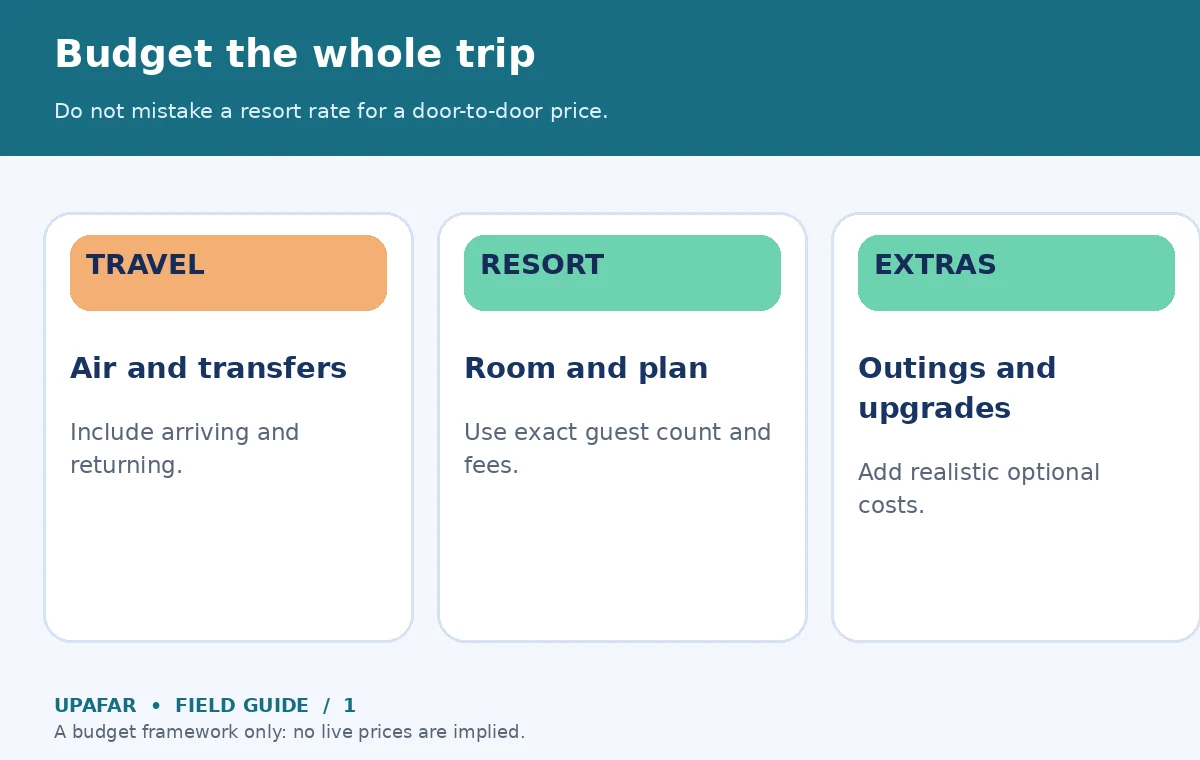
Break the budget into five buckets: getting there, accommodation and the included meal plan, optional upgrades, outside-the-resort activities, and disruption or contingency costs. Getting there includes airfare, checked bags, road transfers and any overnight hotel. The accommodation bucket includes the exact occupancy, room type, taxes and mandatory fees. Upgrades could include premium dining, spa services or a different room category. Off-property costs cover excursions, independent restaurants and transport. The contingency bucket is for changes or costs that are realistic but not yet committed.
Ask for the total price for your traveler mix, particularly if children or extra adults will share the room. A “per person” offer can conceal room occupancy requirements or exclusions. Marriott’s official all-inclusive guidance, for example, says its relevant rates depend on guest count and children’s ages, while amenities and premium exclusions vary by property. That is evidence about one brand’s terms, not a universal definition of all-inclusive holidays.
Audit the actual inclusions before you compare
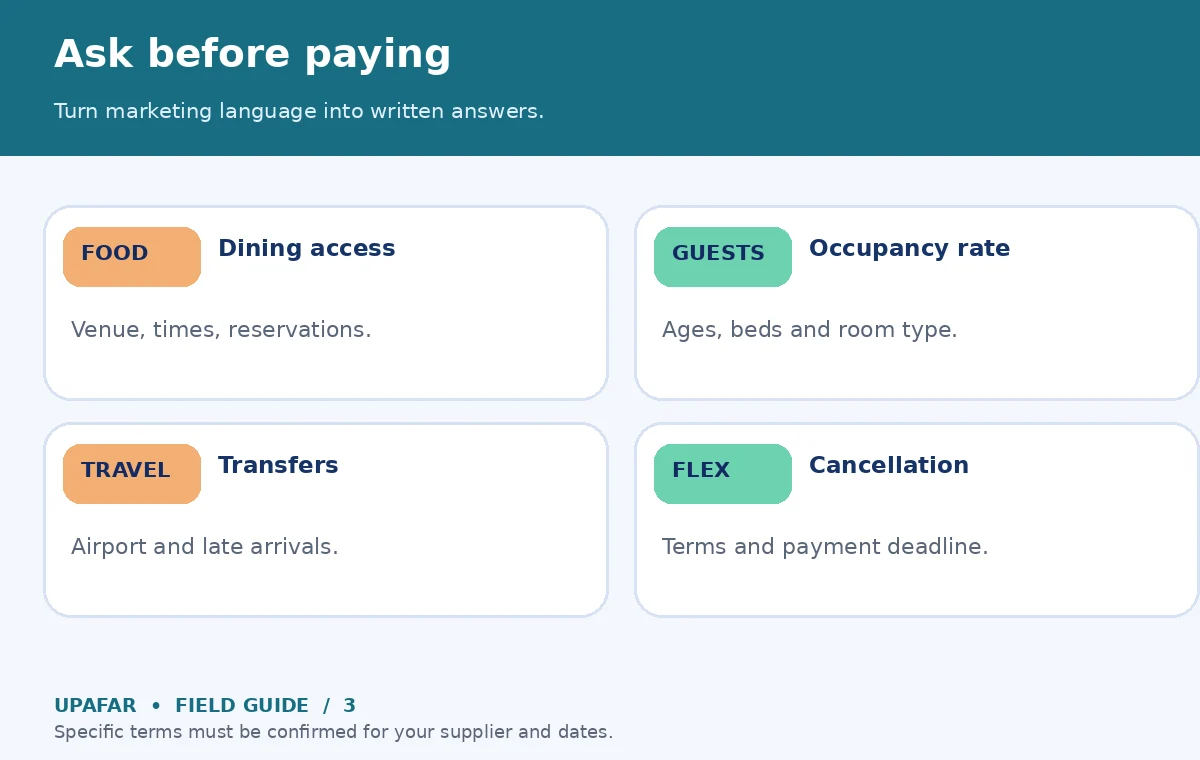
Confirm meals and opening hours, whether reservations are needed for special restaurants, beverage types, room service, child dining, activity calendars, Wi-Fi and any gratuity rules. Do not assume the label means unlimited access to every outlet or class. Ask whether food is available at the hours your flight and daily routine will require. If you have dietary or accessibility needs, get a usable explanation from the actual property, not a generic amenities symbol.
Marriott’s all-inclusive overview illustrates the difference between a base package and off-plan expenses: its stated offering includes rooms, food and beverages and certain resort activities, while services such as transport, excursions, spa treatments and selected food or drinks can cost extra. Another operator may package these differently. A good comparison spreadsheet has an explicit “included / extra / confirm” column for each item; unknown is not the same thing as free.
Choose your resort time versus exploration time
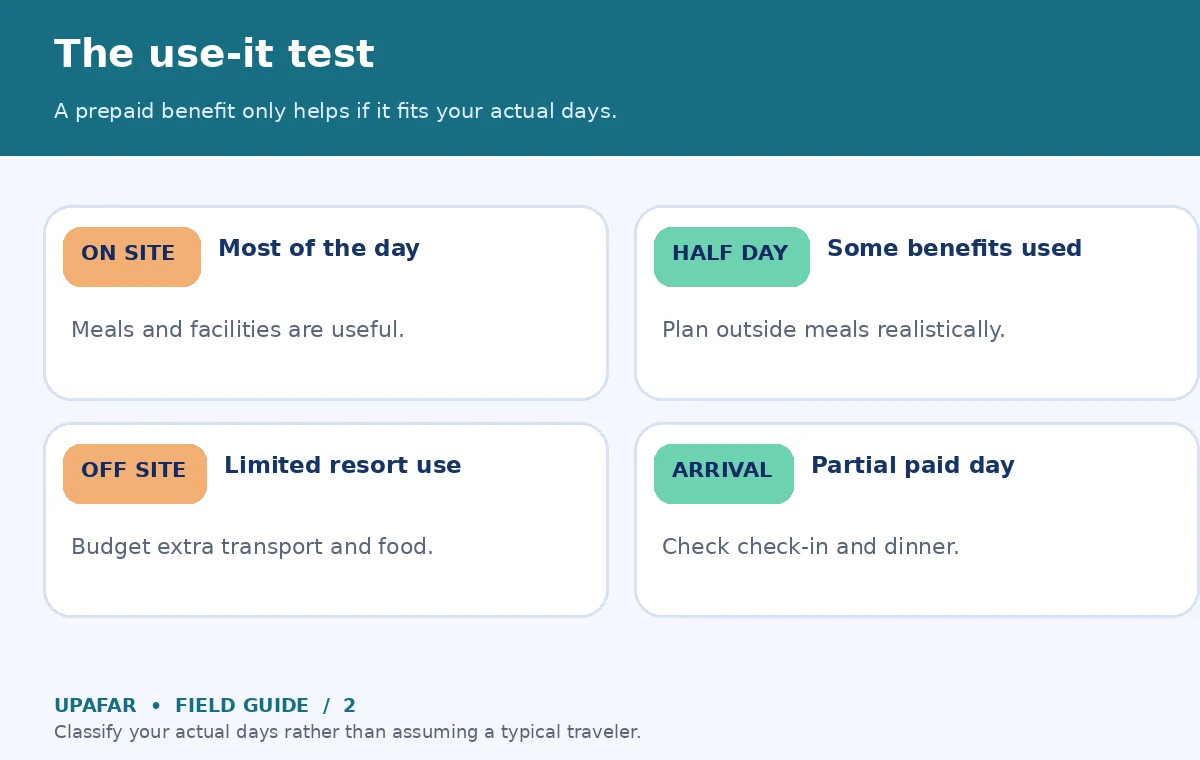
The economics change with behavior. If the resort is the destination and you plan to eat most meals there, the package may replace spending you would otherwise make. If you want long museum days, food markets and frequent outside excursions, the prepaid meal plan may go unused while your transport and restaurant bills increase. Make a simple day-by-day sketch: resort day, half-day trip, full-day trip or travel day. Then count the meals you will realistically consume on-property—not the maximum you could theoretically receive.
Imagine two equally priced seven-night offers. Traveler A wants the beach, easy meals and a predictable evening schedule; Traveler B wants three long independent excursions and local dining. Traveler B should explicitly budget additional transport and meals and may find a room-only alternative more efficient. Neither style is superior. The UVU is the use-it test: treat included benefits as valuable only if they match activities you will actually use, at the times you will be present.
Test transfers, arrival hours and departure day
Airport transfers are among the easiest inclusions to misunderstand. Look for an explicit statement of whether a shared or private transfer is included, the specific airport served, operating hours, booking steps and whether a child restraint can be supplied if needed. Calculate the real door-to-door journey, especially when a resort is far from the airport. Ask what happens after a late landing and how early departure might affect the last breakfast or a prepaid excursion.
On travel days, an overnight stay may deliver fewer usable resort hours than the nightly rate suggests. A five-night booking might include four full days plus two partial travel days. If the property charges for late checkout or access outside room hours, confirm the policy ahead of time. If your primary goal is to explore a nearby region, locate the resort in relation to those activities rather than assuming every beach destination has simple public transportation.
Read cancellation and fee terms carefully
Price comparison requires the same cancellation deadline, payment date, occupancy and add-on structure. A package sold by a third-party organizer may have different alteration rules from a room booked directly with a resort, even when both use the phrase “all-inclusive.” Capture the written booking conditions and refund method before paying. Ask who handles a flight disruption when flight and hotel are purchased separately, and whether an advertised bundle is one contract or several distinct bookings.
For short-term lodging prices advertised by businesses covered by U.S. rules, the FTC’s fee-disclosure rule requires certain mandatory charges to be reflected in upfront totals, with limited exclusions. That rule is not a global price guarantee or an assurance that optional extras vanish. Still read the checkout summary, check local taxes and identify which charges are collected at the property. When a line item is unclear, ask for the cost in writing rather than betting on marketing language.
Score the vacation against your travelers' needs
Use a quick six-part scorecard: (1) truly payable trip total; (2) number of included meals and activities you will use; (3) airport and excursion travel friction; (4) lodging suitability for your actual party; (5) cancellation flexibility; and (6) independent access to the destination. Assign each criterion a weight based on your group. Families may value convenient early dinners and safe room arrangements more than nightlife. Adults traveling mainly for diving may prioritize dive-center access and actual equipment or instruction terms.
A package that wins on room rate but fails on transfer access or usable amenities should not automatically win the trip. Conversely, a slightly higher property price can be rational when it removes repeated transport journeys and a pile of uncertain meal charges. Keep the score as a private decision aid, not a pseudo-scientific hotel rating. We have not inspected rooms, verified live package availability or ranked any resort brands for this article.
How We Research complete vacation costs
We reviewed Marriott’s published all-inclusive inclusions and exclusions and the FTC short-term lodging price-disclosure guidance on October 19, 2026. We use the published terms as examples of questions a traveler should ask, not as proof that another operator follows the same rules. Our “use-it test” and budget buckets are editorial planning methods; all live quotes, airport-transfer arrangements, food access and room capacity must be checked with the seller for your dates. We claim no resort partnership, and any future monetization is subject to our affiliate disclosure.
Frequently Asked Travel Questions
No. Some offers are resort-only and some are flights-and-hotel bundles; confirm the written components of the exact offer.
No. Transfer coverage is supplier- and package-specific. Verify the airport, time window, vehicle, luggage and cost in writing.
Not automatically. Off-property trips, motorized activities and specialty services can carry separate charges; check the operator’s inclusions.
Not necessarily. It depends on the complete trip cost and how many included meals, activities and resort hours you will use.
Use the total for your exact guest count, ages where relevant, room, dates, fees and cancellation terms so the offers are comparable.