
An all-inclusive resort sells a stay with a bundle of meals, drinks, and sometimes activities or services. The label does not mean every restaurant, excursion, transfer, child-care service, or premium drink is included. What matters is the specific booking package for your resort, dates, room, and guests. Before paying, compare the written inclusions against what your party will actually use, and record exclusions separately. This guide explains how to audit the package itself; a separate UpAfar article is planned for choosing between resort locations and property types.
Start With the Written Package Definition
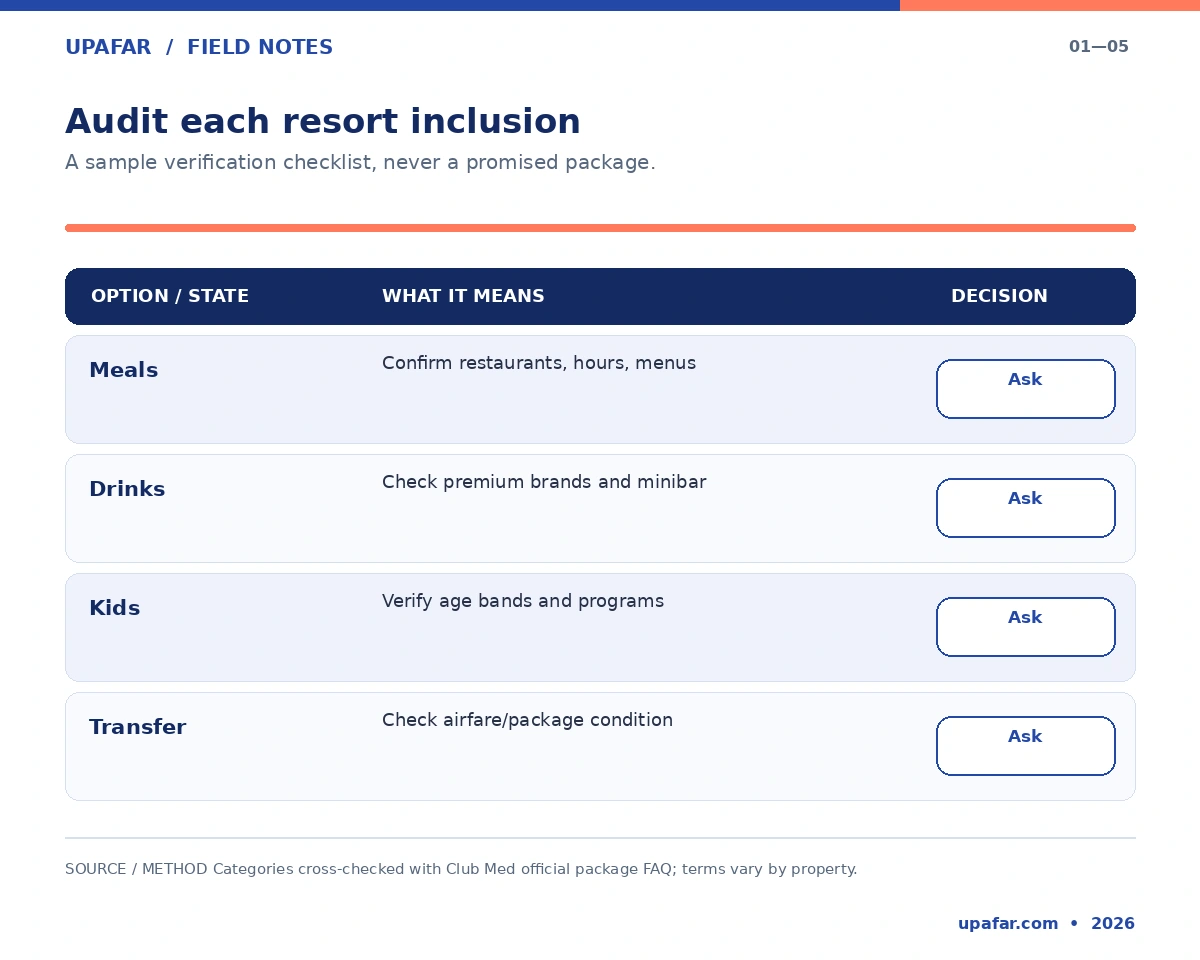
Do not begin with a list of resort amenities. A property can advertise a spa, specialty restaurant, swim-up bar, sports instruction, and airport transfers while charging separately for several of those services. Instead open the package terms for your room and rate. Check which meals and drinks are covered, whether reservations are needed, which restaurants are included, and whether limits apply to particular hours or menus. Then identify any admission, instruction, equipment rental, or reservation charges for experiences that influence your choice. Different seasons, room tiers, and promotions can carry different conditions.
Club Med offers a useful real-world example of why reading the terms matters. Its official FAQ lists accommodation, food, drinks, and some activities in its package, but also describes premium beverage exclusions, age-dependent children’s club conditions, and transfers included only in certain airfare-booking circumstances. Those statements apply to the operator’s specified products, not to all resorts worldwide. The broader lesson is to treat the term “all-inclusive” as a reason to ask precise questions rather than as a universal contract.
Separate Inclusions From Optional Extras
Create three columns: confirmed included, additional charge, and not yet confirmed. Put every meaningful part of the vacation somewhere: meals, snacks, drinks, minibar, dining reservations, activities, equipment, children’s programming, entertainment, internet, transfers, gratuities, and departure-day use of facilities. A service should only be marked included when the booking page or operator has stated that for your exact rate. “Available onsite” is not evidence that it is free. Asking questions in writing reduces surprises and gives you something specific to reference if the booking description later seems different.
When comparing dining benefits, distinguish an included restaurant from a restaurant with an included basic menu and paid upgrades. Verify dress requirements and reservation rules if a special meal is important. For activities, ask whether the advertised class includes required equipment and whether capacity limitations apply. Parents should check ages, supervision periods, and additional costs instead of assuming all childcare is included. This is especially important if one adult is planning to work or participate in an activity while the children are occupied.
Compare Package Value by Actual Usage
The easiest mistake is valuing every listed amenity as if you intend to use it. A traveler spending most days sightseeing outside the resort may get little benefit from prepaid midday meals and daily onsite activities. Someone who prefers long pool days and predictable dining may value the same bundle much more. Take the booking total, add transport, unavoidable charges, and the paid extras you realistically expect. Then compare it against the realistic price of a room-only alternative plus meals and activities you would buy anyway. Do not count hypothetical free cocktails you do not want as savings.
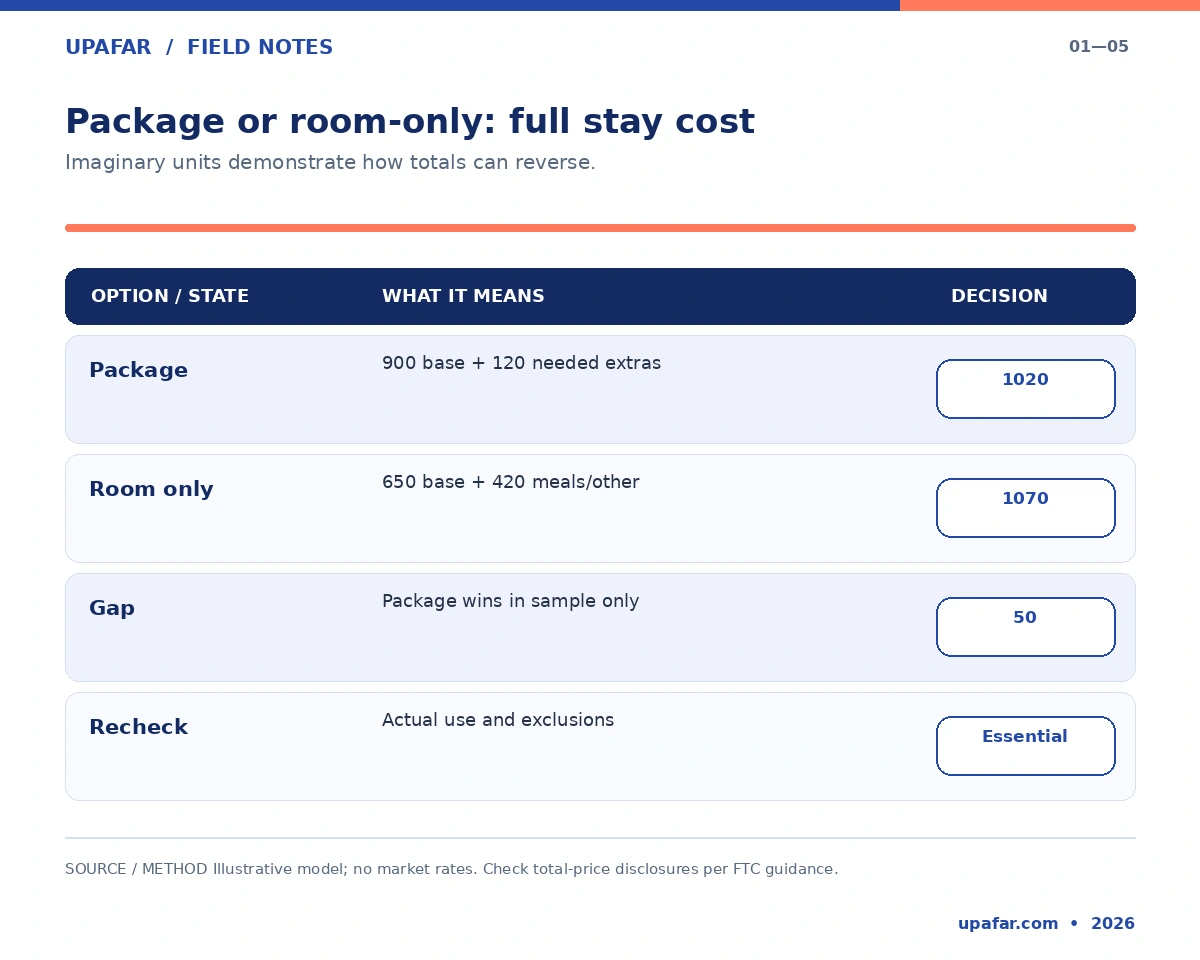
Here is an intentionally simplified example in arbitrary units. A resort package costs 900 units for the stay and likely paid extras add 120, making 1,020. A room-only alternative costs 650; expected meals, activities, and transfers add 420, making 1,070. The resort is ahead by 50 only for those assumed usage patterns. If the party eats away from the property each day or needs several premium excursions, the result can reverse. Recalculate with your own booking terms and itinerary; this is not a market price comparison.
| Example comparison | Package stay | Room-only stay |
|---|---|---|
| Initial stay charge | 900 example units | 650 example units |
| Needed extras | 120 example units | 420 example units |
| Illustrative total | 1,020 example units | 1,070 example units |
| Outcome | 50 units lower in this scenario | May win with different actual usage |
Read the Total Price and Cancellation Terms
In the United States, the FTC’s unfair or deceptive fees rule addresses upfront disclosure of the total price for covered short-term lodging when prices are advertised, including many mandatory charges known and calculable in advance. The rule does not ban every fee or make optional purchases free. Taxes or certain other excluded charges may be disclosed separately under the rule’s conditions. Because laws vary by place and booking channel, use the operator’s final quote and full payment breakdown rather than assuming the U.S. rule describes every international resort offer.
After checking the displayed total, identify the deposit, remaining payment date, change policy, cancellation deadline, and refund route. Find out whether booking flights together changes your protections or transfer inclusion. Consider whether weather, accessibility, medical needs, or a changing group size make a flexible rate worthwhile. Compare equivalent occupancy and room categories; a family room with two adults and two children cannot reliably be compared with an entry-level rate shown for two adults. Read confirmation details again after purchase so the promised inclusions match what was booked.
Ask the Resort Five Specific Questions
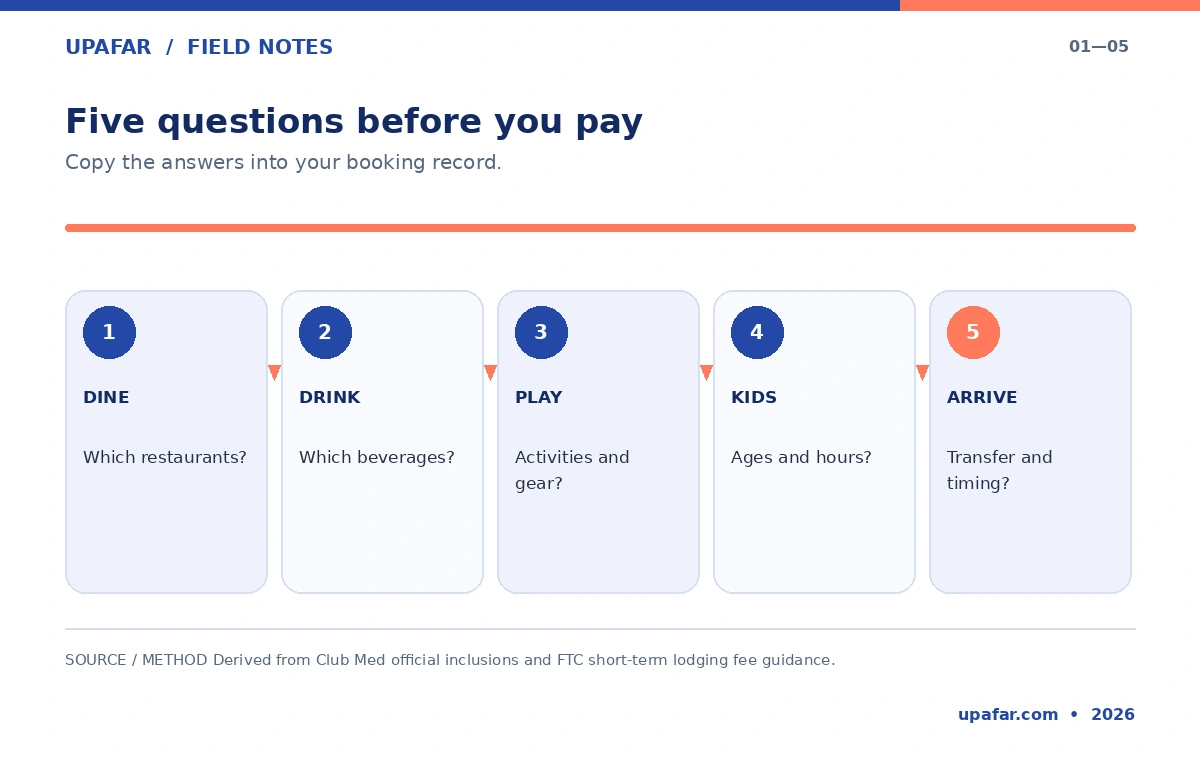
First, which restaurants and menu items are included for the actual rate code? Second, are drinks, minibar refills, and tips handled differently in different areas? Third, which activities require paid equipment, instruction, or reservations? Fourth, exactly what is included for children, including ages and hours? Fifth, is airport transportation included in this reservation or sold as a separate service? Add a sixth question if accessibility or dietary accommodation is crucial to your party. Save the written answers with your booking rather than relying on a generic photo gallery.
Also decide whether the location itself makes sense. An isolated beach property can be a benefit when you want to stay onsite and a cost when you intend to explore surrounding towns. A resort full of family activities may not deliver the calm atmosphere a couple wants, and an adults-only model may not match a multi-generational party. Those are traveler-fit judgments, separate from the package-inclusion audit here. Resist the temptation to choose solely by a huge list of amenities or an advertised percentage discount without a comparable original price.
Keep an Inclusions Record Before Arrival
Save screenshots or PDFs of the rate plan, the package’s exclusions, confirmation numbers, and any promised transfer or children’s program details. Check what happens if your flight lands after normal dining hours and whether early checkout affects included meals or activities. Once onsite, use the same simple inclusion categories to ask before booking a spa treatment or excursion. This small record transforms a fuzzy marketing claim into a set of actionable conditions and can be far more valuable than arguing later about what “everything included” was supposed to mean.
How We Research and Keep This Guide Current
This guide separates lasting decision methods from rules and prices that can change. We checked the following primary sources on October 19, 2026: Club Med package FAQ (package inclusions and explicitly excluded premium beverages or some childcare, plus conditional transfer inclusion); U.S. FTC Unfair or Deceptive Fees FAQ (U.S. short-term lodging total-price transparency and treatment of mandatory charges); FTC consumer guidance on fee disclosures (meaning of upfront mandatory-fee disclosure for U.S. short-term lodging). Examples and visual decision tools are editorial frameworks, not live quotes or guaranteed offers. Recheck operators, carriers, airports, and government requirements for your exact trip. UpAfar may earn a commission on qualifying links if relationships are activated; our affiliate disclosure explains how referrals are handled. No booking prices or availability are asserted here.
Frequently Asked Questions for This Topic
No. Standard beverages may be included while premium brands, bottles, or special service can cost extra; consult the exact package.
Do not assume so. Some operators bundle transfers under defined booking conditions, while others offer them separately.
No. Age brackets, locations, programs, and additional childcare fees can differ; verify for every child.
Yes. Optional services and certain other charges may apply. Review the complete booking price and exclusions for your destination.
It depends on the actual price and how you expect to use dining and amenities. Compare full-stay totals using your realistic habits.