
For a first Japan trip, the best starting point is not a list of everything to see. Choose one main region and an itinerary pace you can actually sustain. A classic first visit may connect Tokyo with Kyoto and an Osaka or Nara excursion; a shorter visit can be more rewarding if you stay in just one region. Japan’s national tourism organization describes an extensive rail network, but trains do not eliminate the time involved in reaching stations, handling baggage, and changing hotels. Use this guide to choose a geography and transport approach; a separate Japan Itinerary page is reserved for a specific day-by-day route.
Choose One Region Before Collecting Attractions
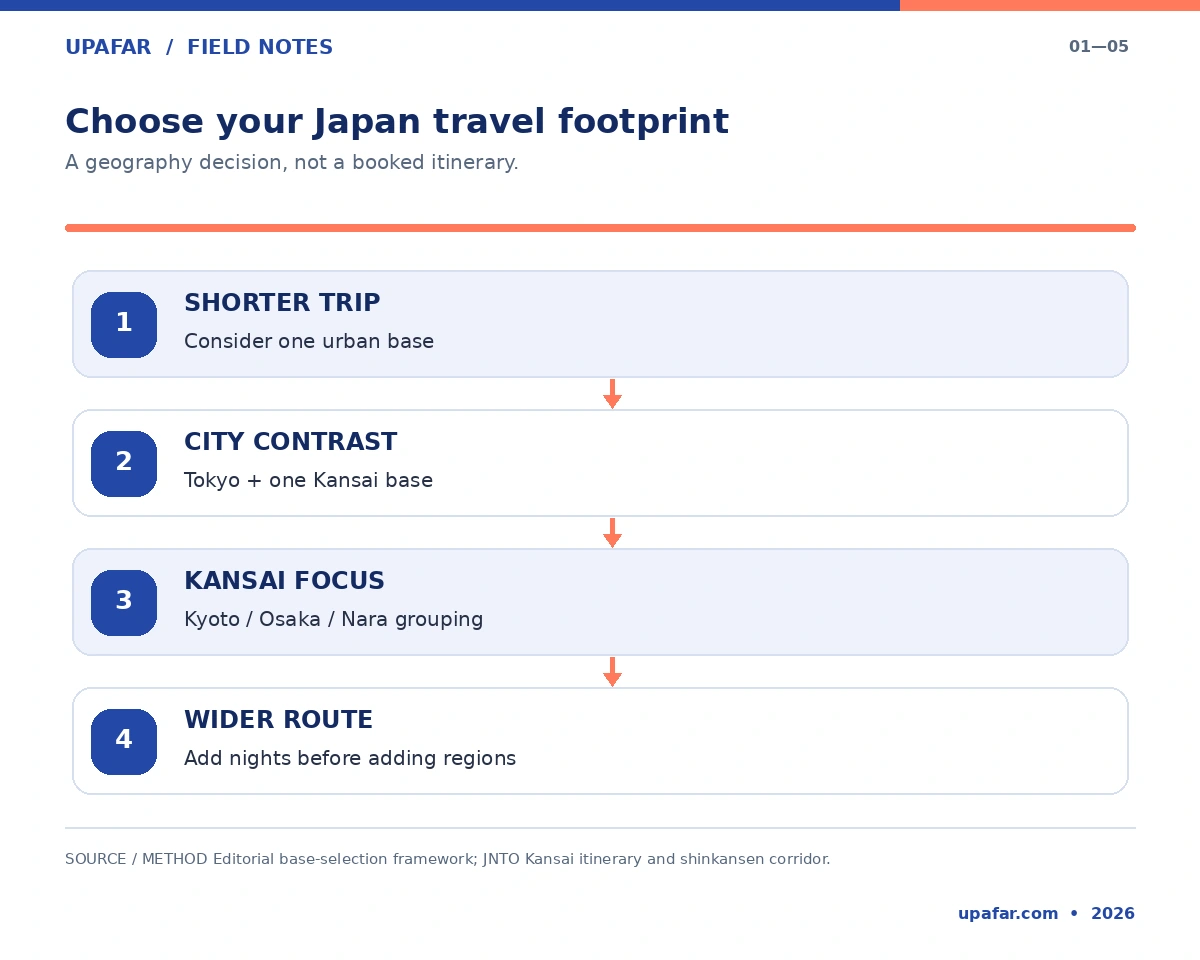
Tokyo works well for travelers interested in neighborhoods, museums, food, contemporary culture, and short city-focused excursions. Kansai provides a different mix: Kyoto’s historic districts and temples, Osaka’s food and urban energy, and Nara’s heritage sights. These are not interchangeable bases. Decide whether your trip is primarily a metropolis vacation, a cultural journey, or a mixed trip before counting must-see attractions. Trying to fit Tokyo, Kyoto, Osaka, Hiroshima, Mount Fuji, and a remote mountain town into a brief vacation creates an airport-to-station relay rather than a clear experience.
Make a regional shortlist with two tests: what do you want to do, and what would it cost in moving days? Plot activities into broad areas rather than comparing them only by name. A Kyoto temple day, for example, benefits from grouping sites in the same part of the city instead of bouncing between distant districts. If a day trip is appealing, check its first and last usable transport legs as well as opening days. International arrival and departure logistics should influence which city you start in and whether a loop or one-way route makes more sense.
Decide How Many Hotel Bases You Need
For a city-focused trip, a single well-chosen base can reduce luggage handling and give you more time in neighborhoods. For a wider Japan visit, consider two bases rather than moving every night. Tokyo and Kyoto are a common pairing because the Tokaido Shinkansen corridor connects them; Osaka can often be explored from a Kansai base depending on your plans. The Japan National Tourism Organization also groups Kyoto, Nara, and Osaka into a Kansai route, which supports treating these places as a coherent regional cluster rather than three unrelated long-distance destinations.
A base should be evaluated at the station-to-hotel level, not just by city name. Check the walk with luggage, elevator or step-free access if required, late-night arrival options, and whether your booked sightseeing starts at the opposite end of town. An inexpensive room next to a remote station may spend your budget in repeated local transfers. When choosing between another hotel and a long day trip, compare morning departure effort, luggage storage, total return travel, and evening flexibility. There is no default requirement to buy a rail pass merely because you plan to take trains.
Understand Japan Transport as Connected Layers
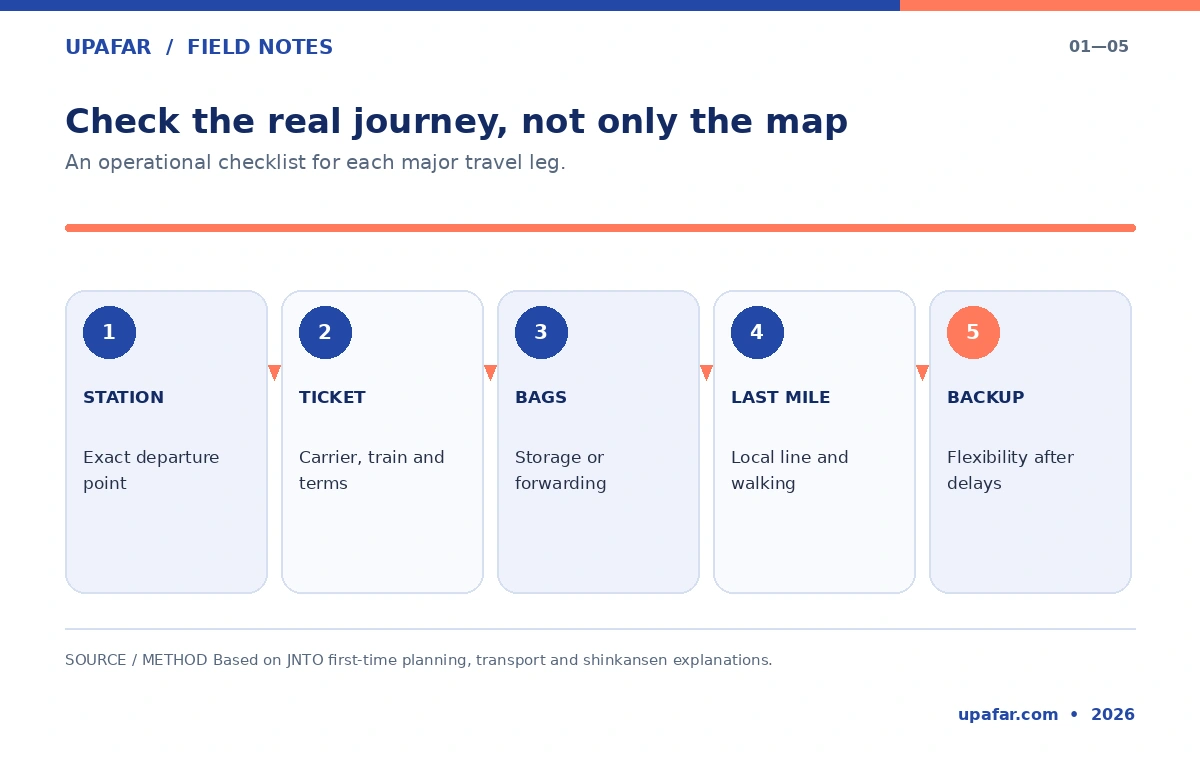
Japan travel often involves several transport systems on one day: airport access, a major intercity train, an urban rail or subway line, and a short walk or local bus. Official JNTO guidance describes rail, shinkansen, buses, taxis, ferries, and other modes. Identify the actual operator for each important leg rather than assuming a single ticket or pass covers all of them. Stations with similar names are not necessarily identical; confirm departure station, destination station, and last-mile access before finalizing lodging or timed attractions.
On a Tokyo–Kyoto–Osaka route, the Tokaido Shinkansen serves Tokyo, Kyoto, and Shin-Osaka, according to JNTO. Shin-Osaka is not the same as every attraction in Osaka, and further local transit may be necessary. Ticket options, train types, pass rules, baggage policies, and reservation availability can change, so compare the official operator or ticket seller for the travel date. A pass is a financial decision requiring a route-specific calculation, not an automatic first-time visitor purchase. This page avoids quoting pass prices or blanket rules because they require date-specific verification.
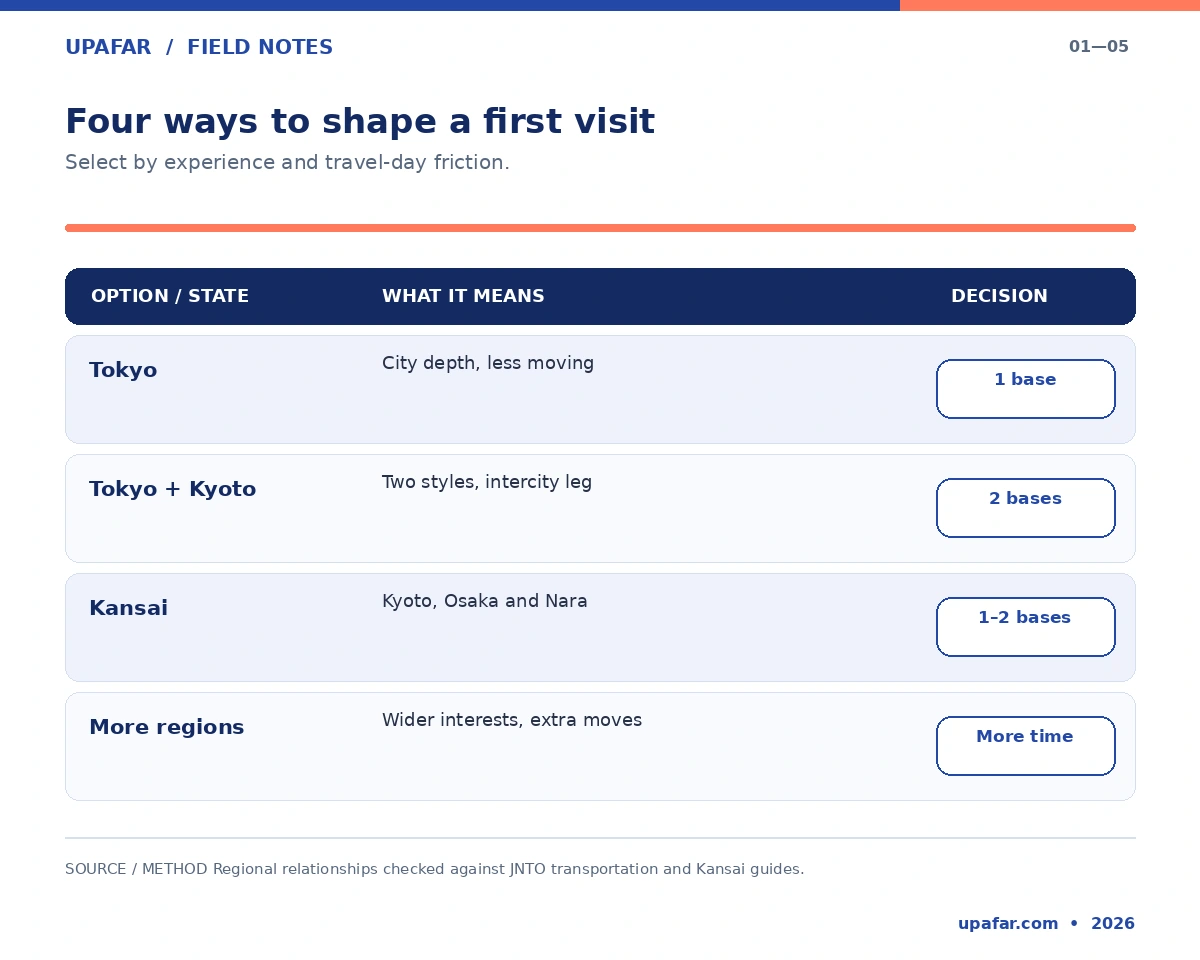
| Route shape | Better when | Main tradeoff |
|---|---|---|
| Tokyo only | Shorter city trip or one base | Less regional variety |
| Tokyo + Kyoto | A longer first visit with two styles | One major intercity travel leg |
| Kansai base + outings | Kyoto, Osaka and/or Nara are priorities | Longer local days depending on hotel |
| More regions | Extra nights and a specific purpose | More transfers and planning load |
Allow for Seasons Without Promising Forecasts
Japan spans different climates and travel experiences, so “the best month” depends on region and activity. Cherry blossoms, autumn foliage, winter sports, and summer festivals attract interest, but exact timing and visitor demand are not fixed from one year to the next. Check destination-specific weather and event information close to the travel date. If you prioritize one seasonal highlight, protect the rest of the itinerary against conditions outside your control; for example, keep other activities appealing even if blossoms arrive early or mountain visibility is poor.
Peak vacation periods can affect accommodation and transport availability. Do not assume that a journey which looks straightforward in a general travel guide will offer the same availability on a holiday weekend. Check booking windows and seat-reservation requirements where applicable, then decide which day-specific activities deserve advance reservations. If mobility, heat sensitivity, snow conditions, or long walking days are factors, include them in destination selection from the outset. A trip that follows your comfort limits beats an ambitious route you are too exhausted to enjoy.
Plan Daily Neighborhoods and Practical Details
Use a neighborhood-first sightseeing approach. Choose one major district or geographic cluster for a morning, add lunch nearby, and leave the afternoon flexible for one additional site or rest. Tokyo, Kyoto, and Osaka each reward wandering, but frequent cross-city journeys can consume valuable time. Keep meal preferences, dietary requirements, opening times, and reservation expectations in mind without inventing availability. For cultural sites, look up local visiting rules and be respectful of photography signs and restricted areas instead of assuming access everywhere.
Before departure, check current requirements for your passport and nationality with the relevant Japanese government authority and any transit country. Use the JNTO first-time visitor resources for practical orientation on connectivity, local etiquette, luggage, and transportation; verify specific rules directly with the operating agency. If arriving at one airport and leaving from another, compare the full route before booking. If carrying large bags, investigate station access and possible luggage forwarding based on your route rather than assuming every train and accommodation has identical handling conditions.
Make the First Trip Feel Coherent
A useful first-trip decision is a choice between three experiences: deep city exploration, a Tokyo–Kansai contrast, or a slower Kansai-focused route. Each can be successful, and each solves a different visitor problem. Resist treating every social-media recommendation as a mandatory stop. Write down the experience you would be happiest to remember: a food neighborhood, a museum, a temple landscape, or time with friends. Build around that, then keep a few open hours for discoveries. Plan the trip with the people traveling, not around a list of places someone else visited.
How We Research and Keep This Guide Current
This guide separates lasting decision methods from rules and prices that can change. We checked the following primary sources on October 19, 2026: JNTO first-time Japan travel planning (first-visit practical orientation, customs, climate, connectivity and luggage); JNTO Transportation in Japan (urban and intercity rail, buses, ferries, taxis and region-specific transport planning); JNTO The Kansai Trio (geographic grouping of Kyoto, Nara and Osaka in Kansai); JNTO Shinkansen guide (Tokaido shinkansen corridor linking Tokyo, Kyoto and Shin-Osaka, plus pass caveats). Examples and visual decision tools are editorial frameworks, not live quotes or guaranteed offers. Recheck operators, carriers, airports, and government requirements for your exact trip. UpAfar may earn a commission on qualifying links if relationships are activated; our affiliate disclosure explains how referrals are handled. No booking prices or availability are asserted here.
Frequently Asked Questions for This Topic
Tokyo can fill a shorter trip on its own. Add another region if you have enough time and want a different experience.
Often yes, depending on your hotel and sightseeing plan. Verify actual rail routes, station transfers, and the length of each day.
No. Compare your specific train itinerary and current ticket or pass rules before purchasing.
Shin-Osaka is a major shinkansen station. Many Osaka attractions require additional local transport from that station.
Choose a regional focus, available nights, and arrival/departure route, then verify nationality-specific entry requirements and transportation.