
A Europe rail pass is worth considering when the flexibility it buys is more valuable than the combined cost of individually booked trains—but a pass is not an automatic discount or an automatic seat assignment. Decide between Eurail or Interrail and point-to-point tickets using your actual travel days, trains, reservation costs and ticket-change needs. The most useful step is a line-by-line break-even check rather than dividing one advertised pass price by the number of countries you plan to visit.
Confirm that you qualify for the right pass
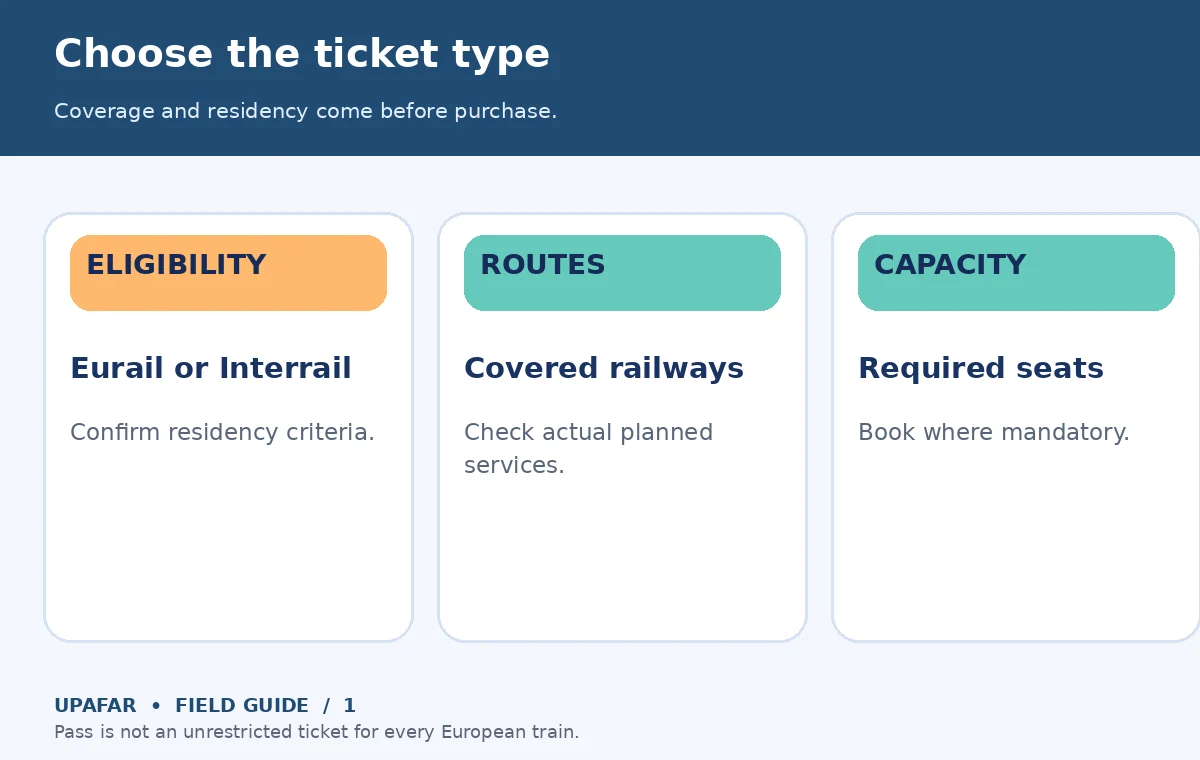
Eurail and Interrail are related rail-pass products but not interchangeable labels for every resident. The official Eurail product information states that Eurail is intended for travelers who live outside Europe, while European residents generally use Interrail. Check the current residency conditions and identification requirements directly; nationality alone can be an imperfect shortcut when someone lives in a different country. Pass coverage depends on participating rail operators and services, not merely the borders drawn on a map.
A Global Pass can cover participating services across countries; One Country Passes have narrower validity. Flexible passes count specified travel days inside an overall validity period, while continuous passes allow a different pattern. Travel days are not the same thing as hotel nights, and a pass day used for one short ride may be poor value. Before buying, write down the trains you want and check whether each is covered, whether its departure has passholder availability and what additional booking is required.
Calculate the price that matters: pass plus extras
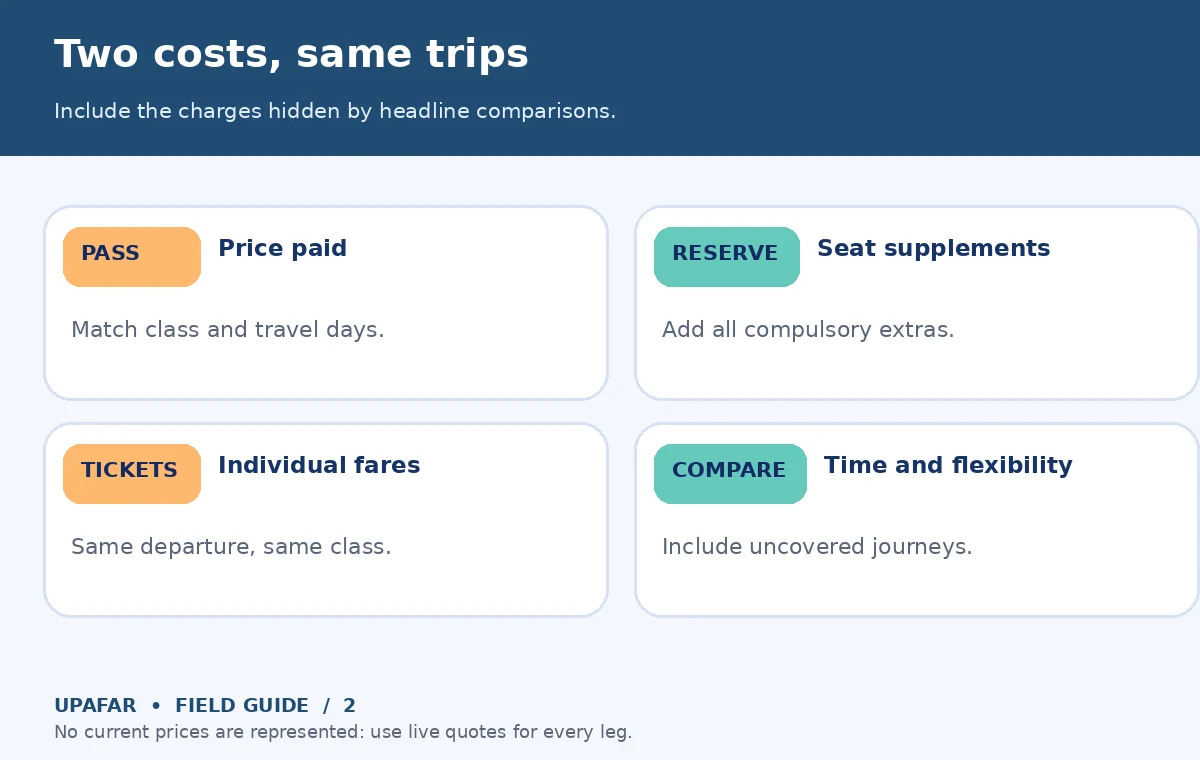
For each train leg, get two comparable figures for the same date, time and class: a normal point-to-point fare with any mandatory charges and the relevant passholder reservation or supplement cost. The pass option is pass purchase price + compulsory reservations and supplements + any uncovered transport. The ticket option is the sum of individual ticket totals. If you’re considering a premium pass that bundles certain seat reservations, use its current published conditions instead of applying the standard-pass formula without adjustment. Prices and eligibility can vary; this article deliberately avoids static pass prices.
For illustration only, suppose a hypothetical five-day pass costs $250 and required reservations across your route add $45. That produces a $295 pass-path cost before uncovered travel. If hypothetical comparable individual tickets total $210, the ticket path is $85 lower on that scenario. If those tickets instead total $390, the pass path could be cheaper, provided the seats and train coverage are genuinely available. These round numbers are examples of arithmetic, not current Eurail quotes or a claim about any real journey.
Count travel days instead of cities visited
Someone staying in Paris for four nights and Amsterdam for four nights may have only one intercity travel day, even though two major destinations are involved. Someone making daily long-distance trips may use more pass days, but could also waste valuable sightseeing time. Mark the specific dates on which a pass would be activated or used for travel; do not include free time in a city. If you plan day trips, check whether low-cost regional tickets beat consuming a valuable pass day.
The official pass descriptions distinguish limited travel-day products from continuous ones. Confirm the terms at checkout because pass products, sale prices and any new variants can change. A pass does not turn every bus, subway or city tram into a free journey. Certain ferries or other benefits might be included or discounted only under particular conditions; classify such items separately unless a current official list confirms your specific service.
Look up seat reservations before purchasing the pass
This is the most common trap in pass comparisons. Official Eurail/Interrail seat-reservation guidance says reservations are not included with the standard pass and can be mandatory on many high-speed and night trains. Requirements vary by service and route. A passholder can be unable to board the chosen departure without the required reservation even with an otherwise valid pass. Checking route availability before you buy therefore matters as much as checking the headline pass price.
For every premium or high-speed segment, note whether a reservation is compulsory, how far ahead it is available, the fee, and which booking channel can issue it. Verify sleeper accommodation separately on night trains; a pass does not simply promise a bed. If the passholder allocation is unavailable, compare a later departure, an alternative operator or a regional route, recognizing that detours can take more time and involve multiple changes. A rail pass is a travel entitlement under conditions, not a guarantee of capacity at your preferred hour.
Factor in flexibility and missed-connection exposure
Point-to-point fares can be attractive when purchased in advance for fixed routes, but the lowest classes may be restrictive. A pass may be worth more to someone who can genuinely change the day or destination. Still, reservation-dependent services can limit that flexibility. Do not assign a dollar value to an imagined spontaneous itinerary if your lodging, event tickets and work leave already lock the route. Write down which train departures can move without causing other penalties.
If you travel on several operators, inspect through-ticket protection and the rights attached to your specific rail contract. The EU’s passenger-rights page explains the importance of through-tickets, delay procedures and possible service exemptions. A May 2026 Commission proposal to improve cross-operator ticketing must not be confused with already-effective coverage for every separate ticket. Always review the operating railway’s current terms.
Use a four-case recommendation matrix
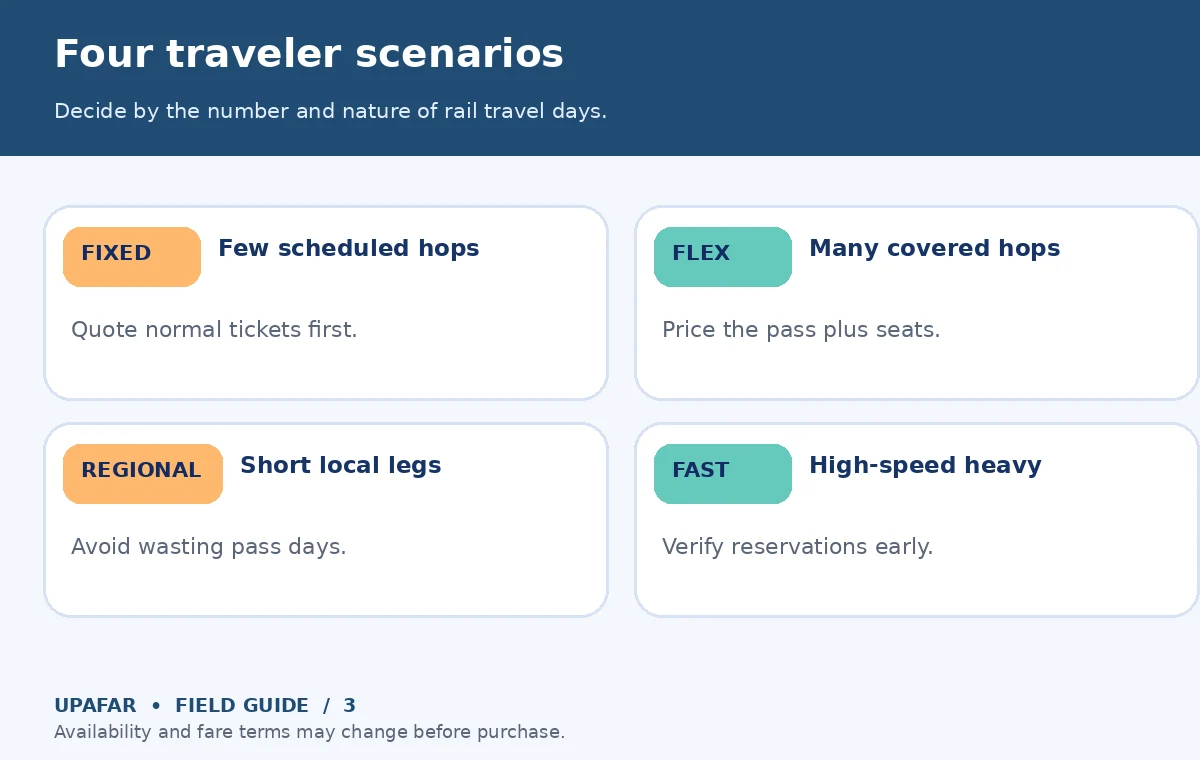
A few prebooked intercity trains on fixed dates typically deserve a point-to-point comparison first. Many travel days across eligible networks deserve a pass comparison, but only after reservation charges are counted. A mostly regional itinerary may favor either approach depending on the countries and pass-day use. An itinerary dominated by mandatory-reservation high-speed trains demands special attention to seat supply regardless of the fare math. In every case, calculate both totals for the same travel class and acceptable departure times.
Record the results and revisit them only if dates or routes change materially. Buy the product that passes all three tests: it covers the journeys, seats are obtainable where required, and the total price or flexibility benefit justifies the choice. A cheaper numerical total is not enough if it forces an unreasonable overnight arrival or several extra changes. The purpose of the comparison is a trip that works, not a pass displayed for its own sake.
How We Research pass eligibility and reservations
We checked Eurail’s eligibility and pass descriptions, its reservation guidance, and official EU rail-rights information on October 19, 2026. The worked dollar amounts are explicitly hypothetical and no real-time railway fares or reservation inventory were queried. This guide avoids declaring a universally cheapest pass and treats evolving cross-operator ticketing legislation as proposals unless formally enacted. Re-check coverage, residency, seat supply and terms with the operating railways before purchase. UpAfar claims no rail-pass commission in this article; see our affiliate disclosure.
Frequently Asked Travel Questions
No. Many high-speed and night trains require a separate reservation, and passholder seats may be limited.
The product generally depends on residence: Eurail is intended for people residing outside Europe, while Interrail generally serves European residents. Verify current eligibility.
No. Travel days relate to rail use within the pass terms, not the number of hotels or cities on your itinerary.
Do not assume so. Standard pass coverage mainly concerns participating rail services; confirm any specific local transport or ferry benefit.
Compare pass price plus required reservations and uncovered legs with individual fare totals for the same dates, class and acceptable departures.