
A first Europe trip is easier to enjoy when you design it as a small number of connected bases, not a checklist of capitals. Pick a region or travel corridor, protect full days between transfers and reserve room for arrival fatigue and delays. For a 10-day trip, two or three bases are often a better working hypothesis than five or six—but there is no official city quota. This guide gives you a route test, a 10-day sample you can adapt and the entry-system checks that matter in October 2026.
Select one corridor instead of collecting countries
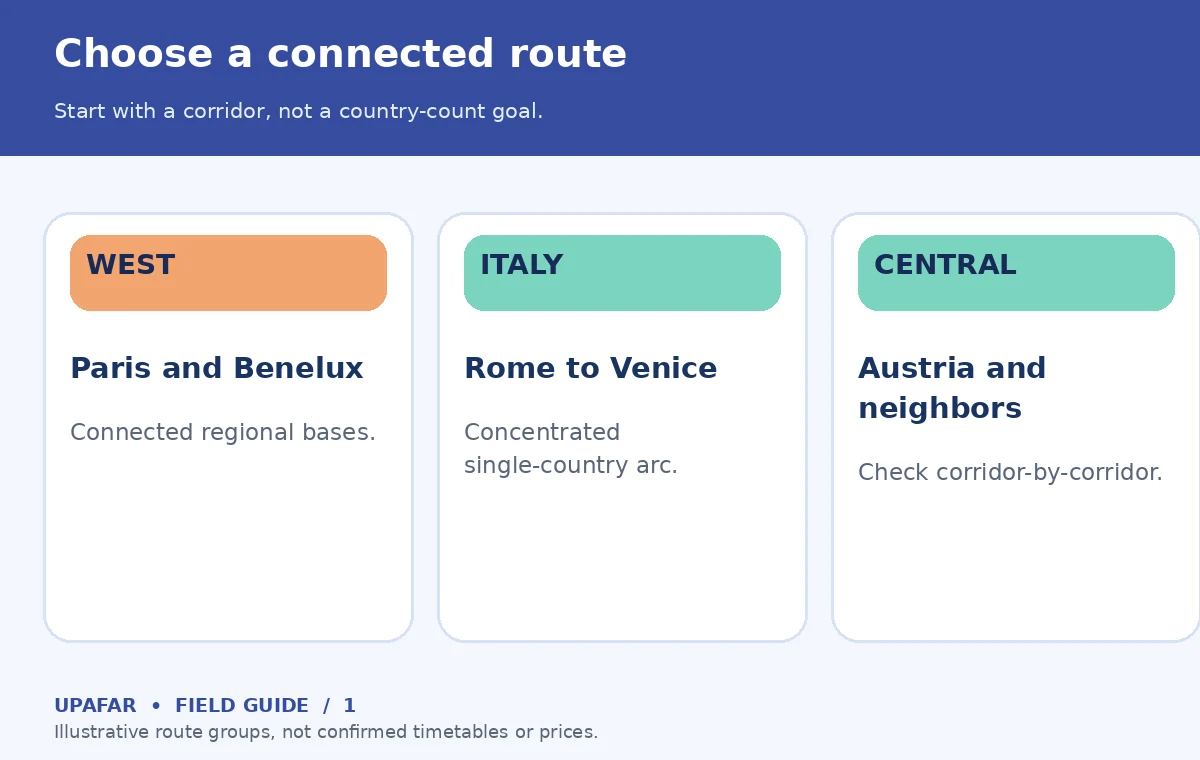
Start with a theme and a geographic shape. A London–Paris–Amsterdam trip follows a broad northwestern corridor; a Rome–Florence–Venice trip stays within one country; Vienna–Salzburg–Munich offers a different compact cluster. These are route sketches, not promises of direct train service or specific travel times. Check each connection on the actual operating date with the rail or transport provider. A line drawn across a map can conceal limited departures, separate stations and longer door-to-door times than expected.
Choose your arrival and departure cities together. An open-jaw flight, arriving in one place and returning from another, can reduce backtracking, but compare total airfare and ground costs before assuming it saves money. Resist the urge to add a city because it is “on the way” if it turns into a hotel change, luggage storage problem and a half-day spent moving. A day trip from a well-located base may preserve the flexibility to rest or adjust plans if the weather turns bad.
Count usable days instead of calendar squares
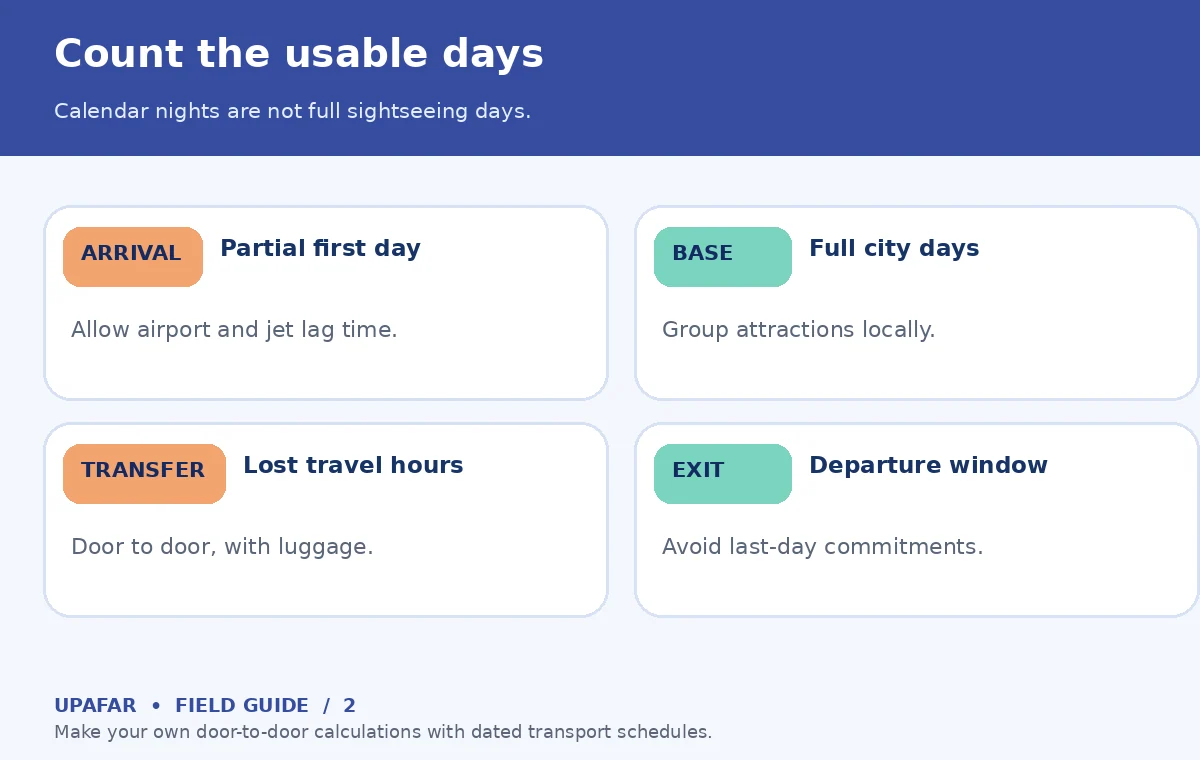
Travel-day math changes how an itinerary feels. A ten-calendar-day vacation with an arrival flight on day one and departure on day ten is not ten full sightseeing days. Subtract those terminal travel periods, then subtract meaningful chunks for each intercity move. Getting to the station, checking out, carrying luggage, waiting, boarding, reaching the next hotel and checking in all consume time even when the scheduled rail journey looks short.
Use a sample ten-day route with three bases: days one through four in Paris, days five through seven in Brussels or a nearby Belgian base, and days eight through ten in Amsterdam, with departure on day ten. This is an illustrative outline; day one and ten remain travel days, and the available time is not evenly divided. Instead of rigidly assigning every hour, reserve one principal activity for each full day and hold a nearby alternative. The key test: does each base earn enough actual usable time to justify moving there?
Compare rail and air door to door
High-speed trains can be convenient on some city-center corridors, but “train always beats plane under X hours” is too simplistic. Calculate accommodation-to-station travel, station arrival buffer, scheduled journey, transfers, onward transport and baggage requirements. For air, include airport travel, check-in, security, boarding and the arrival-side trip into town. Compare availability and fares only for the dates you would genuinely travel. Routes crossing water or spanning more distant regions may favor flights; dense rail corridors can favor trains.
For journeys involving multiple trains, inspect whether tickets form one through-ticket or separate contracts. The EU’s rail passenger-rights guidance explains why that distinction matters and notes exemptions depending on the service. Do not claim identical missed-connection protections everywhere. If you are deciding whether a Eurail or Interrail pass helps, compare reservation requirements and actual point-to-point ticket costs after your route is fixed; a pass is not necessary simply because more than one country appears on the map.
Keep Europe, Schengen and EU entry rules separate
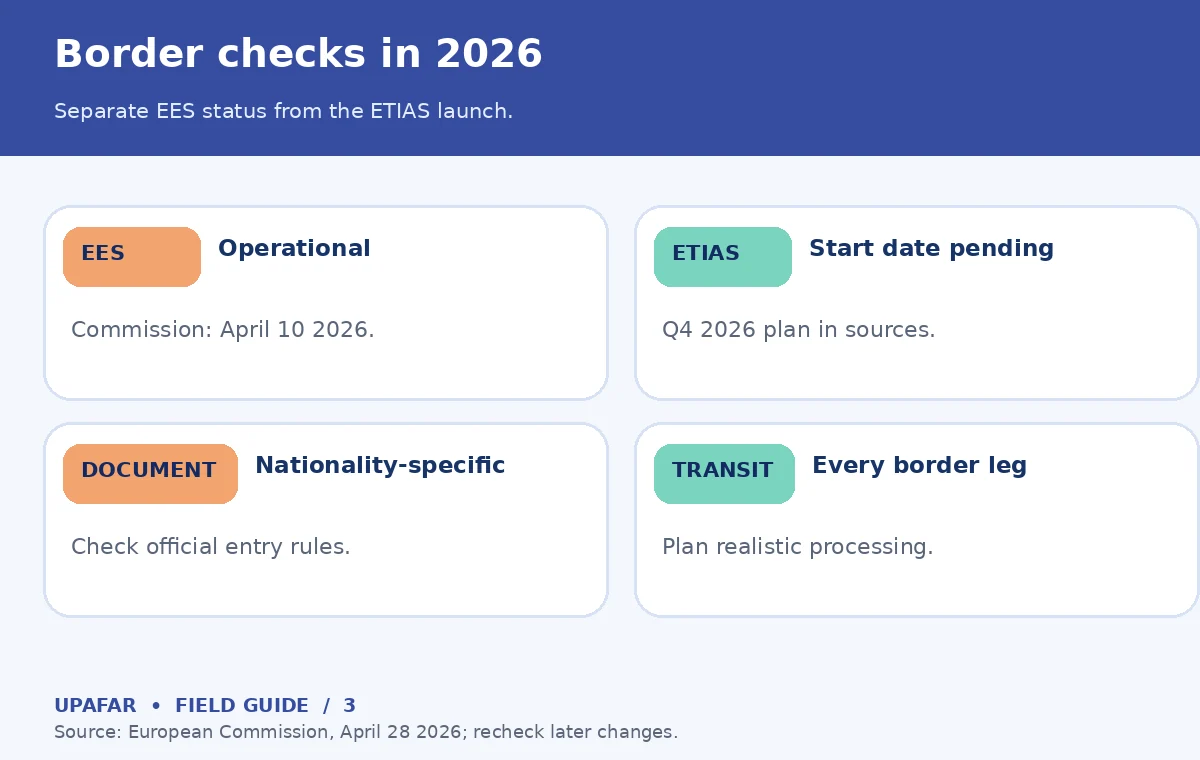
Europe, the European Union, the Schengen Area and the geographical set of countries using the EU Entry/Exit System are related but not identical. Nationality, residence status, trip purpose and entry route determine the documents you need. The European Commission stated that EES became fully operational on April 10, 2026 for covered short-stay non-EU travelers at external borders. Biometrics and digital registration can affect the practical border-crossing process, so leave realistic time in your arrival plans.
The same Commission communication, and the official ETIAS information site, described ETIAS as planned for the last quarter of 2026 without a fixed start date at the time reviewed. Therefore, do not treat older articles claiming universal ETIAS approval is already required as a substitute for checking the official site close to departure. If the rules have changed since this October 19, 2026 review, the official destination and EU resources take priority. The 90-days-in-180 short-stay concept is relevant to many covered non-EU travelers but is not a blanket permission for every passport or purpose.
Group experiences by neighborhood and energy
A good itinerary has anchor activities and enough freedom to follow the city. For each base, group one major prebooked activity with nearby, lower-commitment options such as public parks, neighborhood walks or markets. Avoid crisscrossing the city for unrelated reservations on the same day. Rather than trying to do every headline attraction, decide in advance which experiences you care about and which are optional if queues, weather or fatigue intervene.
The first full day deserves extra flexibility after an overnight flight. An early train departure after a late theater performance may look efficient on paper and exhausting in practice. Check accessibility, walking distances and luggage storage before relying on stations or attractions as free facilities. For a group, mark the places where people can split for a few hours and reconnect easily. That can turn different interests into a feature rather than a daily negotiation.
Build a route that survives a missed connection
Limit the number of nonnegotiable bookings on transfer days. A museum ticket immediately after an international arrival or a separate-ticket onward flight can create unnecessary pressure. Keep critical connections comfortable and record the actual operator’s terms. Save offline tickets and hotel addresses, note platform or terminal information as a live detail and avoid publishing a precise train timetable in an evergreen plan. Local strikes, maintenance and seasonal service patterns can alter the best route.
Before committing, run a reversal test: would visiting these same bases in the opposite order lower the transport burden or improve flight choices? Run a deletion test: if one city were removed, would you gain a restful full day or lose a must-have experience? Finally, run a residency-and-documents test for everyone in the party. A brilliant-looking itinerary that fails an immigration condition or requires long unprotected transfers is not ready to book.
How We Research Europe routing decisions
We checked the European Commission’s EES/ETIAS explanation, EU rail passenger-rights guidance and the official ETIAS information on October 19, 2026. The example corridors are editorial route designs and we have not verified specific train departures, attraction inventory or ticket prices for particular travel dates. We distinguish official border-system status from fluctuating planning details and do not imply that proposed rail-ticket reforms are already law. Readers should confirm national entry rules and operating connections close to travel. No supplier relationship is asserted; see our affiliate disclosure.
Frequently Asked Travel Questions
Two or three practical bases often allow more full sightseeing days than a fast-changing list, but travel pace and transfer times determine your choice.
No. Europe, the EU and the Schengen/EES participating country sets differ. Check each country’s official rules for your nationality.
The official sources reviewed described a planned Q4 2026 rollout without an announced exact start date. Recheck the official EU website before traveling.
No. EES registers covered non-EU short-stay entries and exits at external borders; ETIAS is a separate planned authorization system.
No. After fixing the route, compare the pass price and required reservations against actual point-to-point fares and schedule flexibility.