
A walking tour is worth booking when a knowledgeable guide will make a place easier to understand, when an unfamiliar route is stressful to navigate, or when scheduled interpretation is the point of the visit. Explore independently when you want long photo stops, a flexible meal break, or a route you can comfortably follow yourself. The best choice is often hybrid: a focused guided walk first, then an unstructured afternoon. This guide shows how to decide before paying, rather than assuming every destination needs a tour.
Begin with one question: what would be difficult to do alone? A historic district full of layered stories is different from a compact waterfront with clear signs. A tour that explains local context may be valuable even if the distance is short; a long walk through famous streets is not automatically a richer experience. Likewise, a free or tip-based walk is not necessarily cost-free for your budget. Consider the suggested contribution, the number of participants, and whether the experience aligns with your priorities.
Choose a guide only when it changes the experience
Use three filters: interpretation, navigation, and access. Interpretation matters when a site has a complicated history or when details are easy to overlook without explanation. Navigation matters when confusing lanes, transport changes, or limited time make a wrong turn expensive. Access matters when a place requires its own booked program or has restricted entry. But a walking-tour ticket never guarantees entry to a museum, special area, or attraction unless the operator explicitly states it and the venue confirms it.
The U.S. National Park Service illustrates why this is a real decision, not a universal preference: its Rosie the Riveter self-guided programs combine narration and map points that visitors can follow independently. Other NPS locations offer scheduled guided options alongside self-guided experiences. These are examples of different visitor formats, not promises that a particular program will be running on your travel date. For a city walk, look for equivalent official museum, neighborhood, or visitor-center resources before committing to a commercial product.
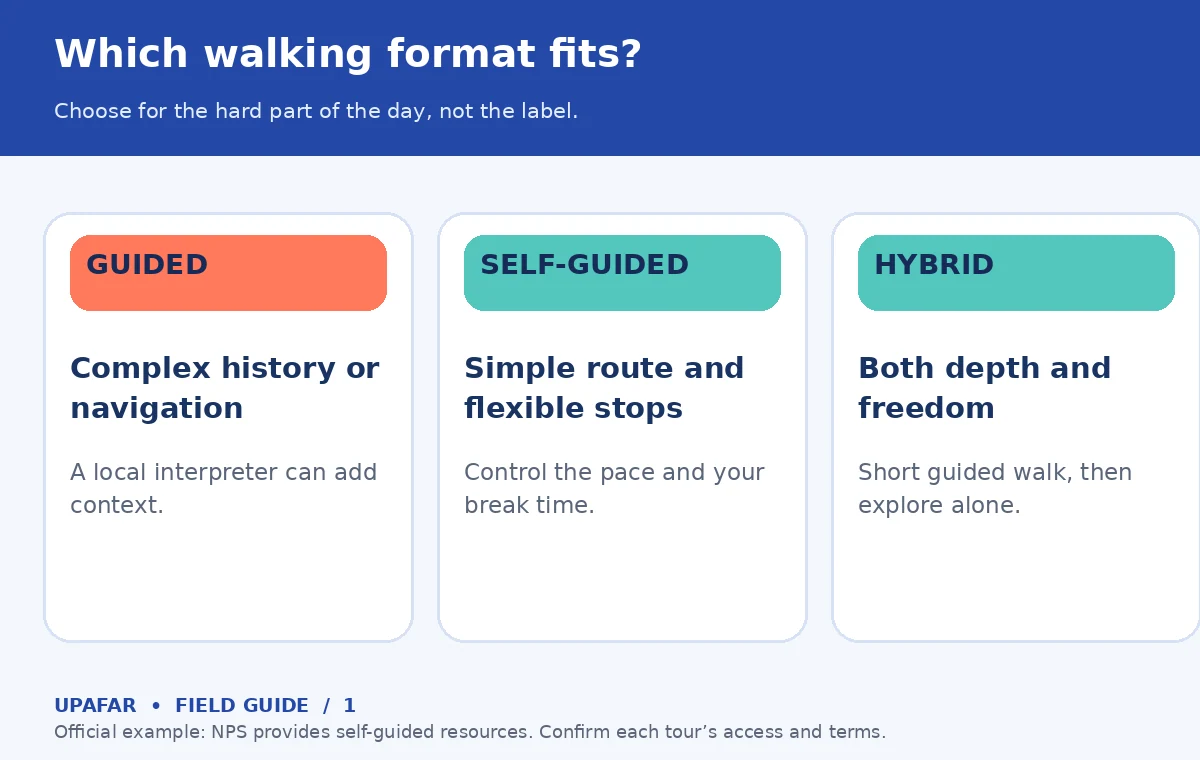
Compare a shared group tour, a private guide, and DIY on more than the advertised start price. A shared walk can make expert interpretation accessible but keeps a group pace. A private walk can be adapted to particular interests if the guide agrees, yet may cost more in total. DIY can be the most flexible, but you provide the navigation, fact-checking, and contingency plan. If you need step-free routes, seating, a quiet audio format, or a particular language, confirm accommodations directly rather than relying on a generic accessibility icon.
Build the route around real walking time
Start by plotting the actual meeting point, finishing point, and your next appointment. A two-hour guided session is not the same as a two-hour door-to-door commitment. Add time to travel to the meeting point, locate the group, use a restroom, and get from the final stop to the next destination. The advertised route distance may exclude extra walking to transit or detours. For an independent route, estimate time for every stop, not just the straight-line distance on the map.
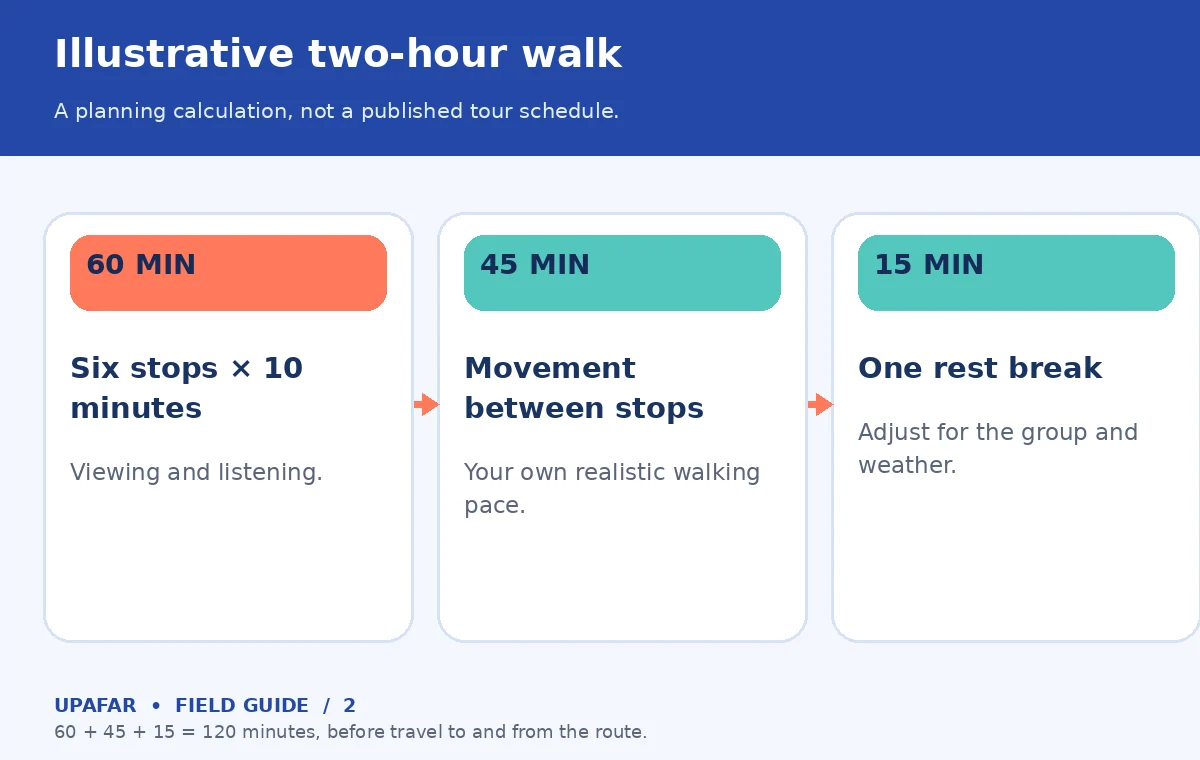
As an illustrative planning calculation, six stops with ten minutes of viewing each consume an hour before you count a single minute of movement. Add 45 minutes of walking and a 15-minute break and you already need about two hours. That arithmetic is a planning example, not a published schedule for any tour. If your travelers include children, people using mobility devices, or anyone who needs frequent rests, replace the average pace with the pace that actually works for your group.
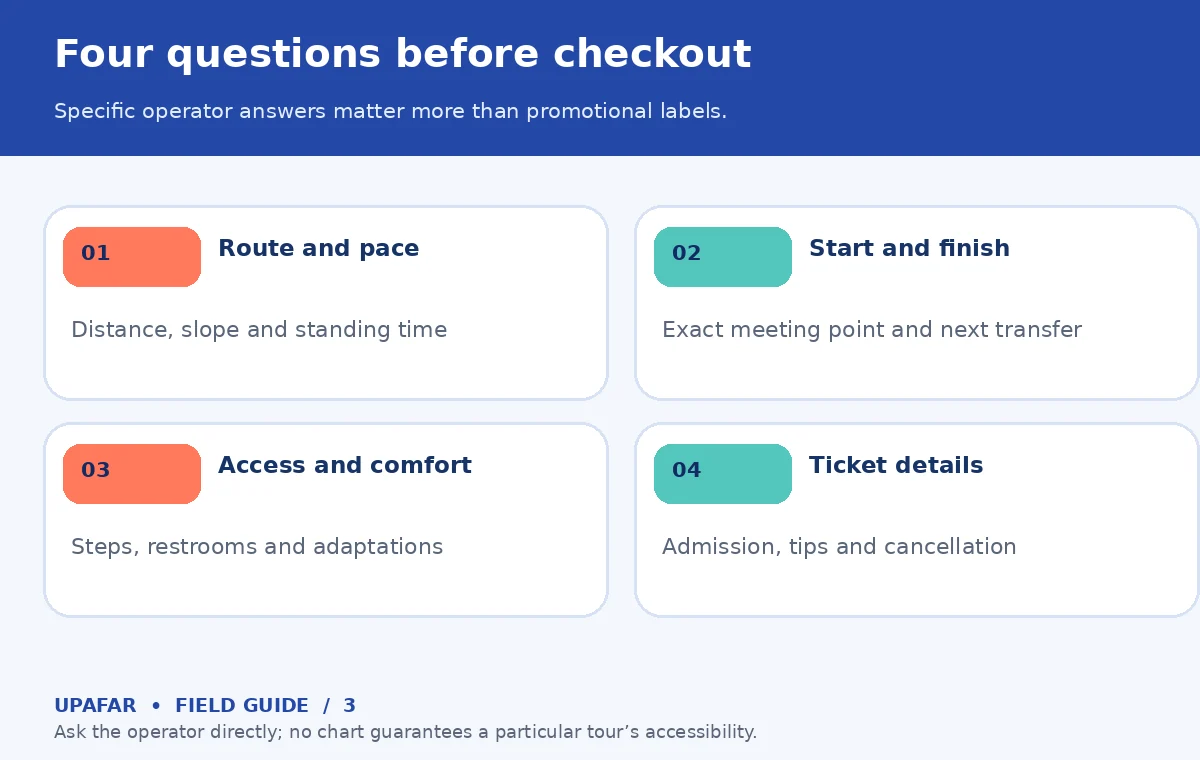
The NPS accessibility planning guidance recommends contacting individual parks about reasonable modifications and accessible facilities in advance. Apply the same principle to a commercial walk: ask about stairs, cobbles, steep slopes, standing time, bathroom stops, and whether leaving early is practical. “Easy” is subjective; concrete route details are useful. Also verify whether the stated end point is near public transportation, particularly after dark or when weather may change.
Check exactly what the booking includes
Read the tour description as a contract, not a mood board. Confirm the language, meeting instructions, estimated finish time, group-size policy, weather policy, accessibility details, cancellation terms, and whether entrance fees, transit tickets, food, or tips are included. “Skip the line” is not a substitute for official entry rules; security screening or timed admission may still apply. A guide’s meeting instructions should identify a specific landmark or address, not merely a broad neighborhood.
Free walking tours commonly operate on a voluntary-payment model, but the recommended payment, reservation process, and cancellation arrangements vary. Do not assume a tip is optional in every practical sense, or that the guide is paid the same way across providers. For paid group walks, judge value by the expertise, route fit, and conditions rather than a universal per-hour benchmark. Avoid unsupported claims about credentials: if specialist expertise is essential, ask how the operator verifies guide qualifications.
Make a workable half-day instead of an overfilled itinerary
For a first visit to a city, group sights geographically. Put an interpretive walk in the morning when attention is fresh, then allow unscheduled time to return to the stops you found interesting. If the walking tour ends in a different district, arrange lunch near the finish rather than backtracking. If a tour begins before transit typically runs or ends after service changes, check official local transport information. Avoid stacking two lengthy walks solely because the attractions appear close on a flat map.
A useful backup plan needs three elements: an offline map, a nearby sheltered stop, and a clear return route to the lodging. Heat, heavy rain, unsafe footing, or a change in group energy can be reasons to shorten a walk; no itinerary deserves finishing at any cost. Carry water appropriate to the conditions, wear shoes you have tested, and respect private property and residential streets. Download any self-guided audio, map layers, or tickets before leaving reliable connectivity; availability of offline features depends on the specific service.
A five-minute decision before you reserve
Write down the one place or story you most want to understand. Compare that goal against the tour’s listed stops and guiding format. Next, confirm your real door-to-door time window, then check terrain and any accessibility requirements. Finally, review the operator’s inclusion and cancellation rules. If a tour fails one of those four checks, an independent walk or a shorter specialist tour is usually a better fit. This prevents a common mistake: booking a broad highlights tour when your actual interest is one small neighborhood.
For a traveler with one free morning, a short guided orientation followed by independent exploring may preserve flexibility. For a repeat visitor who knows the city well, a themed history or architecture walk can provide more depth than another general introduction. For a family or mixed-ability group, an accessible self-guided route with optional stops can sometimes outperform a rigid group schedule. These are decision examples, not guarantees about any individual operator.
How We Research Walking Tour Decisions
We compared official NPS self-guided tour information with its accessibility planning guidance and reviewed current search results about guided versus independent walking formats on October 19, 2026. Our added value is a four-check booking screen—interpretation, door-to-door time, terrain, and inclusions—rather than a ranked or invented provider list. Opening hours, route access, tour inventory, and weather are location- and date-specific; check the operator and attraction directly before purchasing. UpAfar has not independently tested or booked every kind of tour described here. For our commercial relationship policy, read the affiliate disclosure; the links in this guide are informational, not represented as affiliate recommendations.
Frequently Asked Travel Questions
Choose a guide for interpretation, complex navigation or a scheduled program. Choose self-guided when the route is clear and flexible timing matters most.
Some use voluntary contributions or tip-based models. Check the particular provider’s stated expectations, booking and cancellation rules; do not assume all formats are identical.
Add travel to the meeting point, early arrival, the guided route, stops, and the journey onward. A quoted tour duration rarely includes every door-to-door segment.
Request route distance, slopes, stairs, pavement type, standing time, rest stops, bathrooms and the possibility of leaving early. Contact the operator rather than relying only on labels.
Not necessarily. Confirm admission, timed entry, security screening and other costs directly in the operator description and official venue information.