A food tour is worth booking when it offers something a self-guided tasting walk cannot easily provide: meaningful local context, reliable access to small establishments, thoughtful pacing, or help navigating unfamiliar dishes. If your priority is simply to eat lunch at a famous market, a guided tour may add cost and constrain your schedule without improving the meal. The decision starts with what you want to learn, how much you can comfortably eat, and whether the operator can address dietary requirements before you pay. **Never treat a tour’s mention of “vegetarian options” or “allergy friendly” as a safety guarantee.**
Choose between a guided tasting and your own food crawl
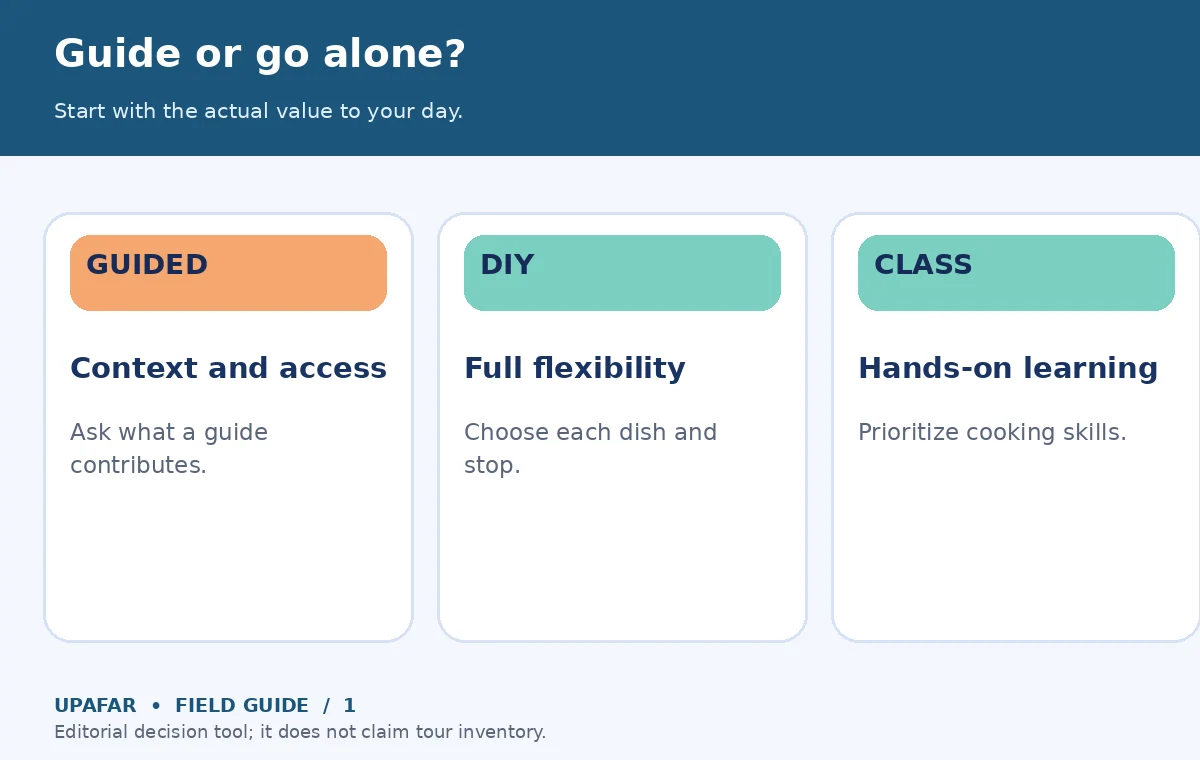
A guided small-group walk fits travelers who want a coherent introduction to the city’s food history, preparation methods and neighborhood culture. A private guide may suit a group with a specific educational focus, although private does not automatically mean safer for people with allergies. A DIY crawl makes more sense when you have familiar venues in mind, an unpredictable arrival time, small children needing frequent breaks, or a strong preference to select every dish personally. A cooking class is a different experience: it prioritizes participation and technique rather than sampling the neighborhood’s range of venues.
Before booking, put your main objective in one sentence. “Understand why these pastries differ from the ones across town” suggests you need interpretation. “Try two desserts between museums” suggests a self-guided stop. “Learn to make a regional dish” suggests a cooking class. If a tour description mostly promises quantities of food without explaining the guide’s expertise, stops or learning angle, request more details rather than assume it will deliver cultural value. Review recent participant accounts critically: look for specific details about pacing and access, not merely five-star enthusiasm.
Verify the edible itinerary rather than the advertised stops
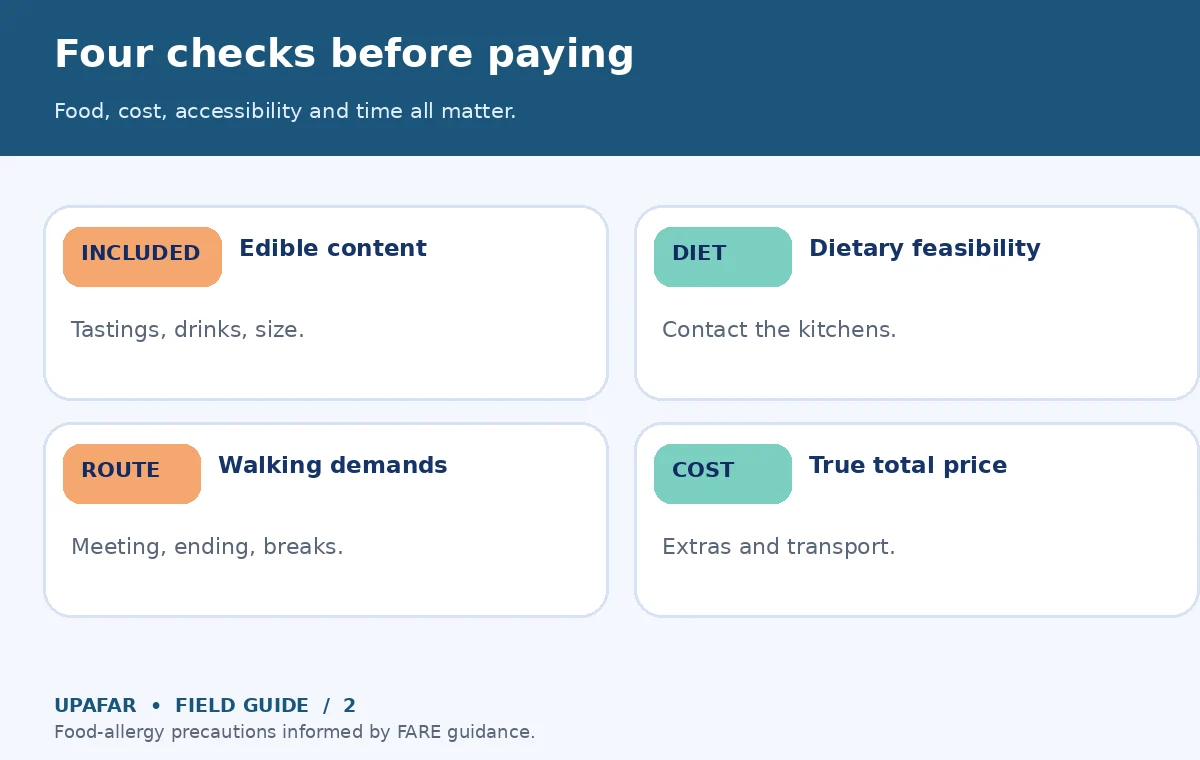
Ask how many tastings are actually included, whether they equal a full meal, which beverages are covered, and whether you pay for any optional items. A four-stop tour can be more satisfying than an eight-stop one if it allows conversation and meaningful portions. “Tastings included” can mean different things among operators. Find out whether it is a seated experience, a market wander, or a rapid series of standing stops. Check how food costs, guide gratuities, entrance tickets and transportation are treated in the current booking terms.
Estimate a useful total cost as **tour price + required fees + drinks or tastings not included + transport to and from the meeting point**. Then compare that with a realistic DIY meal-and-transit budget, not with a grocery-store snack. The premium pays for interpretation, organization and convenience. It does not automatically make the food safer or more authentic. If the tour’s venues are not disclosed in advance, the operator should still be able to explain cuisine style, typical ingredients and which constraints it can assess.
Ask dietary questions before committing money
Food allergies require a separate booking gate. Food Allergy Research & Education (FARE) recommends reviewing menus, communicating directly with restaurant staff and asking about cross-contact. A guide’s assurance alone cannot establish how each kitchen separates equipment or ingredients. The FARE dining-out guidance specifically emphasizes contacting venues and carrying a chef card when appropriate. Tell the operator the exact allergen, ask which participating kitchens can communicate directly, and confirm whether you may decline an unsafe tasting without pressure. A tour that cannot answer these questions should not be booked on the assumption that things will work out on arrival.
Vegetarian, vegan, religious or ingredient preferences deserve clear questions too, but they are not equivalent to severe allergies. For allergies, shared fryers, grills, utensils and premade sauces matter; swapping a garnish is not necessarily sufficient. If no satisfactory arrangements can be confirmed, choose a personally vetted restaurant or a non-food activity instead. Follow individualized clinical advice about emergency medication and food exposure; this article cannot assess whether any particular dish is safe.
Build a realistic schedule around the meal and walking
Many tours include walking, stairs, crowds or narrow markets. The advertised tour duration may not reflect time to reach the starting point or return from a different ending location. Check meeting instructions, the tour’s end point, distance or mobility accommodations and whether restrooms and seating are available. In hot destinations, a midday outdoor tasting can be tiring. In cities with several restaurant closures each week, an itinerary may change; ask how alternatives are handled.
Avoid planning a second large meal immediately after a food tour that is described as filling. Instead, treat the tasting window as the anchor of a half-day: allow transit and an arrival buffer, take the tour, then reserve an optional gentle walk or museum nearby. If the operator advertises alcohol tastings, confirm the minimum age, substitutions and whether the route works for everyone in the group. Never assume the city name or tour title tells you what will be served.
Food hygiene is another reason to ask rather than improvise. The CDC’s traveler food and drink guidance advises handwashing, foods served hot when appropriate, and extra caution with uncooked items where sanitation is uncertain. A busy stall is not proof of safe handling. Apply the same judgment to a guided tasting as you would to food purchased independently; a booking receipt does not remove foodborne-illness risks.
Compare three sample traveler situations
First-time visitor with one free afternoon: choose a compact neighborhood-focused tour if the guide explains local food and ends close to the next activity. A half-day market plus tasting can produce more understanding than a list of disconnected restaurants. Food-confident repeat visitor: build a DIY crawl of three nearby venues with flexible stops and an explicit spending limit. Traveler with complex allergies: start with direct venue communication and a medical safety plan, not a generic “dietary options” filter. For the last scenario, skipping a food tour may be the best outcome of the comparison.
A useful booking shortlist has three columns: what is confirmed, what remains unknown and what must be resolved before paying. Confirm the tour’s food coverage and end location. Mark dietary feasibility and cancellation terms as unresolved until the operator supplies details. Do not mistake a tour listing that appears on multiple booking websites for multiple independent confirmations of its operating conditions.
Run the five-question booking screen
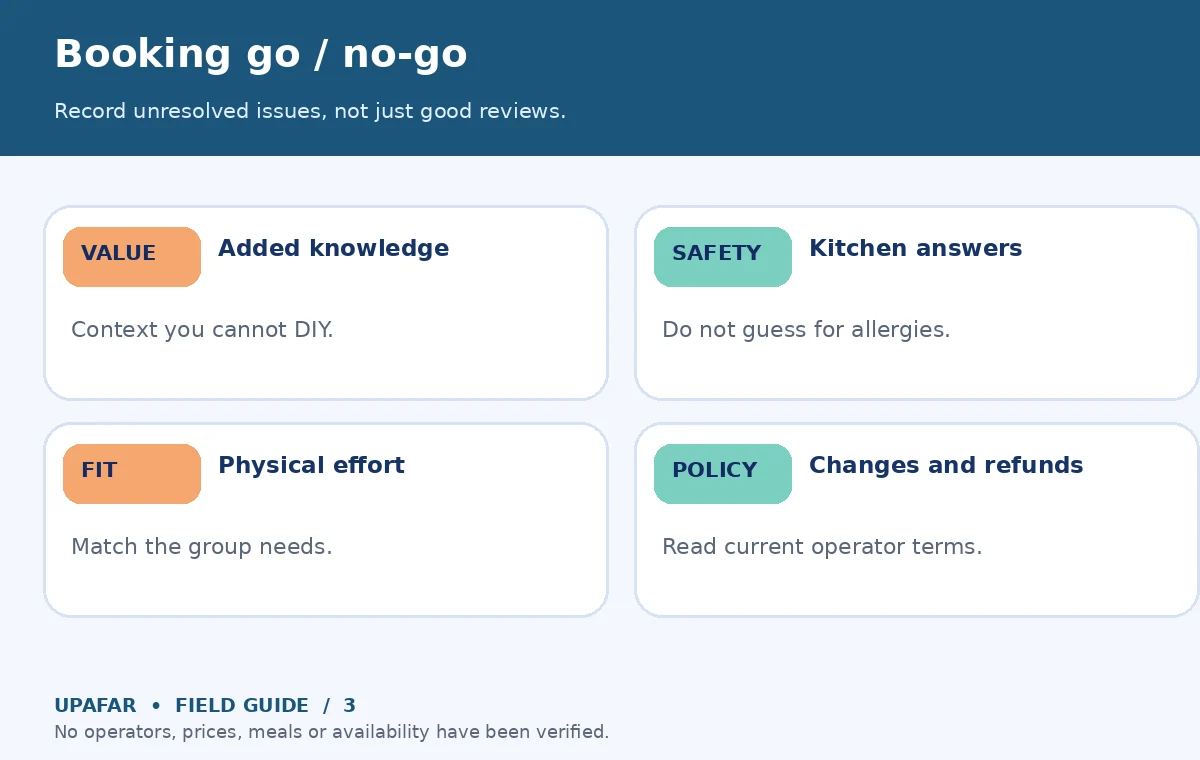
First, what specific learning or access do you gain from the guide? Second, is the edible content sufficient for your appetite and budget? Third, are allergy, dietary or mobility requirements genuinely workable? Fourth, does the meeting point, duration and end point fit the rest of your day? Fifth, are weather, route changes and cancellation rules clear? A tour that fails a nonnegotiable safety or accessibility question is a hold, not a bargain.
If the answers support booking, save the original operator instructions offline and reconfirm the meeting point shortly before departure. If not, assemble a DIY route with fewer stops and permission to change plans. This page deliberately does not rank operators or promise availability, food portions, admission, or skip-the-line access. Those details differ by place and date and require live operator confirmation.
How We Research food tour decisions
We used primary traveler food-safety guidance from the CDC and direct restaurant allergy/cross-contact advice from FARE, reviewed October 19, 2026. Our guided-versus-DIY scorecard is an editorial planning tool; it is not the result of field testing or operator inspections. We did not verify inventory, prices, specific food businesses or affiliate arrangements. The traveler must confirm each route and operator’s current terms. UpAfar makes no paid-tour partnership claim here; read our affiliate disclosure.
Frequently Asked Travel Questions
It can be when interpretation, local context or logistics add value. A DIY crawl is better when you only want selected foods and complete timing freedom.
Not necessarily. Confirm the number and size of tastings, drinks and required additional purchases directly with the operator.
There is no blanket safety guarantee. Speak to each relevant kitchen about ingredients and cross-contact, follow medical advice and decline if answers are inadequate.
No. Walking demands, tasting menu, alcohol service and minimum-age restrictions vary. Ask about the exact tour and accessibility.
There is no universal deadline. Check the operator’s inventory and cancellation rules for your dates, particularly when you need specific dietary arrangements.