
Family vacation planning gets easier when the adults agree on three things before looking at packages: a total spending ceiling, the longest realistic travel day, and the daily experience the children will actually enjoy. Unlike a general family travel checklist, this guide helps choose **which vacation to book**: a stay-put beach break, a walkable city stay, a nature-based trip or a multi-stop itinerary. The goal is to compare real family comfort and opportunity cost, not count the largest number of attractions per dollar.
Set a family trip brief before choosing dates
Write a short brief that names the travelers, ages and routine needs, a date window, trip length, budget ceiling and two must-have experiences. Include nonnegotiable constraints such as accessible rooms, medication storage, child-safe transport or schooling dates. Separate things you would enjoy from things required for the trip to function. A resort with ten activities may still be a poor choice if it requires an exhausting transfer after an overnight flight. A low-cost flight can be false economy when it lands beyond the family’s manageable bedtime and requires an extra hotel night.
Choose one defining daily activity and let other plans be optional. That does not mean reducing every family vacation to children’s entertainment. It means building a route that can survive slow mornings, snack stops, naps and weather changes. For older children, invite each person to choose one priority and show them the budget tradeoff. For younger children, create more room for repetition and recovery. The right level of structure should reduce arguments rather than impose a timetable that everyone resents.
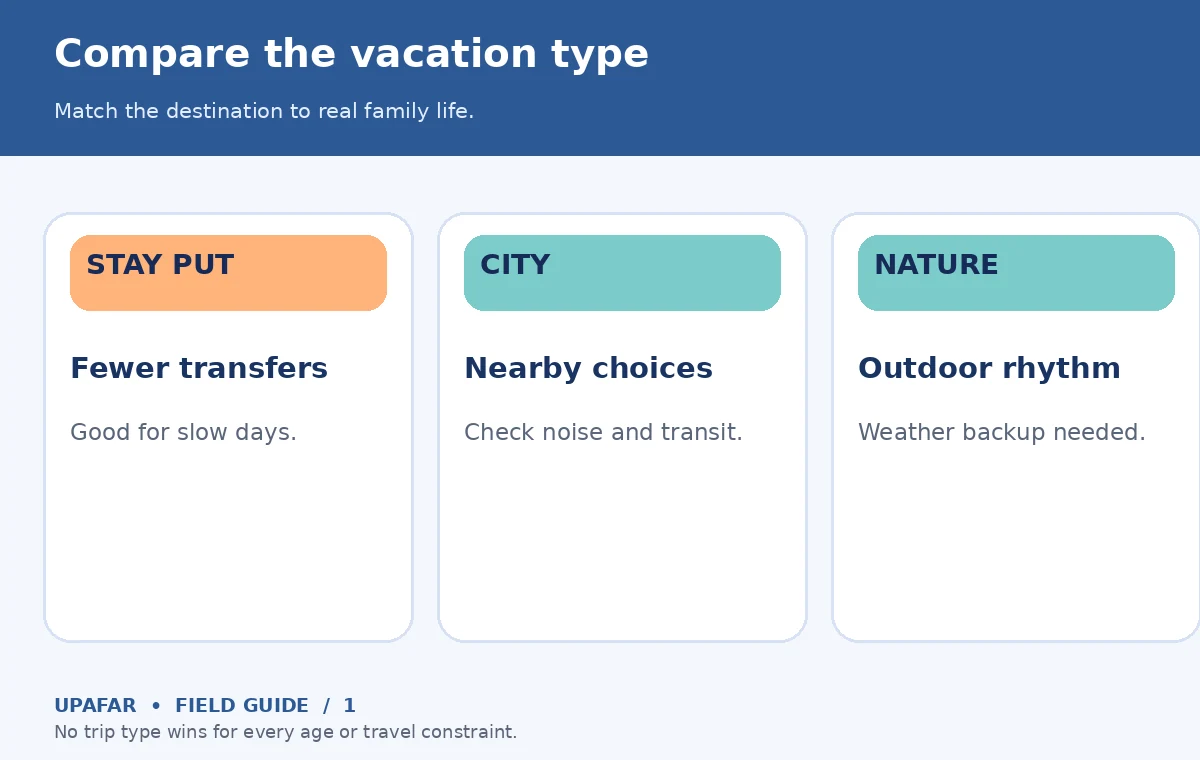
Compare vacation types using the same criteria
A stay-put beach or lakeside vacation minimizes repacking and may simplify meals, but weather can dominate the experience; check actual swimming conditions and local safety notices. A city trip can provide transit, attractions and indoor fallbacks, yet a busy center may be noisy for early sleepers. A national-park or mountain base supports outdoor time but requires careful consideration of terrain, driving distance and seasonal access. A multi-city vacation brings variety but adds transfer costs, interrupted routines and more chances to miss connections. None is inherently best for all families.
Score each candidate on five points: door-to-door travel load, sleeping arrangements, food practicality, weather alternatives and full-trip cost. Give extra weight to the category that has historically caused your family the most stress. For example, if everyone sleeps poorly in one shared room, a cheaper hotel may not win against an apartment with separate sleeping space after cleaning fees and transport are considered. Do not assume “family friendly” means that a cot, adjoining room, kitchen or car seat is included. Ask the property and transport operator to confirm availability and terms for your dates.
Price the complete family trip rather than the headline
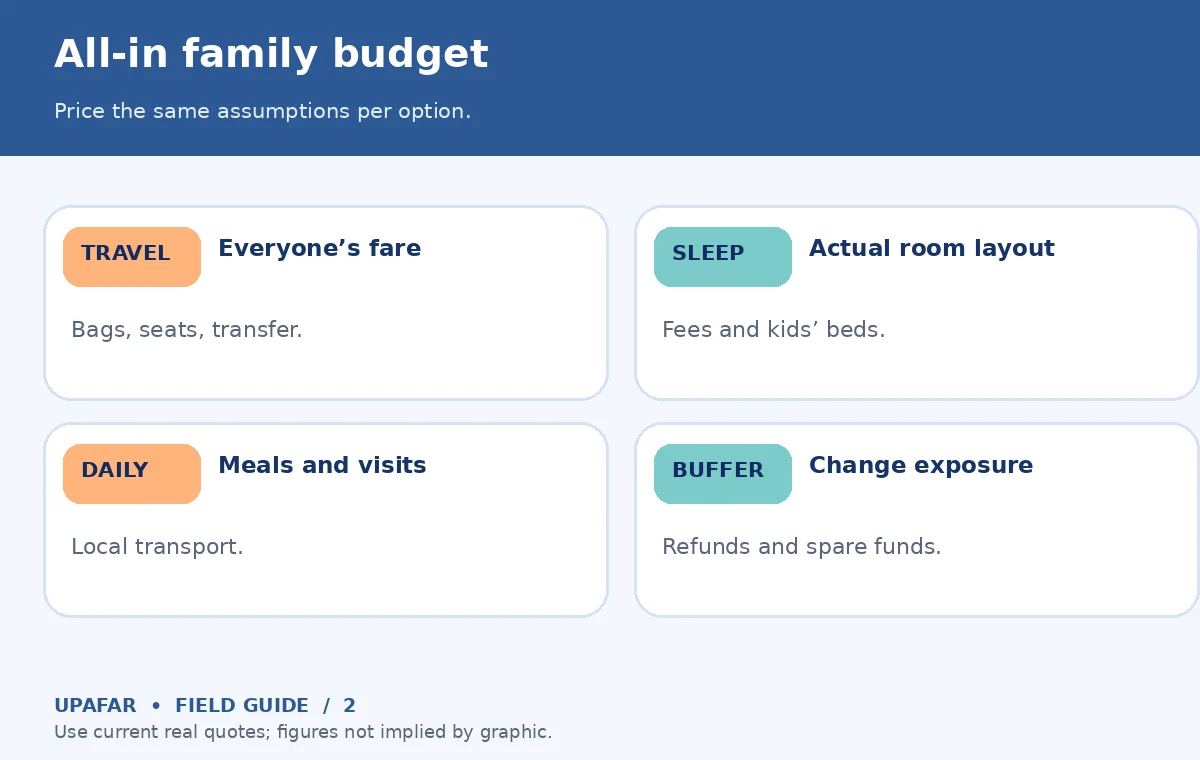
Start with transportation for every traveler: base fares, seating, baggage, ground transfers and possible overnight stays. Add accommodation using the occupancy rules that actually apply to your children’s ages. Then include meals, realistic activities, necessary transport at the destination and a contingency allowance. Compare the same number of vacation days and the same meal assumptions for every option. A purported all-inclusive deal can be appealing but still require transfers, activities, room upgrades or taxes; read the booking details rather than relying on the label.
One practical worksheet lists each candidate as a row and cost buckets as columns. Mark estimates clearly until you have genuine quotes. Track which elements are refundable and the last date to change them. A high percentage of nonrefundable spending is more consequential when school or illness may force the family to change plans. Price uncertainty should be treated as part of the choice, not hidden by a rounded grand total. For long journeys, protect a buffer for the unexpected instead of spending every available dollar on upgrades.
Check transport safety while the itinerary is flexible
Before purchasing flights or transfers, confirm the safest workable child restraint arrangements. The FAA’s Flying with Children guidance strongly recommends an approved child restraint system or device appropriate to the child’s size on U.S.-regulated flights, and states that purchasing a separate ticket for a child under two is the way to guarantee use of an approved restraint. Airline seating policies, actual aircraft layout and installation requirements can affect the booking; verify them directly. A vehicle transfer also needs suitable child restraints and safe seats, so ask exactly what is provided rather than counting on a taxi or shuttle to have the right seat.
For international destinations, the CDC’s travel-with-children guidance recommends destination-specific health preparation, including discussing the itinerary with a clinician and checking routine immunizations. Its advice is more nuanced than packing a generic “family emergency kit.” Plan ahead for any traveler who needs medication, specialized food, extra supervision or rapid healthcare access. This page does not provide individualized medical advice, vaccine schedules or country-specific entry rules.
Choose lodging by the hardest hour of the day
Think about arrival after a travel delay, an early bedtime, and the period between dinner and adults going to sleep. These are the times when room layout makes a difference. Check whether the accommodation has a reliable place to prepare or store essential food, elevator or stair access, laundry options if needed, noise separation and a bathroom arrangement that works for your group. A property far from attractions can still be pleasant for a single-resort stay; for a city vacation with many daily outings, repeated transit may erase the headline savings.
If an accommodation listing says that it sleeps four, confirm whether that means real beds for four, a sofa bed, or children sharing existing bedding. For cots, cribs, extra beds and adjoining rooms, obtain written confirmation or an explicit booking guarantee when the detail is essential. For any accommodation, review current cancellation conditions and likely local transport options. An attractive photograph cannot tell you whether the daily logistics will be manageable.
Build a booking sequence with decision gates
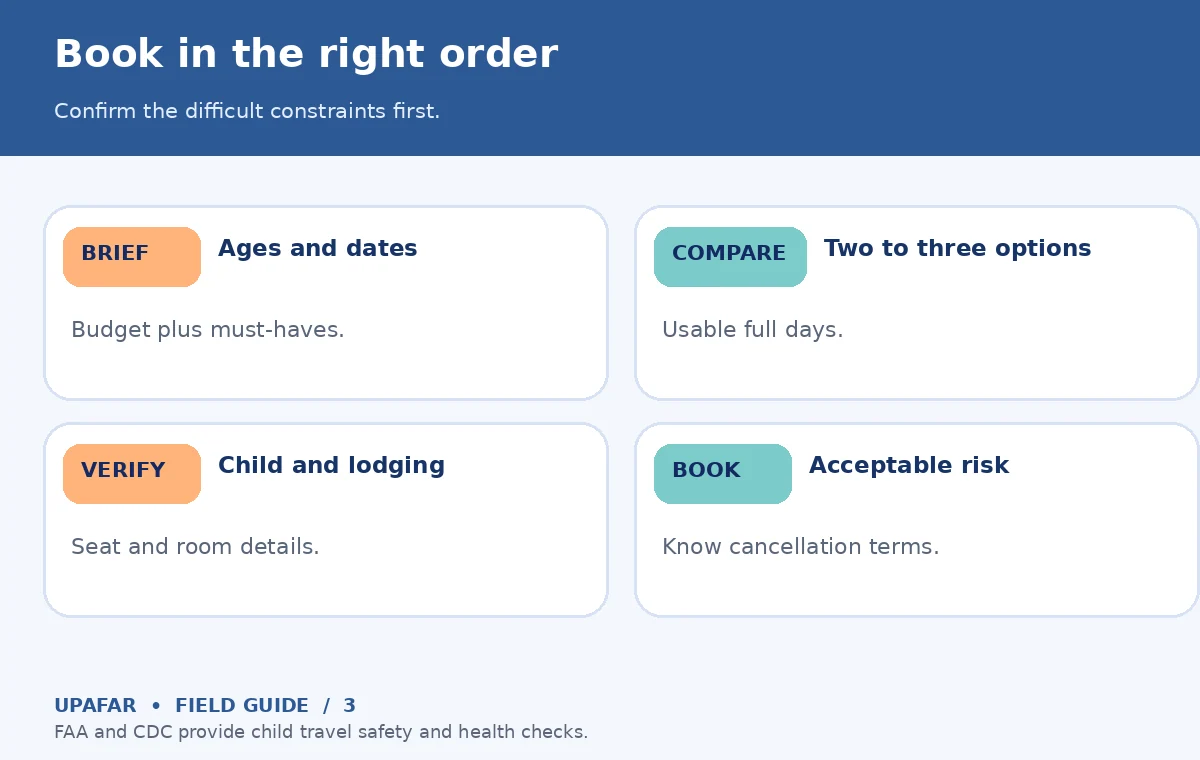
First, choose a date range and check document or school constraints. Second, select two or three destinations that meet the family trip brief. Third, estimate costs and door-to-door travel times using actual available routes. Fourth, confirm high-priority lodging requirements and child transport before nonrefundable bookings. Fifth, choose one anchor activity per day with flexible alternatives nearby. If the budget, travel load or safety requirements fail, adjust the destination or duration before paying—not after a discount deadline forces a rushed decision.
For an example, consider a family weighing three nights in a nearby city against six nights at a distant beach. The beach may offer more rest once arrived, but requires two significant travel days. The city gives fewer vacation nights yet may preserve routines and cost less overall. Do not award the longer option an automatic win. Calculate usable full days, accommodation suitability and transfer fatigue. When you can explain the tradeoffs in one paragraph to another family member, you are ready to make a booking decision.
How We Research family vacation choices
We reviewed FAA child-restraint travel guidance and CDC information on traveling with children, including the 2026 CDC Yellow Book’s family travel safety chapter, on October 19, 2026. The decision framework is editorial and does not establish live flight prices, resort services or the safety of a specific transfer provider. It intentionally differs from UpAfar’s broader family travel logistics overview by focusing on destination selection, trip-wide comparisons and booking order. There are no verified affiliate partnerships for the options discussed; see our affiliate disclosure.
Frequently Asked Travel Questions
Price the same number of usable vacation days, count transfers and lodging suitability, and include meal, activity and refund conditions.
Consider the entire trip duration, arrival time, price and child needs. A direct flight can reduce transitions but is not automatically the best choice.
No. Check the property’s actual bedding, cot rules, child occupancy and any extra charges before committing.
Consult FAA guidance on certified child restraints and airline policies. An infant’s own seat is the way to guarantee that an approved restraint can be used.
Plan one priority experience with alternatives and recovery space. Adjust for age, heat, fatigue, weather and transit rather than packing every hour.