
A useful travel budget starts with the most you can comfortably spend, not with the price of a plane ticket. Establish a personal trip ceiling, reserve money for possible changes, subtract the real cost of getting there and sleeping there, and only then calculate what is left for meals, getting around and things you want to do. That order prevents an affordable-looking flight from becoming an unaffordable vacation. This guide provides a reusable worksheet and a clearly hypothetical numerical example, not advertised destination prices or individualized financial advice.
Set a trip ceiling before comparing destinations
Write down the amount available for the entire trip without relying on borrowing, late bill payments or money required for emergencies at home. Include every traveler who will share the same fund. Distinguish a genuine savings balance from a future paycheck you have not received; dates matter if deposits are due before that paycheck. If the trip is months away, decide how much can be saved per pay period and whether the savings plan is realistic. Fidelity’s vacation-saving guide recommends keeping a budget and tracking expenses; it does not supply one correct vacation budget for everybody.
Define the time frame in nights and days. A five-night vacation might require six calendar days, two of which are substantially used by airport and transport logistics. You will still buy food on travel days, but your sightseeing allowance may differ. Record the start airport, destination airport, number of rooms, ground transport, and whether the dates are flexible. A cost estimate is only comparable with another when these assumptions match. Build two potential trips with the same length and party size before deciding that one destination is cheaper.
Separate costs that are fixed from costs you control daily
The fixed-cost column should capture airfare or ground travel in both directions; baggage and seat fees if relevant; accommodation for every night; mandatory lodging charges; airport transfers; prepaid event tickets; and any necessary documentation or health-related expenses, verified separately. Add taxes and currency conversion charges when applicable. Pet care, parking at home, or transport to the departure airport can be meaningful costs even though they do not happen at the destination. Do not bury them in a vague miscellaneous row.
The variable column includes meals, local transit, small admission tickets, coffee, optional activities and souvenirs. Assign a reasonable amount for each category based on menus, fare lists and official attraction prices you actually check for your destination. When you cannot verify a price, mark it ‘estimate’ and leave a margin rather than making the average seem authoritative. Lodging that includes breakfast changes food spending; a distant low-rate hotel may make transport costlier. Calculate all quotes for the same number of travelers and rooms, and distinguish what is refundable from what is payable immediately.
Use one realistic worksheet instead of a magic percentage
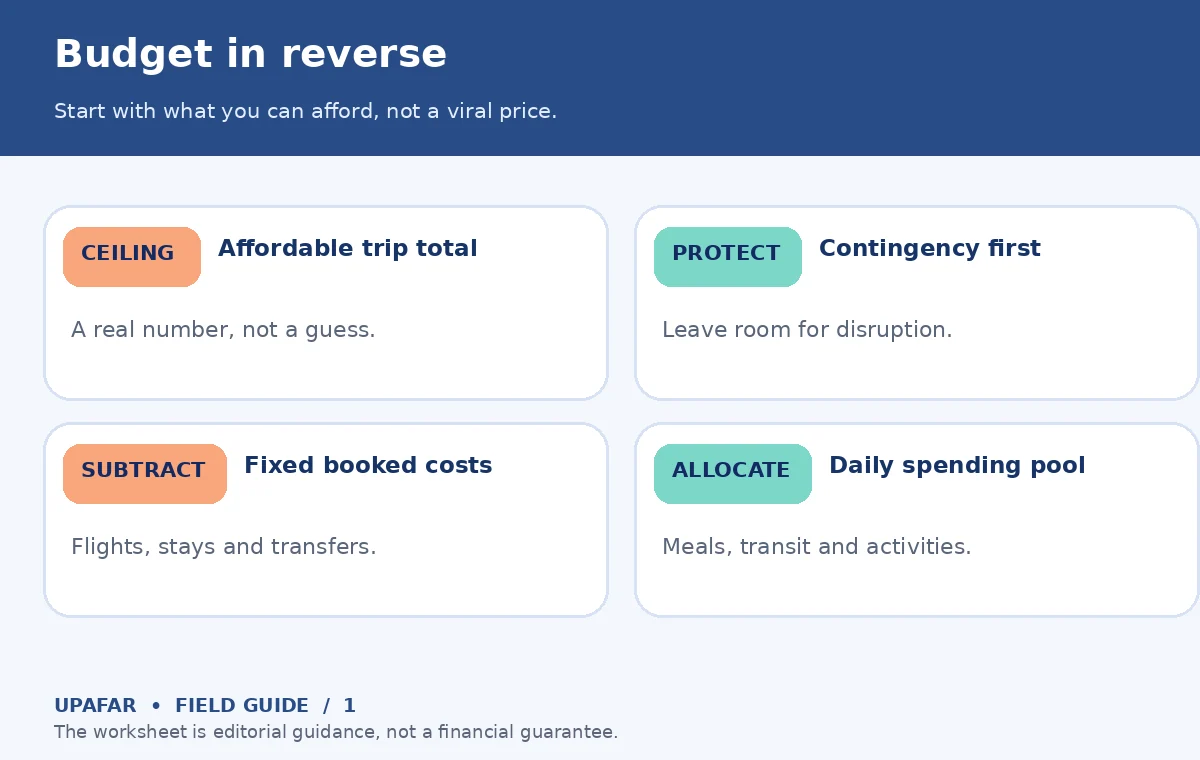
Your travel budget worksheet can be six lines: (1) affordable total, (2) separate contingency, (3) transportation fixed cost, (4) lodging and other fixed commitments, (5) flexible spending pool, and (6) daily allowance. The formula is flexible pool = total ceiling – contingency – all fixed trip costs; the daily allowance is that pool divided by the number of spending days. A positive answer does not prove the trip is affordable: check whether the resulting per-day figure will genuinely cover food and local transport. If it will not, change the itinerary before booking anything nonrefundable.
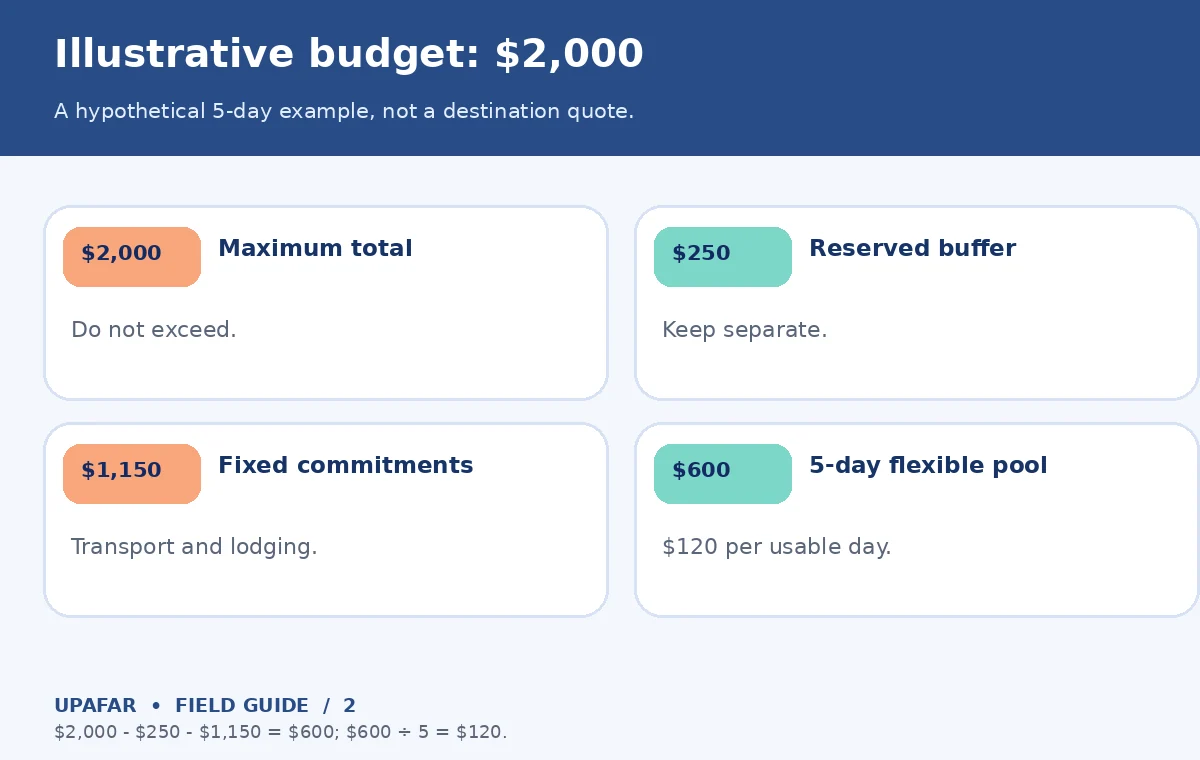
For example, imagine a completely hypothetical five-day trip with a $2,000 ceiling, $250 held aside for contingencies and $1,150 of verified fixed commitments. The flexible pool is $600, or $120 across five days. That is a calculation exercise, not a claim that lodging, airfare or meals at any real destination cost these amounts. Suppose you then want a $170 optional excursion. If the excursion is not already part of the fixed total, you either decrease the remaining flexible pool to $430 (an $86 daily average), replace another expense, or choose a different experience. Spending the contingency to disguise an otherwise negative budget defeats its purpose.
Check mandatory fees and the final payment amount
A room advertised at one rate may create a different final payment after required charges and tax. In the United States, the Federal Trade Commission’s rule on unfair or deceptive fees, effective May 12, 2025, requires sellers of covered short-term lodging to present an upfront total including known and calculable mandatory fees, subject to limited exclusions. Taxes and certain optional charges may be shown later but must be disclosed before payment. This is a pricing-disclosure protection, not a ban on fees or a guarantee that a particular booking is the lowest price. Outside its scope, different consumer protection regimes apply; always inspect the final breakdown.
Compare fares in the same way. One airline ticket may include checked luggage while another adds the charge, and a tight connection may require a more costly ground transfer. Treat change fees, deposit schedules, cancellation deadlines and nonrefundable portions as part of your risk exposure, not as tiny print to be checked after purchase. The FTC’s advice on avoiding travel scams also warns against travel offers that lack clear details or pressure you to pay through unusual methods. Do not send a deposit to an unverified contact simply because a screenshot advertises a bargain.
Compare trips using the same number of usable days
A four-night city break with a direct transfer can produce more actual time exploring than a five-night itinerary requiring two internal flights. Compare an approximate cost per usable day alongside total cost, but do not turn that metric into a substitute for comfort or safety. The usable-day figure is editorial: count days when the planned activities are realistic after arrival, check-in, fatigue and travel. A less expensive route that costs an extra transit day may still be right for a flexible traveler, but it should be a conscious tradeoff.
A helpful comparison table has columns for option A and option B and rows for total cost, nonrefundable commitment, flight or train hours, nights in a bed, transfer legs and daily allowance left after fixed costs. You might find that shortening the trip by one night saves more than hunting for a marginally cheaper restaurant every day. Conversely, paying a little more for accommodation near your main activities might reduce transfers enough to be worth it. Neither choice can be decided accurately without actual dates and quotes.
Adjust the big levers before eliminating essential spending
If the budget fails, change one constraint at a time. Try different travel dates, a closer destination, fewer lodging changes, a shorter stay or fewer expensive paid activities. Do not start by zeroing the meal budget or assuming a medical, travel-document or safety expense can be skipped. Check whether a refundable booking is worth more than a cheaper inflexible deal, especially when plans depend on seasonal weather or another person’s schedule. Re-run the formula after every major itinerary edit so that saved dollars remain visible rather than being absorbed into untracked extras.
If the flexible amount is not enough for realistic daily expenses even after adjustments, the best decision may be to defer the trip and save longer. That is a valid planning outcome, not a failure of the worksheet. For group trips, agree in advance on what is shared, how payments are divided and what happens if someone cancels. Collecting money from friends is not the same as having everyone committed to the same cancellation risk.
Monitor spending without turning the vacation into bookkeeping
Before leaving, record the fixed expenses already paid and those still due. During the trip, track the combined daily flexible spending rather than imposing an exact cap on every meal. A higher-activity day can be offset by a lighter day as long as the remaining pool stays healthy. Use a simple note with three figures: total pool, spent to date, and days left. Update after large purchases or withdrawals, and remember that some transactions may post later or settle at a different exchange rate.
Do not repeatedly convert the reserved contingency into available shopping money just because it appears unused midway through the vacation. A buffer is designed for a problem that may occur at the end. Leave some room for the final airport trip, baggage changes and an unplanned extra night. For currency expenses, note the exchange rate assumption and compare transaction totals with your own bank statement rather than assuming a fixed rate for the entire trip.
Make the final booking decision on evidence
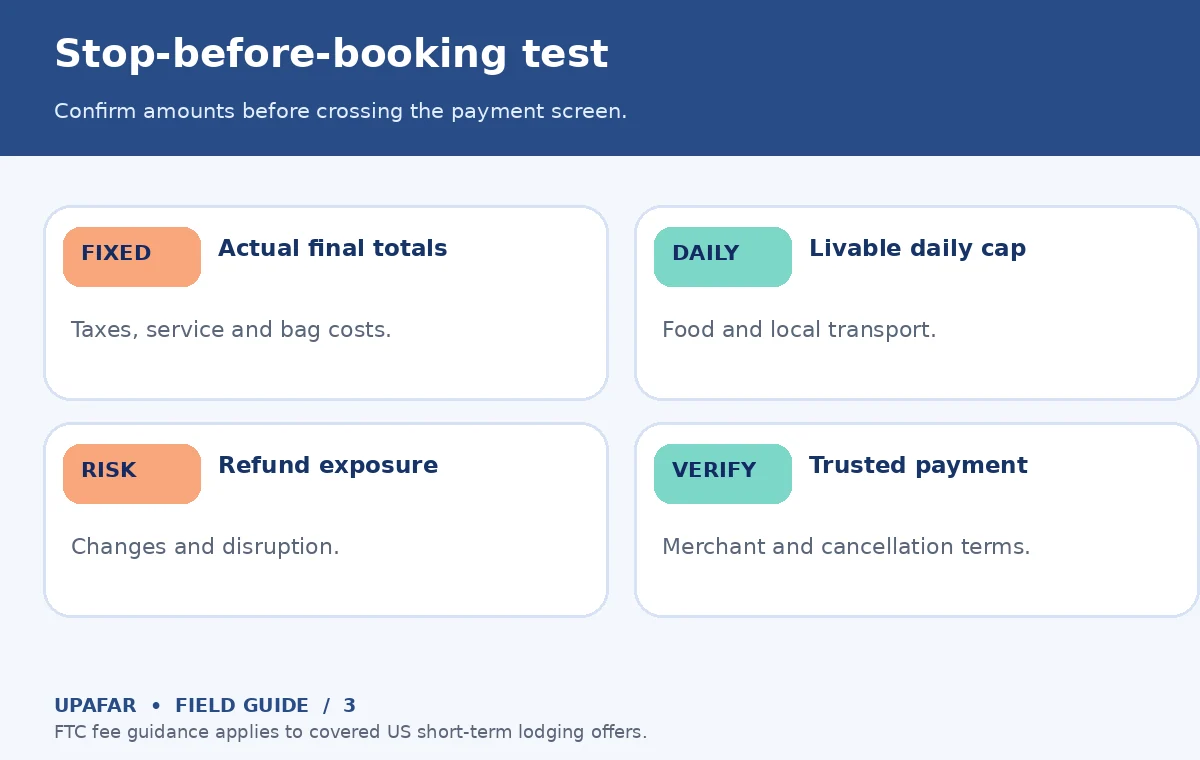
Before paying, answer four questions: Can we afford the final prices shown for the exact dates and travelers? Does the money remaining after fixed bookings cover normal food and local transport? Is the contingency separate and reasonable for our exposure? Do we understand who takes payment and what is refundable? If any answer is unknown, mark the trip on hold until you obtain the missing information. A quote that expires today is not a reason to make a financially unsafe purchase.
Keep a snapshot of the assumptions, booking confirmations and actual spending notes. Afterward, compare the final cost with your original categories rather than judging success by whether you overspent on one meal. The difference will help your next budget; it should not be presented as an industry-wide destination price guide. UpAfar does not guarantee prices, exchange rates, travel deals or affiliate savings.
How We Research travel budget planning
We checked Fidelity’s consumer guidance on vacation savings and the FTC’s official short-term lodging fee rule and travel-scam advice on October 19, 2026. We independently built and checked the simple $2,000 example to demonstrate how a ceiling, buffer and fixed commitments relate. No destination prices, rates, airline fares or product reviews were collected, and the calculations are illustrative rather than live quotes. This article provides general planning information, not financial advice; see UpAfar’s affiliate disclosure. No paid partnership is asserted.
Frequently Asked Travel Questions
Start with a total you can afford without compromising essential bills or emergency savings, subtract a contingency and fixed trip costs, then divide the remainder by usable travel days.
No. Your daily allowance is the variable on-trip portion; it must not conceal airfare, lodging, transfers, taxes, fees or money reserved for changes.
There is no universal percentage. Size a separate contingency to plausible disruptions, refundable versus nonrefundable reservations and your financial capacity.
In the United States, the FTC fee rule requires covered sellers to display known, calculable mandatory fees in the advertised total, with limited exclusions. Always verify the final payment and specific terms.
Shorten the itinerary, reduce lodging moves, compare travel dates or choose fewer paid activities. Remove discretionary costs before cutting essentials or ignoring a contingency.