
A boat tour can be the best way to see a harbor, shoreline, marine habitat or island from the water. It can also be a poor use of a limited vacation day when the route is vague, the vessel does not suit your group or the operator’s weather policy is unclear. The strongest choice begins with the experience you want, then screens safety, conditions, transport and cancellation terms. No advertised sightseeing route guarantees calm water, accessible boarding or wildlife sightings.
Decide whether the route justifies being on a boat
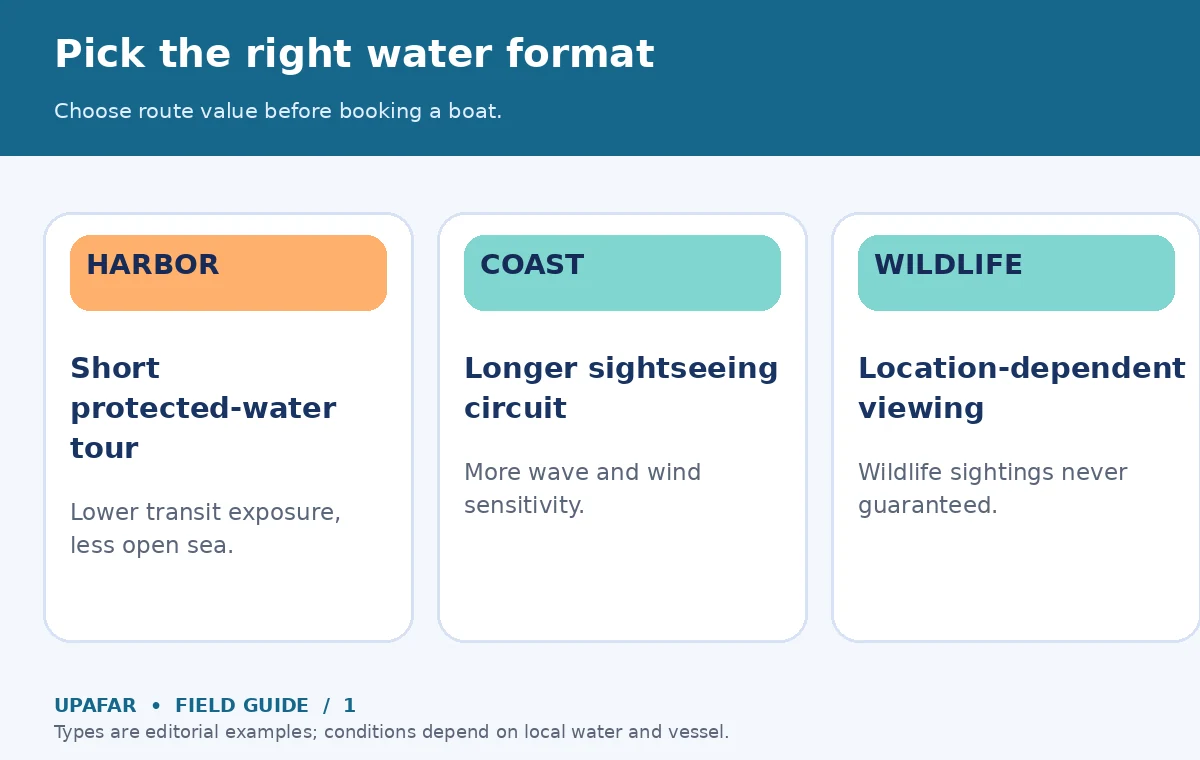
Ask what the boat makes possible that a waterfront walk, ferry crossing or land-based viewpoint cannot. A short guided harbor loop may deliver architecture and history with little travel away from a city. A coastal circuit may offer distant cliffs or open-water scenery but can consume much more time in transit. Wildlife-oriented trips depend on animal behavior and conditions; photographs and seasonal descriptions are not a sighting guarantee. Start with a map of the proposed route and the distinct views or stops you will actually get.
Compare the departure port, the route’s approximate open-water exposure, whether passengers remain on board, the total advertised duration and the return port. A two-hour trip can require substantially more than two hours of your day once you add transport to the pier, early arrival, security or boarding instructions, and the trip back. Treat a remote boarding point as a separate transfer decision. If your next activity has a timed entry, avoid making it depend on a boat landing exactly on schedule.
Compare shared cruises, small boats and private charters
A shared sightseeing vessel can offer guided interpretation, predictable seating and a structured timetable. A small boat may reach narrow waterways, but its comfort and exposure to chop can be very different. A private charter offers scheduling flexibility when the operator permits it; it does not automatically mean better safety equipment or a more qualified captain. Ask about passenger capacity, covered and uncovered seating, restroom availability, wheelchair or step access, and whether participants must be able to climb a ladder to reboard after swimming.
For a family or a group with motion sensitivity, comfort is part of suitability. Look for shade, a reliable place to sit and a realistic ability to step away from spray or engine noise. If you are prone to seasickness, the route’s waves and the boat’s motion matter more than promotional phrases like smooth sailing. Request vessel details rather than inferring them from a stock photograph. Anyone with a specific medical concern should consult their clinician before choosing a water activity.
Verify the operator before you pay
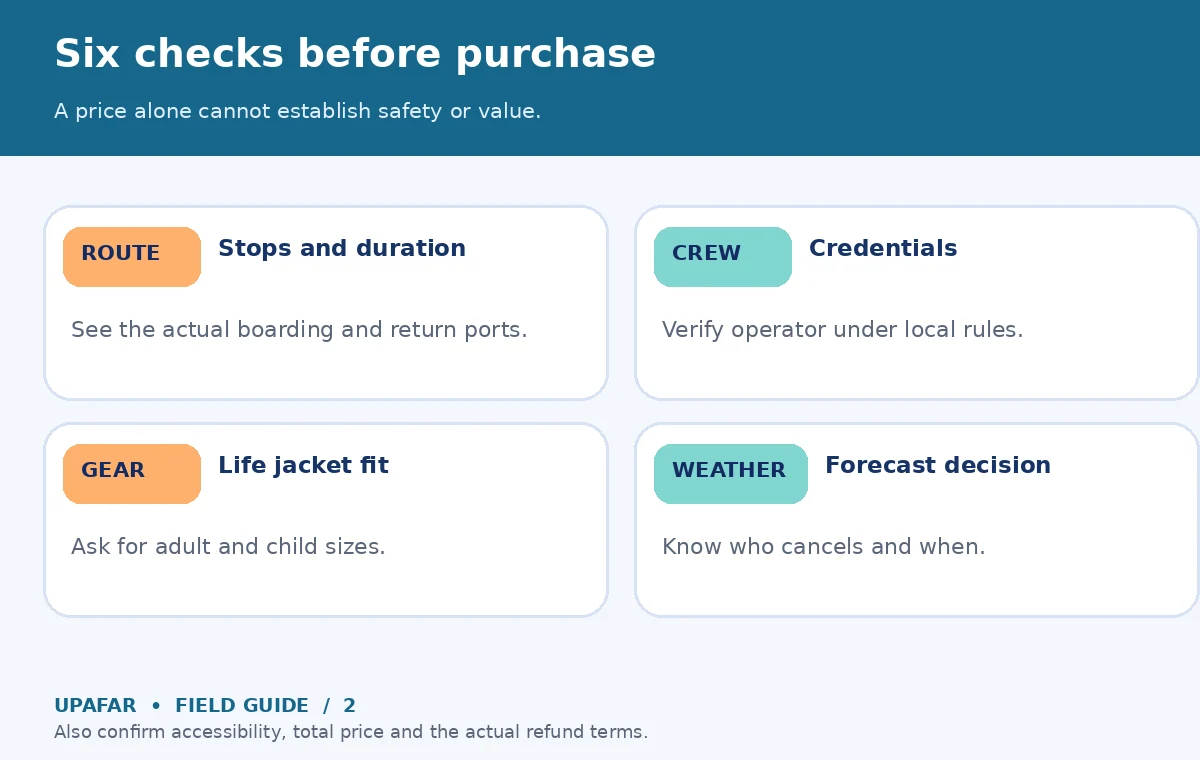
The U.S. Coast Guard’s August 31, 2026 charter advisory tells passengers to check the captain’s credentials and, for US charter vessels carrying more than six passengers when applicable, a Coast Guard-issued Certificate of Inspection. That is a US-specific example, not a universal legal test for every destination or tour. In other countries, identify the relevant local maritime authority and ask what authorization applies to this operator and vessel. An online booking page alone does not prove compliance.
Before payment, get the operator’s complete name, departure location, actual boat type, total charge, age restrictions and contact channel. Ask what briefing passengers receive, who makes the final go/no-go call, and whether properly sized life jackets exist for every traveler. The Coast Guard’s life-jacket guidance emphasizes correct fit and activity suitability. A child-sized label is not a substitute for checking that a jacket actually fits the child. If those questions cannot be answered convincingly, choose another activity.
Understand weather and cancellation as separate decisions
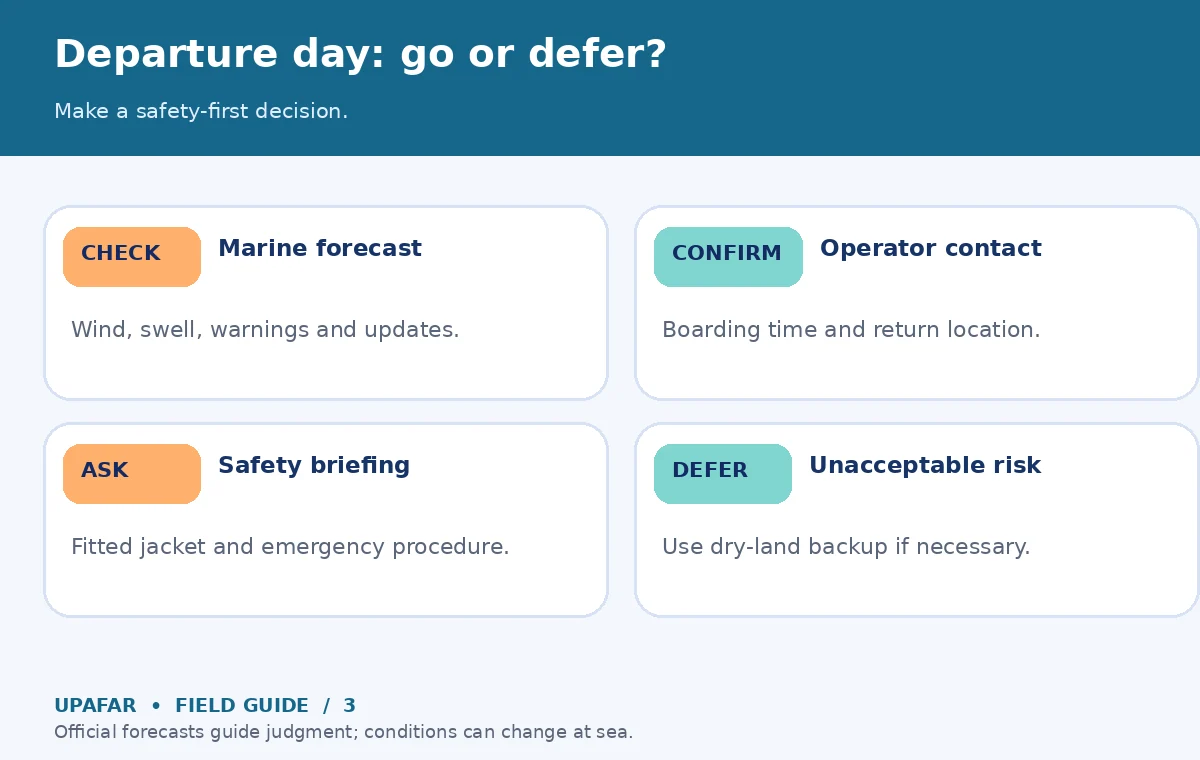
Marine forecasts cover wind direction, wave heights, sea state and warnings, not just whether the sky looks sunny. The National Weather Service’s boating guidance explains how conditions can change rapidly and why forecasts have ranges. Operators may cancel for conditions that look pleasant from shore, or adjust their route for calmer water. Do not press a crew to depart after a safety decision. Check the latest localized marine forecast and any official warnings on the day rather than relying on a weather-app symbol several days old.
A booking can have several distinct outcomes: the operator cancels, the traveler cancels, the tour runs with fewer stops, or passengers decline a trip after meeting at the pier. These may produce different refunds and rebooking options. Save the provider’s specific terms before paying, including how you will be notified and whether a full refund or a voucher is offered when the operator cannot sail. Ask when the final decision is made and how an early-morning cancellation affects your transport to the dock.
Build a practical cost and time comparison
Do not compare only the headline ticket. Include getting to and from the pier, any mandatory port charges, equipment rental, meals, gratuities if customary and any nonrefundable transfers. For an illustrative, entirely fictional choice, imagine Tour A is a 75-minute harbor loop from the city and Tour B is a three-hour coastal cruise that requires a one-hour transfer in each direction. Tour B might reveal more coastline, but consumes roughly five hours plus check-in instead of a short city outing. Choose based on what the extra travel gives your group.
On an excursion with swimming or snorkeling, verify whether the water activity is optional, what supervision or instruction is provided, what equipment is included, and whether there is an easy way to stay aboard. Do not treat swimming ability, an inflatable toy and a correctly fitted life jacket as interchangeable. For children, require active adult supervision around water and confirm that the boat accepts their ages and sizes. For travelers with limited mobility, get exact boarding and emergency-access information in advance rather than a vague assurance of accessibility.
Pack for spray and leave room for a route change
Carry only essentials: weather-appropriate clothing, sun protection, secure footwear for the vessel, drinking water where permitted, a waterproof pouch for documents and any medication you may need during the trip. Secure loose hats and phones before boarding. If the boat has enclosed space, it may still be cool or windy on deck. Do not bring hard-sided luggage unless the operator explicitly accepts it. For a professional camera or drone, check vessel policies and applicable local restrictions first.
Save the actual meeting-point pin and instructions offline, along with the operator’s number and reservation confirmation. Schedule at least one alternative onshore activity. If high winds cancel a coastal cruise, a waterfront museum or historic district may preserve the day’s value without tempting your party into an unsafe replacement ride. The safest itinerary is one that still works when a boat does not go out.
How We Research boat-tour decisions
We prioritized the US Coast Guard’s 2026 operator advisory, National Weather Service marine forecast guidance and Coast Guard life-jacket fit information; they were reviewed October 19, 2026. The decision diagrams are editorial frameworks rather than incident statistics or forecasts. We do not recommend or certify a particular operator, assert ticket availability or claim to have sailed any described route. Check destination-specific requirements, current weather and contract terms directly before booking. UpAfar’s affiliate disclosure explains our linking policy; there is no claimed paid partnership for this guide.
Frequently Asked Travel Questions
Check local licensing and passenger-vessel requirements, the exact operator and vessel, and safety information. In applicable US charter operations, the Coast Guard recommends checking captain credentials and a Certificate of Inspection where required; other jurisdictions differ.
Do not assume fit or availability for your party. Ask about appropriate sizes for every passenger, accessibility and the crew’s safety briefing before booking.
Rain alone may not stop a service, but marine wind, waves, thunderstorms and operator rules can. Ask about weather cancellation decisions and refunds.
No. Passenger count and price do not establish safety. Evaluate the vessel, competent crew, applicable credentials, safety equipment and weather policy.
Compare the revised stops, duration and refund policy against the experience you paid for. If conditions make the trip unsafe, do not pressure the crew to depart.