
An airport transfer is the journey between an airport and your next real destination: hotel, home, station, resort, or another airport. The best mode depends on arrival time, where you actually need to go, baggage, mobility, group size, and tolerance for waiting. Do not pick a taxi, train, bus, or prebooked car solely by headline price. Compare the complete terminal-to-door trip and have a backup if your flight is delayed. Airport operators publish pickup locations and transport categories, but schedules, charges, restrictions, and availability need checking for your specific arrival.
Start With the Actual Terminal and Destination
First write down the airport code, arrival terminal if known, address of the final destination, and whether anyone needs accessible travel. Several airports serve the same metropolitan area, and a hotel labeled “airport hotel” may still require transport. Find the official airport’s ground-transport page, not a search advertisement that merely uses the airport name. Compare each service at the actual arrival point: rail platform or station, coach stop, taxi rank, app-designated pickup area, and any meet-and-greet location. Distances inside the airport matter, particularly with children or multiple bags.
Next trace the trip all the way to the door. A train may cover the longest distance quickly but still require walking, stairs, a local bus, or a taxi after the city-center station. A door-to-door car simplifies luggage handling but may be affected by road traffic and variable pickup arrangements. For groups, calculate the cost per vehicle and total baggage capacity rather than multiplying a solo traveler rail fare by guesswork. For late arrivals, ask whether the proposed mode operates after you have cleared immigration and collected bags, not merely at the scheduled flight arrival time.
Compare Rail, Bus, Taxi, and Prebooked Car
Rail is often attractive for destinations near stations and travelers comfortable moving their bags through the network. Bus or coach service may serve neighborhoods or cities not convenient by rail, but check stop locations and how much walking remains. Taxis can offer direct travel with local queue arrangements and fare systems. Rideshare availability and pickup points are airport-dependent, while a booked private transfer can offer a defined meeting process but still needs a clear late-flight policy. None of these modes is universally the cheapest, fastest, or easiest for every airport.
Heathrow’s official airport pages illustrate the range: it publishes rail, Underground, bus/coach, taxi, minicab, and journey-planning information. Bangkok Suvarnabhumi’s official airport page likewise distinguishes taxis, app-based vehicles, limousine services, buses, rail and other options. The useful common principle is that airport-by-airport details matter. A pickup instruction appropriate for one terminal or city should never be generalized globally. Verify the latest accessibility, passenger limits, operating hours, fares, and service notices on the airport or operator’s own site before making a reservation.
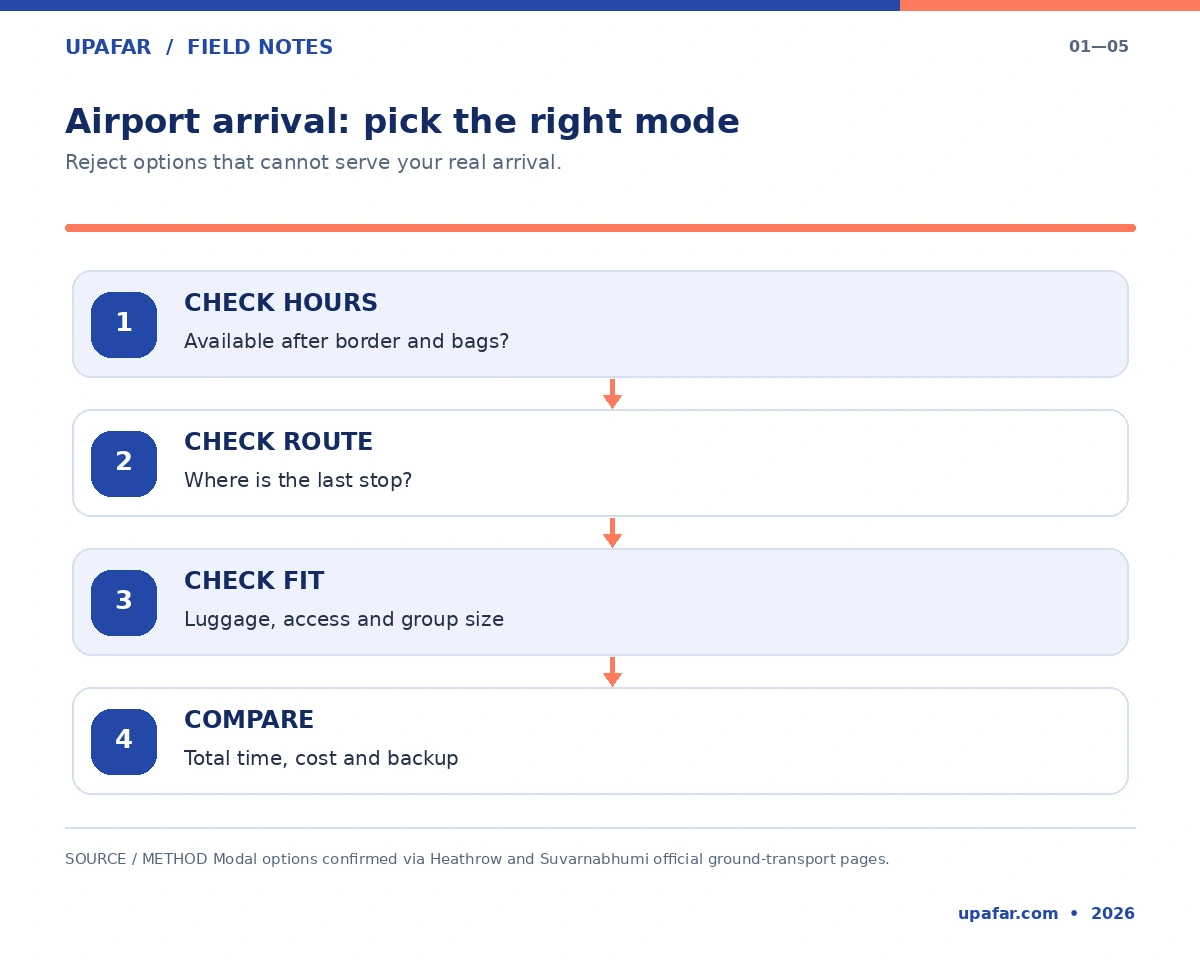
Use Four Questions to Eliminate Bad Options
Question one: Is the service operating at the time you are likely to be ready to leave the terminal? Add immigration, baggage, and any meeting-point travel to your mental estimate. Question two: Can your party handle the walking and baggage transfers required? Question three: Is the final stop close enough to your actual accommodation? Question four: what is the realistic total price, including all passengers, baggage rules, and any airport or waiting charges? If an option fails a nonnegotiable condition, discard it regardless of how favorable its headline fare appears.
A solo traveler with one light bag and a hotel near a rail station may favor rail. A couple with several suitcases arriving after a long-haul flight may place more value on a direct car. A larger family may require a vehicle with sufficient seating and luggage space, and a traveler using mobility aids should check accessibility details in advance. Those are scenarios, not guarantees about transport networks. The correct choice comes from the specific route and capacity constraints, not a blanket rule such as “always book an airport taxi.”
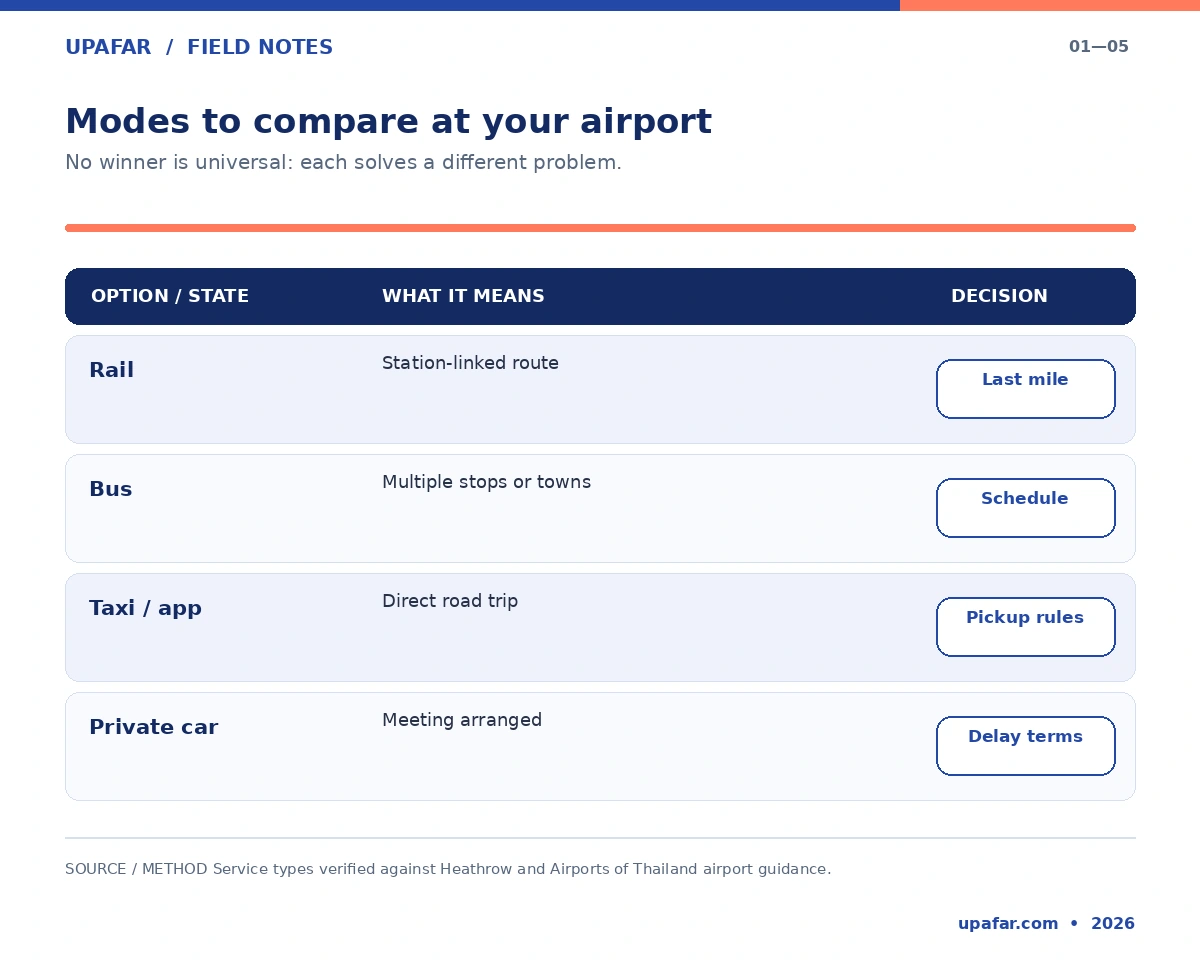
| Mode | Common strength | Check before choosing |
|---|---|---|
| Train or metro | Predictable rail corridor where available | Station access and last-mile journey |
| Bus or coach | Useful route/stop coverage | Service hours, luggage rules, stop location |
| Taxi or app-based car | Direct destination travel | Authorized pickup, fare terms, vehicle fit |
| Prebooked transfer | Planned meeting and vehicle | Delay policy, contact and waiting terms |
Know the Difference Between Transfer Types
A shared shuttle, a scheduled public bus, a direct private car, and a hotel courtesy shuttle are not interchangeable services. They can differ in waiting arrangements, stops, baggage limits, booking requirements, and whether they operate only for hotel guests. A separate UpAfar Airport Shuttle article is planned to cover shuttle-specific details. Here, focus on selecting between broad transfer modes and verifying the terms of whatever you choose. If a hotel claims a transfer is included, confirm whether it is complimentary, reservation-only, restricted to certain hours, or part of a paid package.
If you must change airports, that is a higher-risk journey than an ordinary transfer to a hotel. Heathrow’s official guidance explicitly advises allowing time for immigration, luggage collection, check-in, security, waiting and possible traffic or service changes. Do not treat a map-estimated driving time as the full connection requirement. Check whether two flight segments are on one ticket and whether the transfer is the traveler’s responsibility. Re-evaluate the full air itinerary before booking a seemingly cheap connection that depends on a tight cross-city transfer.
Prebook Only With a Clear Pickup Plan
If using a booked driver, confirm the company name, contact method, flight-number tracking policy if offered, exact terminal meeting point, included waiting time, late-arrival rules, cancellation terms, and what vehicle will fit your party. Ask what happens if your flight diverts or a terminal changes. For taxis and app-based cars, follow official airport pickup directions and use designated ranks or app instructions. Do not assume an unsolicited driver inside arrivals is your confirmed ride. When service claims appear inconsistent, contact the provider using a verified channel rather than a number supplied by an unknown person.
For public transport, save the correct operator journey planner, final stop, and walking directions to your accommodation. Check whether you need a separate ticket for airport rail access or an onward transit line, but do not rely on a quoted flat fare without verifying it. For all modes, keep the accommodation address in a form you can show a driver or staff member. If you expect no mobile data on arrival, store the meeting instructions and backup route offline.
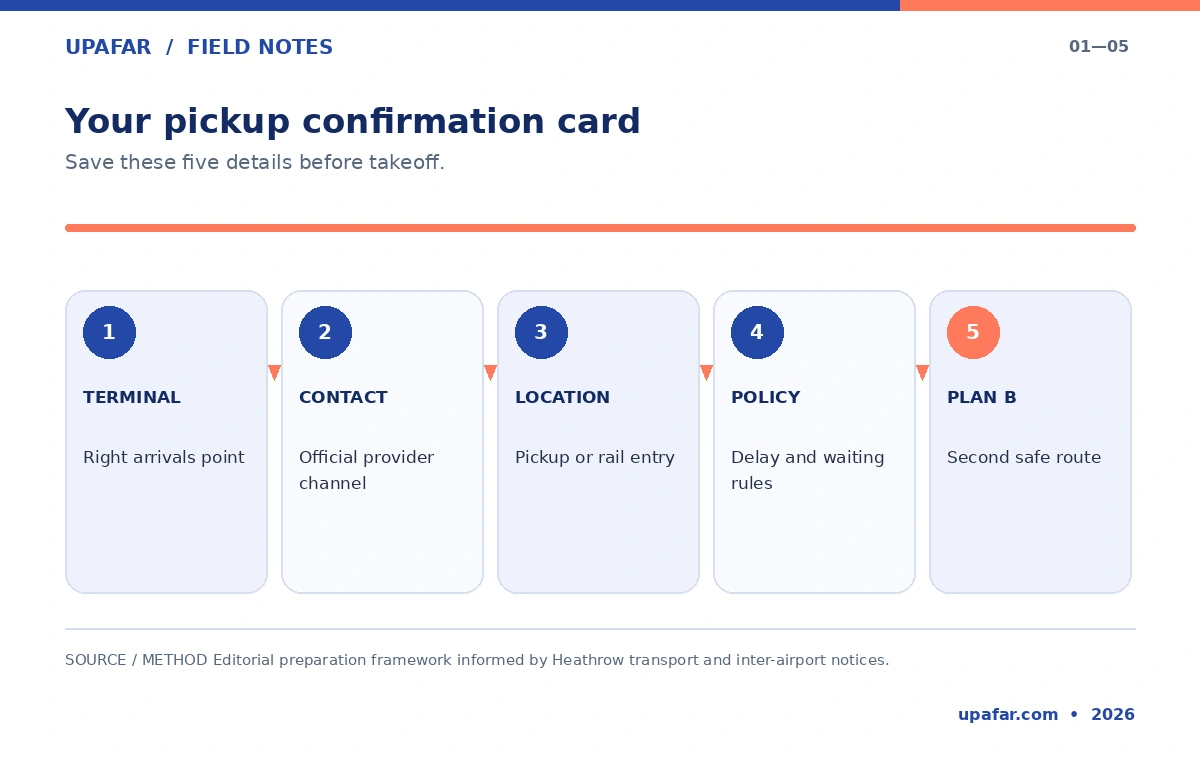
Have a Backup Before the Flight Lands
A useful backup is not “take any taxi.” Write down one alternative mode that fits your luggage and arrival time, a verified airport pickup location, and a maximum spending limit. If rail is the primary plan, know where the official taxi queue is. If a prebooked car is the primary plan, know how to contact the provider and what happens after a delay. For an early-morning departure, reverse the calculation: arrive at the correct terminal with sufficient check-in and security time according to the airline and airport, rather than using arrival-transfer assumptions backwards.
How We Research and Keep This Guide Current
This guide separates lasting decision methods from rules and prices that can change. We checked the following primary sources on October 19, 2026: Heathrow official transport options (airport train, bus, coach, taxi and private-hire modal choices); Heathrow transport between airports (need to account for passport checks, baggage, security and service variability during airport connections); Airports of Thailand Suvarnabhumi ground transport (airport-specific official ground-transport categories and terminal pickup processes). Examples and visual decision tools are editorial frameworks, not live quotes or guaranteed offers. Recheck operators, carriers, airports, and government requirements for your exact trip. UpAfar may earn a commission on qualifying links if relationships are activated; our affiliate disclosure explains how referrals are handled. No booking prices or availability are asserted here.
Frequently Asked Questions for This Topic
A shuttle is one possible transfer service. Airport transfer is the broader trip between the airport and another destination.
Consider booking when vehicle capacity, accessibility, late arrival, or an unfamiliar destination makes a confirmed pickup valuable. Check the delay and cancellation terms.
No. Consider the whole party, station access, last-mile cost, and service hours against other modes.
Allow for arrival procedures, baggage and meeting-point travel. Confirm the driver’s flight-delay policy instead of assuming one universal buffer.
It is risky to judge by driving time alone. Include immigration, baggage, new check-in, security, waiting and delay exposure.