
Traveling with children gets easier when adults plan the moments that are hardest to improvise: airport security, a delayed meal, a nap that disappears, a transfer without the right seat, or the first evening in an unfamiliar room. Rather than another family destination shortlist or vacation budget, this guide is a day-of operating plan. Assign who carries what, keep the most important items immediately accessible and make one low-effort backup for each major transition. Adapt the details to your child’s age, abilities and health needs.
Plan from departure to the first night's sleep
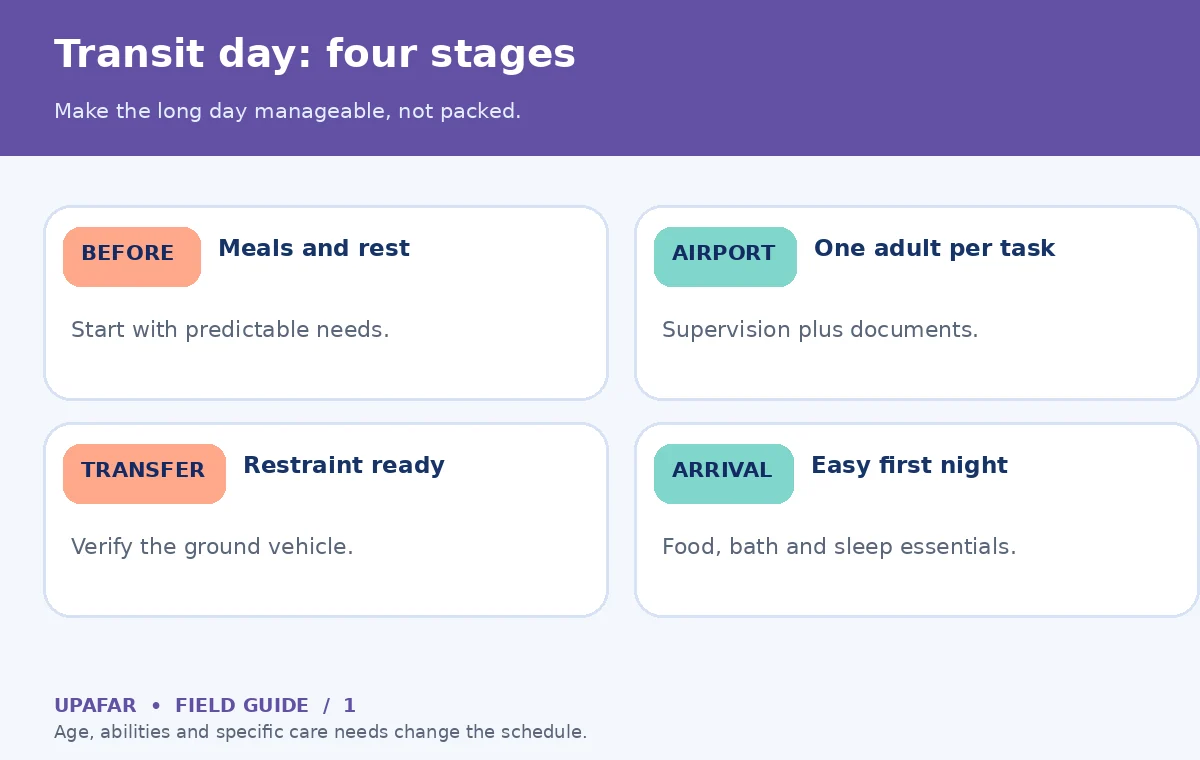
List the day in order: leave home, reach the airport or station, check in, pass security, wait, travel, collect bags, transfer, get into the accommodation, eat and sleep. Then circle the stages when the child will likely be hungry, overtired or unable to move freely. These are the moments where added buffer is most valuable. A schedule that looks efficient for two adults can become fragile when one parent is handling documents while the other must supervise a toddler near a busy curb.
Choose one adult as the lead for passports, tickets and payments at each stage, and another as the lead for direct child supervision where possible. Roles can switch, but they should not be assumed. A solo caregiver can put documents in one predictable place and minimize the number of loose bags. Aim to have the arrival transfer confirmed and the first meal plan simple; do not book a demanding evening activity just because the destination has plenty to see.
Pack one immediately accessible family kit
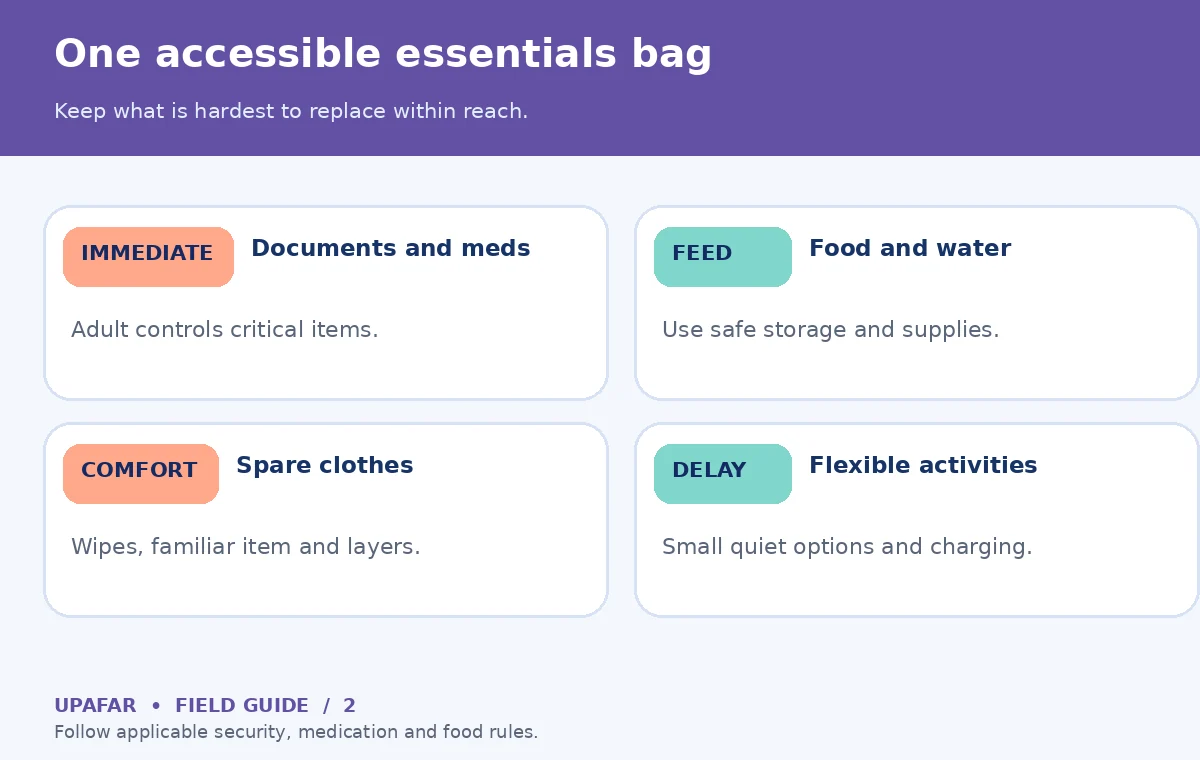
Use a small bag that can be reached without opening the main suitcase. Include identification and travel documents, required medicines, wipes or hand-cleaning supplies, diapers or other care items, a comfortable spare outfit, layers, essential feeding supplies, snacks appropriate for the child and one or two familiar low-mess activities. For babies, bring enough feeding items to cope with likely delays while following safety and storage rules. Pack a small bag for soiled clothing. An extra set of adult clothes can also be useful if there is room.
Give frequently needed items consistent places: food in one compartment, medicine in another, documents in an adult-controlled pouch. Do not make small children responsible for irreplaceable items. Save confirmation numbers and key addresses offline. If an airline takes your cabin roller at the gate, your family kit should remain with you and comply with the carrier’s personal-item rules. Keep batteries, medical necessities and valuables in the accessible bag according to security and airline restrictions.
Confirm safe restraints for the air and ground legs
For US air travel, the Federal Aviation Administration strongly recommends approved child restraint systems rather than holding an infant in a lap. A ticket for a young child makes use of an approved seat possible, subject to airline and aircraft compatibility. Check the seat’s aircraft-use label, the manufacturer’s fit rules, airline seating arrangements and any restrictions for particular rows. Do not assume a regular booster or baby carrier substitutes for an approved aircraft restraint in all phases of flight.
Ground transport also matters. The CDC’s child passenger safety guidance emphasizes age- and size-appropriate car seats, boosters and seat belts. Ask the airport-transfer provider whether a suitable restraint is available and whether its installation will be supported; do not assume taxis supply the appropriate seat. For international travel, confirm local law and the equipment’s vehicle compatibility. A safe plan covers the ride to the departure airport, the flight and each vehicle after landing, not just the longest leg.
Use meals, hydration and sleep as scheduling anchors
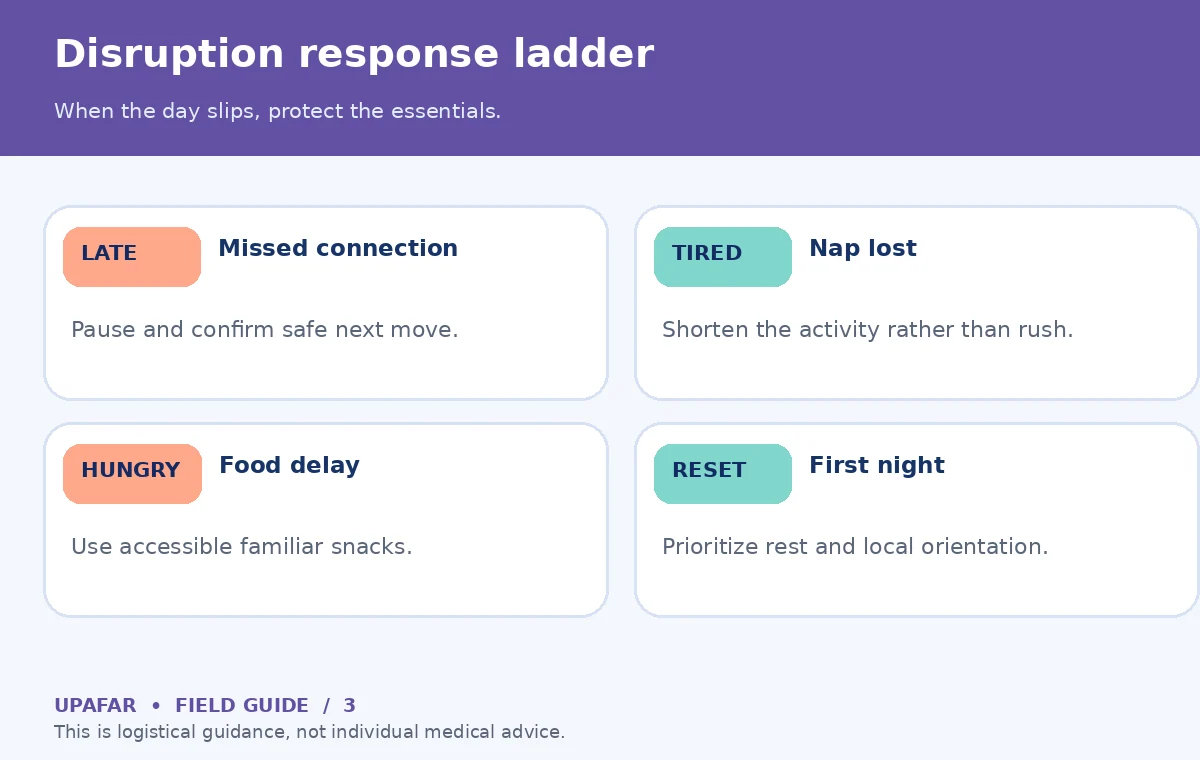
Children may tolerate a long museum visit but struggle when it overlaps with a missed meal or familiar bedtime. Build a day around likely food and rest needs, then fit one primary activity in the most reliable window. The CDC Yellow Book’s guidance on travel with infants and children covers disruptions to sleep, safe feeding and the risk of dehydration during illness. Use reliable drinking water and safe food handling appropriate to the destination. For children with medical or dietary needs, follow clinician advice and carry the necessary supplies.
When moving across time zones, expect that a child might wake earlier, nap at an odd hour or tire before dinner. There is no guaranteed trick that eliminates jet lag. Keep light, meals and the sleeping environment as consistent and calm as reasonably possible, while allowing extra recovery time. In the first twenty-four hours, a nearby park and an early night can be more valuable than an expensive multi-stop tour. Aim to protect routines without becoming rigid about the exact clock time.
Handle airports and long waits in small steps
Make a simple boarding sequence: use the restroom or changing facilities, refill water where permitted, check travel documents and seat numbers, distribute snacks or activities, and move to the correct gate before queues become urgent. If the child is old enough, describe what will happen next in short concrete sentences. For very young children, quietly rotate a few familiar activities rather than presenting an entire collection at once. A long security line becomes easier if one adult can handle screening instructions while the other is ready to guide the child.
If a flight or train is delayed, prioritize basic needs first. Confirm the revised departure, find a safe place to sit, secure food and water, then decide how to adapt the arrival plan. Avoid repeating speculative arrival times to children as promises. If the new arrival will be late, notify accommodation and update the ground transfer directly. A short message to one family member who is tracking the itinerary can be more useful than trying to keep multiple chats synchronized during disruption.
Adapt the day to the child's age and capabilities
Infants need special attention to feeding supplies, hygiene, sleep and car-seat compatibility. Toddlers often need physical movement between periods of sitting, plus close supervision around escalators, platforms and traffic. School-age children may be able to help with a short personal packing checklist and understand a visual plan. Teenagers can participate in navigation and choosing activities while adults retain responsibility for safety and essential documents. These are broad patterns, not guaranteed behavior at any age.
For a child with mobility, sensory or other accessibility requirements, replace generic tips with the specific accommodations that matter: boarding assistance, quieter waiting areas, accessible bathrooms, predictable meal options or suitable transport. Contact airlines, stations and accommodation in advance to verify arrangements. Treat an unconfirmed service as a planning risk rather than an entitlement already secured. Flexibility should include the family’s actual needs, not only changes in the sightseeing schedule.
Make the arrival evening deliberately easy
Before landing or reaching the station, identify the exact pickup zone, backup transfer and route to the accommodation. On arrival, get everybody safely inside, confirm the sleeping arrangement, locate bathroom and feeding supplies, and eat something uncomplicated. Unpack the first-night items rather than emptying every suitcase. If children are exhausted, defer sightseeing, complicated grocery runs and elaborate restaurant plans. A good first evening creates the conditions for a better second day rather than trying to recover lost sightseeing time immediately.
How We Research family travel routines
The safety requirements in this guide draw from FAA advice on child restraints, the CDC Yellow Book 2026 and CDC child passenger safety guidance, reviewed October 19, 2026. Our checklists and role assignments are practical editorial frameworks, not medical care instructions or evidence that all children respond identically. Safety requirements change by airline, vehicle, child and destination; verify directly and consult a qualified professional for individual concerns. This guide contains no claimed sponsored service; see UpAfar’s affiliate disclosure for our linking policy.
Frequently Asked Travel Questions
Keep food, comfort items and spare clothes accessible, reserve realistic transition time and confirm an aircraft-approved restraint with the airline.
Airline policies may allow lap children in some cases, but the FAA strongly recommends purchasing a seat and using an approved child restraint system for safety.
Book only the experiences that truly require it, and leave recovery windows. A heavily prepaid schedule can amplify problems when children need rest.
Documents, medicines, accessible food or feeding supplies, wipes, a spare outfit, a small comfort item and an age-appropriate way to pass the time.
Reserve appropriate restraints and confirm vehicle compatibility before arrival. Requirements and availability vary by destination and provider; do not assume taxis will supply the correct seat.