
A universal travel adapter can be convenient when one trip crosses countries with different wall outlets. It can also be misleading: a multi-plug shell does not necessarily fit every socket, convert voltage, preserve grounding or supply enough power to all its USB ports at once. The right question is not whether an adapter claims worldwide coverage. It is whether its physical plug, electrical rating and charging functions match the specific devices and destinations on your itinerary. Verify those gates before paying for an all-in-one device.
Separate a plug adapter from a voltage converter
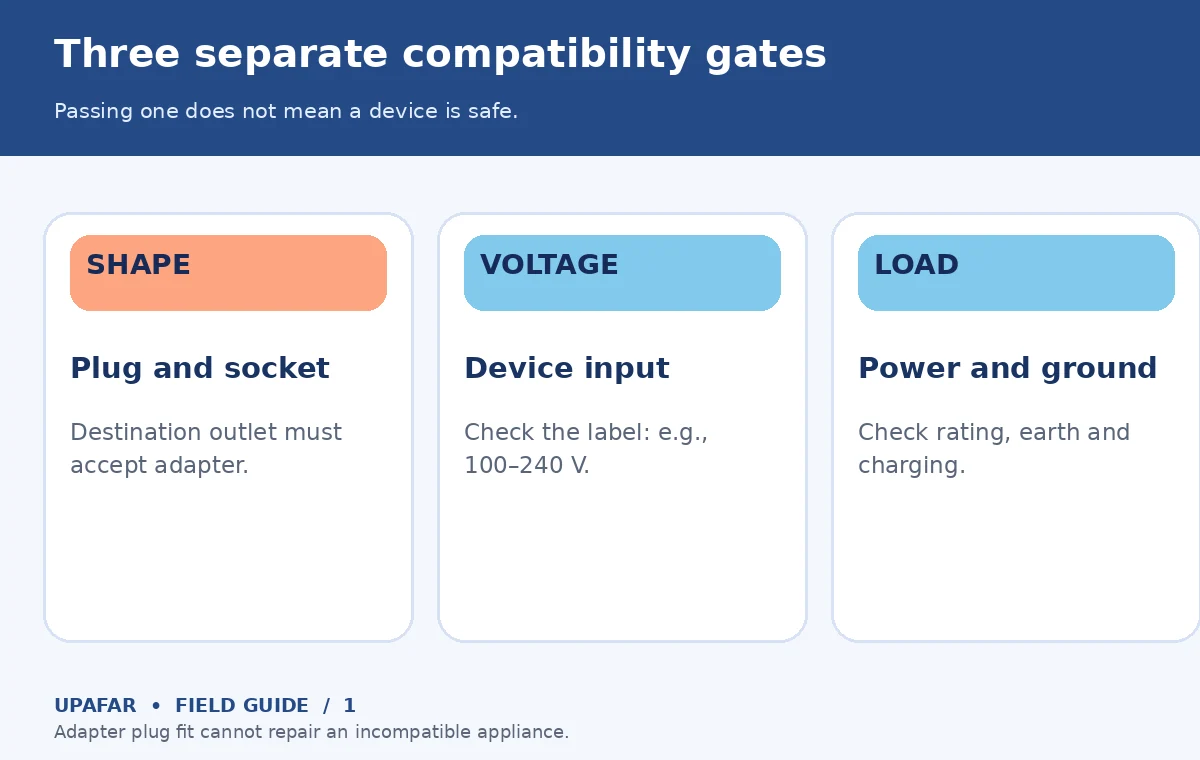
A typical universal travel adapter rearranges the physical connector between a device and a foreign outlet. It does not change the incoming electrical voltage or frequency. Electrical Safety First explicitly warns about this distinction and the risk of exceeding the adapter’s maximum power rating. An adapter that clicks into a socket tells you only that the pins appear to fit. It does not show that a hair dryer, electric kettle or other appliance can safely handle the local power supply.
Look at the input label on the actual device or its separate power brick. A label saying 100–240 V usually means the power supply was designed for a broad international input range; still check the frequency and manufacturer’s instructions. A single-voltage device designed for one mains system cannot automatically become dual-voltage by using a universal plug. World Standards’ traveler electricity explainer describes the same plug-versus-power difference. When markings are ambiguous, do not experiment at the wall socket. Ask the device manufacturer or use a compatible local product.
Confirm every destination's actual socket system
A multination itinerary may involve plug systems that differ between countries and sometimes outlets that are recessed, unusually positioned or inaccessible to a bulky all-in-one block. Hotel rooms can have a mix of outlet styles or dedicated low-power USB ports, but none should be assumed. Write a short list of actual countries and the plug styles expected there using reliable official or electrical-reference information. Check both the adapter’s supported input plug and its output receptacle for your home charger. Some products support many configurations but omit particular destinations.
Also inspect physical clearance. A large adapter may block an adjacent outlet or fail to sit securely behind heavy furniture. Avoid improvising with stacked adapters or creating a loose connection to make an awkward plug reach. A compact destination-specific adapter can be a better choice than a multi-country unit on a single-country trip, especially when you only need to connect one modern, compatible charger. Portability matters less than a stable, safe connection.
Check grounding instead of trusting a three-hole faceplate
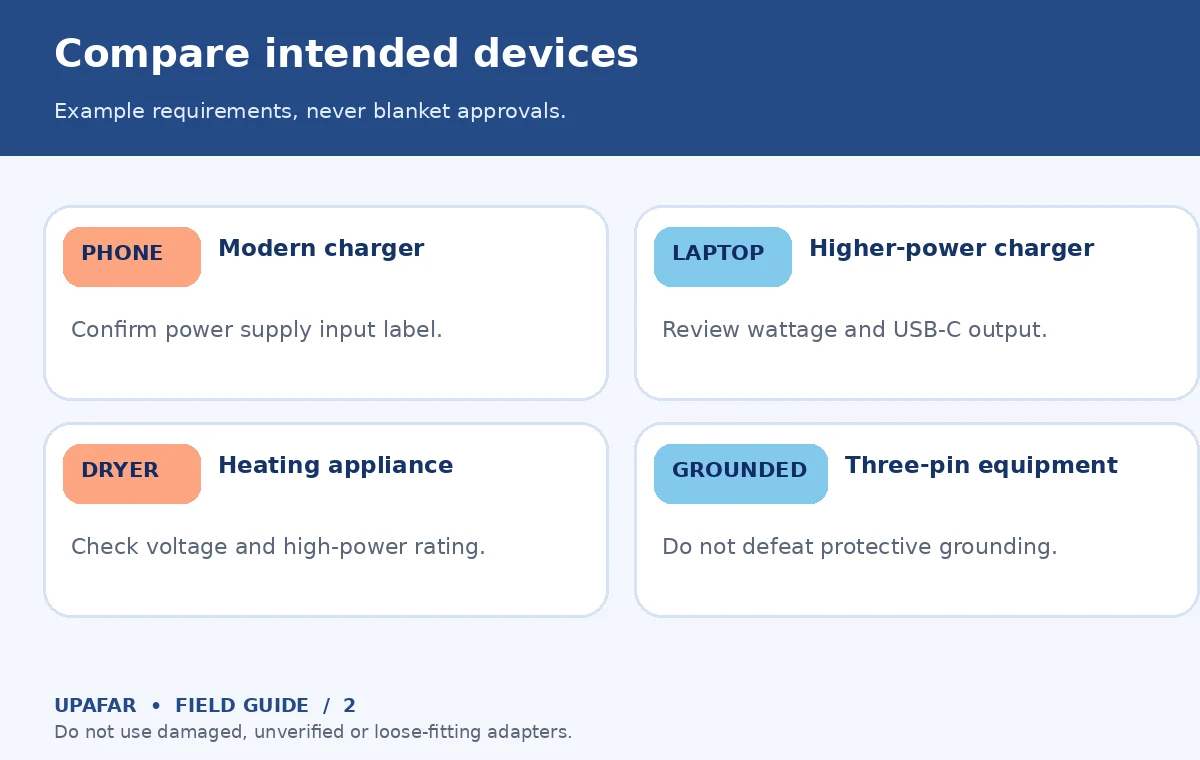
Grounding is an electrical safety function, not a cosmetic third hole. Electrical Safety First notes that some travel adapters do not support equipment needing an earth connection. A device with a grounded plug should not be connected through a solution that defeats protective earth. Double-insulated equipment is a different design category, often marked by a symbol with one square inside another. If the protective arrangement is not clear, check the device and adapter documentation and seek qualified advice rather than guessing.
A universal adapter is especially unsuitable as a casual workaround for damaged cords, loose outlets or mismatched high-powered appliances. Read both voltage and current or wattage ratings, not only the manufacturer’s claim of broad country coverage. For equipment such as CPAP machines or specialized medical devices, contact the manufacturer about mains power, plug and backup requirements. A generic packing guide should not substitute for device-specific technical instructions.
Compare USB ports by output rather than count
Some all-in-one adapters add USB-A, USB-C or both. These outputs can be useful when the wall-facing portion accepts the local mains supply and the internal charger is correctly rated. However, the number of sockets on the housing tells you little about usable charging speed. Read the maximum total output and any shared-port rules. If the device advertises high USB-C charging power, check that the supported charging standard and connected cable match your laptop or tablet’s needs. A port that charges a phone overnight may not adequately support a working laptop.
Consider an illustrative, not product-specific comparison: Adapter A offers several USB ports with one shared power budget; Adapter B offers fewer ports but a higher specified USB-C output. If you need to charge a laptop and phone simultaneously, compare the stated simultaneous-load behavior. If you mainly charge a camera and earbuds, extra capacity may have little value. Never assume that every port delivers its advertised single-port maximum when others are occupied. A high-quality charger plus a simple plug adapter might suit you better than an integrated block.
Use a realistic checkout and inspection checklist
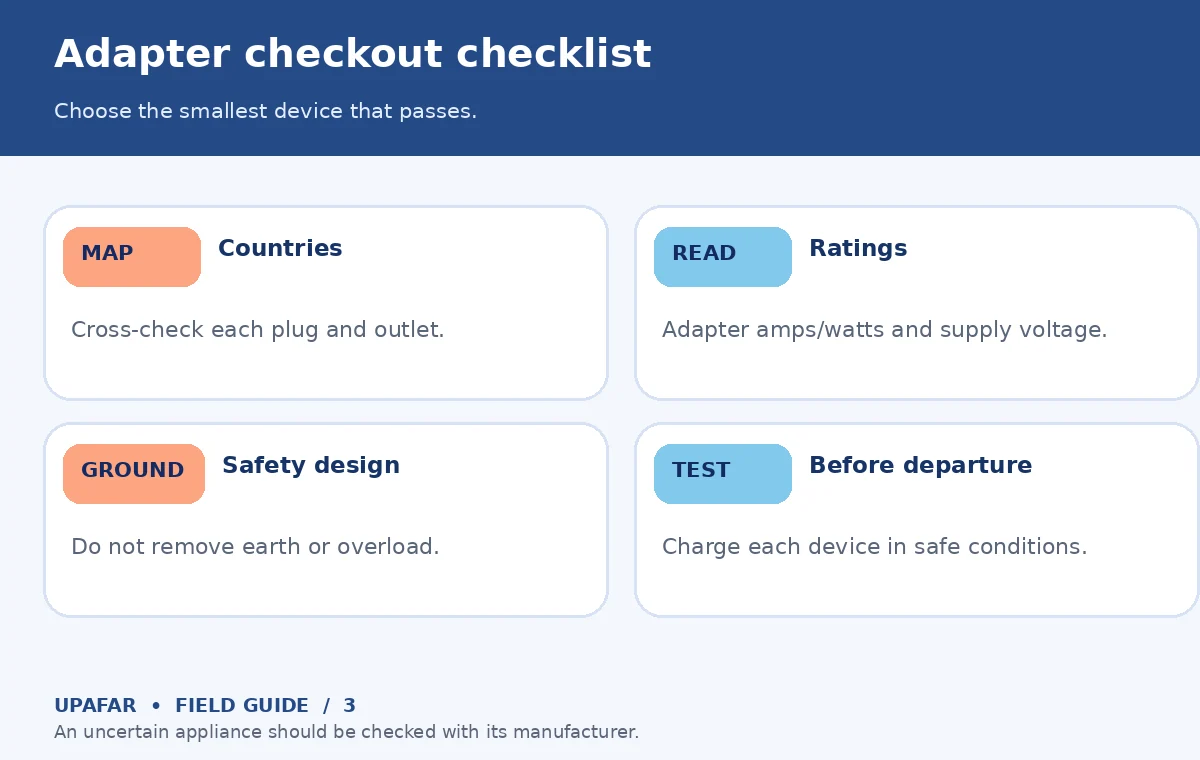
Before buying, check each destination plug, the voltage and frequency of every mains-powered device, adapter wattage and current capacity, correct grounding, USB output details, retailer credibility and available electrical safety information. Electrical Safety First’s broader travel advice recommends checking dual-voltage status rather than assuming a converter will solve every mismatch. Treat very cheap unbranded devices and unsupported safety claims cautiously; a certificate logo by itself does not replace a trustworthy manufacturer and appropriate product documentation.
Before departure, visually inspect the adapter for cracking, bent pins or overheating marks. Test the charger with your actual cables in a safe environment where possible, understanding you cannot simulate another country’s mains voltage merely by plugging into a local socket. Avoid overloading a wall outlet, leaving equipment charging in unsafe locations or using an adapter that becomes abnormally hot. Do not leave the device inserted in a loose receptacle or under fabric. These are electrical safety basics, not evidence that any specific adapter has been independently tested by UpAfar.
Know when the simplest option wins
If you travel to one country and already own a manufacturer-approved wide-input USB-C charger, a suitable single-country grounded adapter may be enough. If you regularly move between multiple compatible plug regions and have several low-power devices, a well-specified multi-country unit can reduce the number of accessories. If you are bringing a single-voltage heating appliance, neither approach automatically solves the voltage difference. If the appliance is essential, the most reliable answer may be a manufacturer-approved dual-voltage or local equivalent, not more adapters.
How We Research adapter compatibility
This guide uses Electrical Safety First travel-adapter safety criteria, World Standards’ explanation of voltages and plug types, and additional converter guidance, reviewed October 19, 2026. The diagrams explain an editorial device-compatibility workflow, not a product certification or worldwide outlet guarantee. We have not tested or ranked specific adapter brands or claimed retailer partnerships. Always check current country conditions and the actual device manufacturer ratings. See UpAfar’s affiliate disclosure for general linking information.
Frequently Asked Travel Questions
No. A typical plug adapter changes physical connection only. The connected power supply must accept the local voltage and frequency or use a manufacturer-approved conversion solution.
Not reliably. Universal is a marketing label, and plug shapes, recessed outlets and local requirements differ. Check destinations individually.
No. Hair dryers can have high power demand and may be single-voltage. Read device voltage, wattage and adapter ratings; use compatible alternatives if uncertain.
That usually indicates a wide-input power supply. Still check frequency, power draw, cord grounding and adapter ratings before connecting.
No. Port count alone does not establish maximum shared output, charging protocols, USB-C power levels or manufacturer protections. Compare the actual specification.