
A useful travel planning checklist is not a giant packing list. It is a sequence of decisions that prevents expensive, hard-to-fix mistakes before you pay for the next part of a trip. Begin with the things that can stop travel entirely—entry documents, feasible dates, health needs and a realistic spending ceiling—then lock down transport, lodging and arrival logistics. Use the checkpoints below for domestic or international travel; destination-specific rules always take precedence. This guide is a departure-readiness audit, rather than a repeat of our broad guide to planning a trip.
Start with five decisions that can block the trip
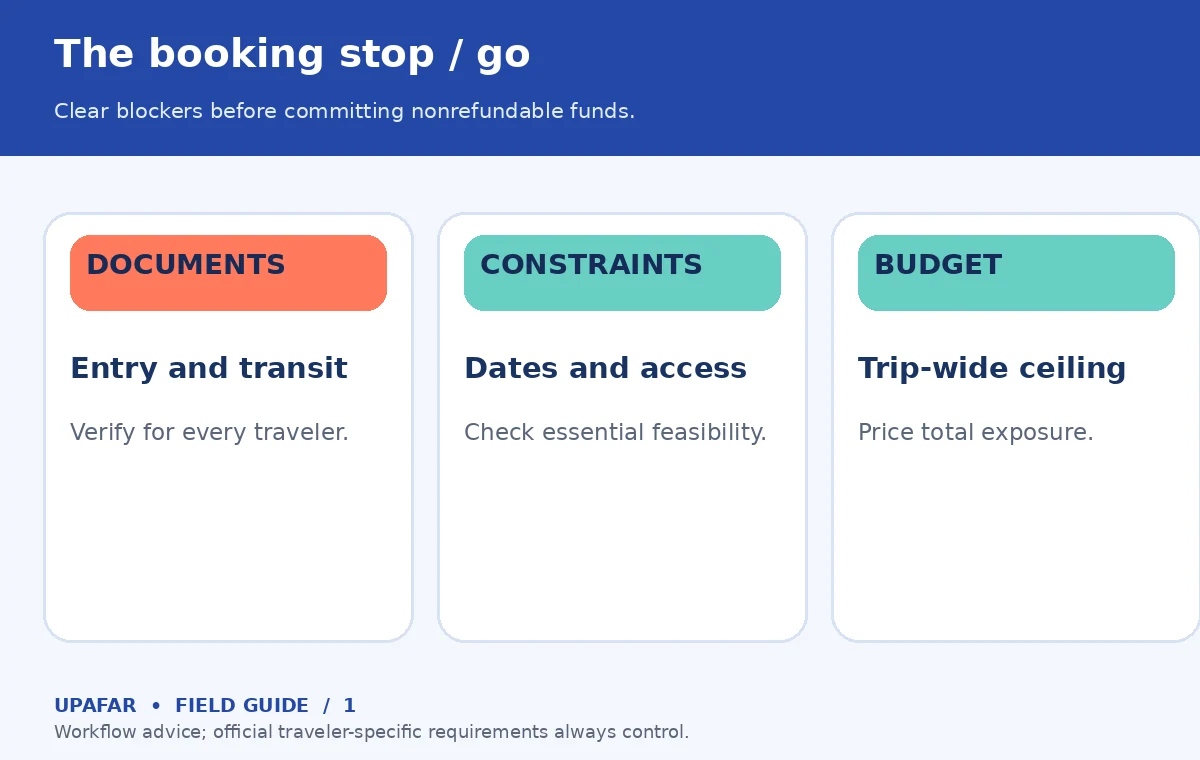
Write the destination, exact travel dates, number of travelers, citizenship or travel-document type, and your highest acceptable total spend in one place. Then list every country where you will enter or transit, not merely the final destination. A connection can create separate airport-transit or immigration requirements. Check the official destination authority and airline for the actual routing and traveler, rather than relying on a generic six-month passport rule. Passport validity requirements, permission to enter, and document-processing lead times vary by destination and nationality. Never make nonrefundable commitments before you know whether the documents and dates work.
For U.S. citizens traveling internationally, the State Department International Traveler’s Checklist directs travelers to destination advisories, visa and entry rules, document copies, STEP and insurance considerations. Travelers holding other passports should use their own government’s guidance alongside the destination’s immigration authority. A second, easy-to-miss blocker is physical feasibility: a connection that looks inexpensive may be impossible with luggage collection, immigration or an airport change. Write down the actual door-to-door itinerary before paying.
Work backward from the departure date
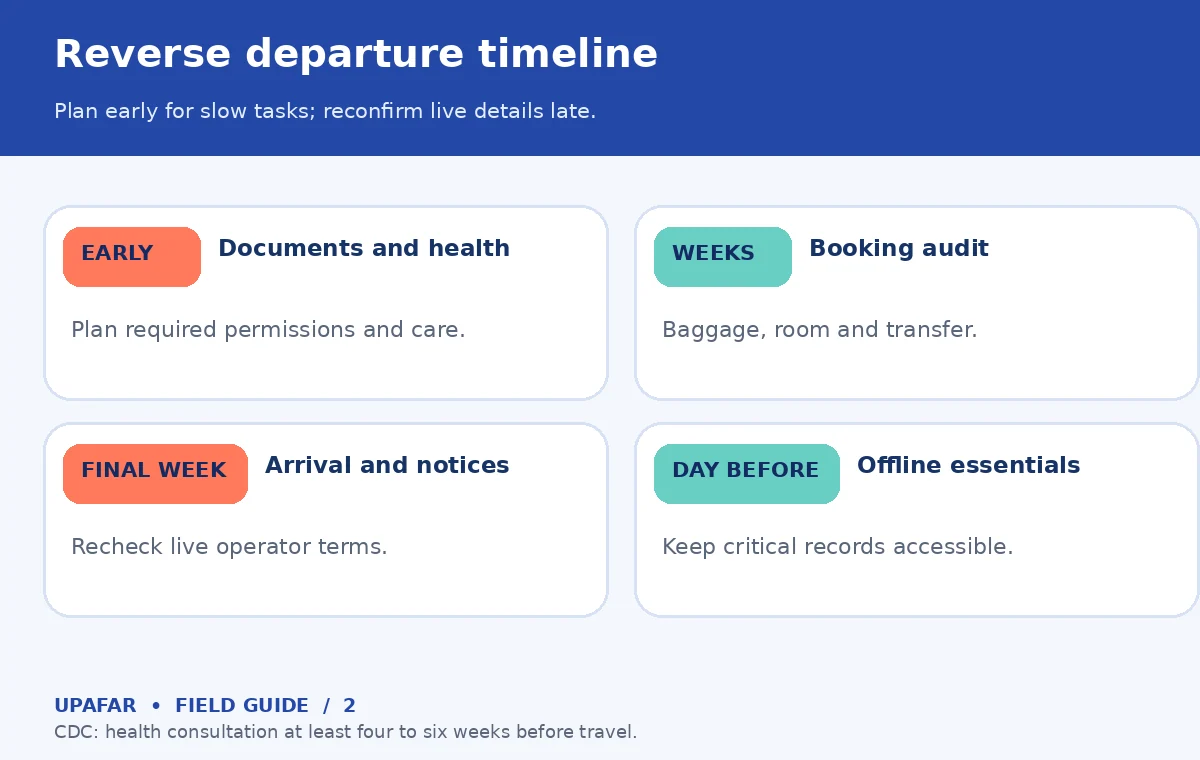
A backward schedule works better than checking everything on the evening before departure. Months ahead, evaluate travel documents, substantial health needs, seasonal access and any event-based constraints. Several weeks ahead, confirm bookings, baggage conditions, ground arrival transport and your first-night address. During the final week, re-check the operating details that can change: departure terminals, schedule notices, weather disruption and local transport. The day before, download critical files offline and pack travel-day essentials in a small accessible bag.
The health timeline deserves its own decision. The CDC recommends arranging a travel-health consultation at least four to six weeks before travel for destination-specific vaccines, medicines and risk guidance. That is an appointment-planning recommendation, not a promise that a vaccine or medication is required or suitable for every traveler. Some needs take longer, so act sooner when feasible and consult an appropriately qualified clinician. Make space in the calendar for passports, permits and any accessibility arrangements that require advance confirmation.
Choose booking order by financial exposure
Secure the least flexible or most capacity-constrained component once you have established the trip is feasible. A wedding, cruise departure or a remote accommodation with few accessible rooms may determine the dates; a flexible city break may allow flight and stay comparisons before committing. Read each provider’s change and cancellation conditions separately. “Refundable” might mean a voucher, refund before a deadline, or an exclusion of certain taxes or extras; it is not a universal product description.
Create a simple ledger with columns for supplier, travel date, cancellation cutoff in local time, payment due, confirmation number and what remains unpaid. Keep flight, hotel, ground transport and activity charges distinct. For a group, identify the person responsible for each booking and ensure names match documents. A shared calendar invitation is useful, but it should not be the only repository for evidence of payment. If one booking fails, you need to know which other reservations are at risk without searching through email threads.
Calculate the complete trip cost before committing
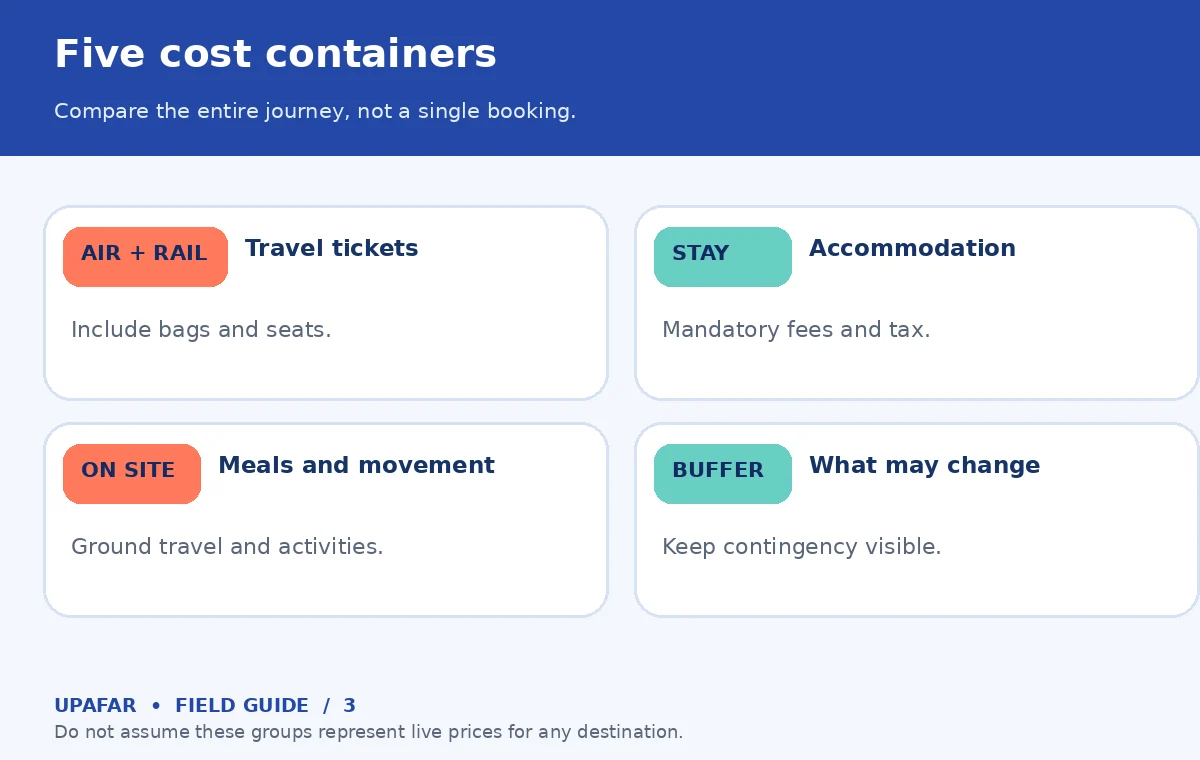
Add transportation to and from the airport, seat or baggage purchases, lodging taxes and mandatory charges, local transit, meals, booked activities, communications and a contingency reserve. Separate the amount already committed from the amount still cancellable. This distinction often matters more than an attractive advertised room or air fare. In the United States, the FTC’s short-term lodging pricing rule requires businesses displaying prices to present certain mandatory fees upfront, with permitted exceptions such as taxes and optional items. It does not eliminate every possible extra cost, nor does it govern every international transaction.
For any travel booking, compare like with like: same occupancy, dates, refund rules, baggage allowance and actual transfer costs. Resist the temptation to use generic daily-budget claims as if they were quotes for your departure city and month. Get comparable live quotes for the actual itinerary, then create a modest buffer appropriate to your financial situation. If the full trip exceeds the spending ceiling, shorten the route or change the travel dates before buying a nonrefundable anchor purchase.
Audit your arrival and first twenty-four hours
Many otherwise careful itineraries end at the airport rather than at the accommodation. Write down the arrival airport and terminal, immigration or baggage-claim needs, first transfer, last practical transport departure, check-in rules and a fallback if the flight lands late. Take a screenshot of the property’s address and a map showing its entrance. Check whether a rental car or hotel shuttle is actually available at your arrival time; a hotel advertising a shuttle does not mean every incoming flight is covered.
For a late arrival, plan the first meal and essential supplies instead of assuming nearby shops will be open. If traveling with children or accessibility needs, confirm elevators, suitable restraints, sleeping equipment and assistance directly. Treat these as requirements to verify, not amenities inferred from marketing icons. Make the first morning forgiving: a delayed arrival should not put a heavily prepaid activity or fragile connection in jeopardy.
Separate carry-on essentials from checked luggage
Place the items you cannot easily replace during a disruption where you can access them: documents, medications, necessary medical equipment, contacts, a small change of clothes and working payment methods. Check the airline’s actual cabin-baggage allowance for your fare; it is not safe to assume one global size standard. Follow applicable aviation and security rules for batteries, liquids, sharps and restricted objects. Keep any device needed to access bookings charged and have an offline fallback if the phone breaks or loses service.
Prepare a compact information sheet with reservation references, accommodation addresses, emergency contacts and essential medical information. Store a private digital copy and a separate offline version that does not expose sensitive information unnecessarily. The State Department advises U.S. travelers to make copies of key documents and share one securely with someone trusted. Avoid putting full identification numbers or financial-account details into publicly shared trip folders.
Perform a final verification rather than a new search
At roughly a week out, review the list of unresolved issues and assign an owner to each: missing booking confirmation, wrong document spelling, unclear baggage rule, health question or arrival transfer gap. At twenty-four hours, inspect the live airline and operator notices and official entry advice relevant to the trip. Do not substitute social-media posts for legal entry requirements. Check the local date and time shown on tickets: overnight travel and time-zone shifts can put an arrival on the following calendar day.
The checklist is finished only when every critical task has one of three statuses: verified, booked with evidence, or consciously declined with a backup. Low-stakes tasks such as choosing a café can remain open. By contrast, an unverified passport rule is not a small loose end. For repeat travelers, save the workflow and remove personal data after each journey; keeping the process reusable is more valuable than accumulating a long list of completed tasks.
How We Research and keep checks current
We separated stable planning order from facts that must be verified for a specific departure. We reviewed the U.S. State Department checklist, CDC pre-travel guidance and FTC pricing FAQs on October 19, 2026, and translated them into a dependency-first workflow. These authorities do not verify any particular traveler, hotel or route. Before departure, reconfirm entry rules with the relevant government, health decisions with a clinician and booking conditions with the actual supplier. UpAfar may discuss commercial services elsewhere, but this guide has no claimed paid recommendations; see our affiliate disclosure.
Frequently Asked Travel Questions
Confirm the relevant entry and transit documents, dates, passenger identity, total trip budget, onward travel feasibility, and cancellation exposure first.
The CDC recommends a consultation at least four to six weeks before departure; contact a qualified clinician earlier when needed and check country-specific health advice.
No. A copy is only an emergency reference. Bring the original valid documents required for your itinerary and confirm any applicable rules with authorities.
Low-risk details such as optional restaurants can remain flexible; recheck live operators, transport, weather and offline documents close to departure.
Yes. Compare real door-to-door charges, baggage, mandatory lodging fees and selected extras, not just advertised airfare and room rates.